
MDR CE Marking Approval Process Flowchart
The MDR CE marking approval process for medical devices follows Regulation (EU) 2017/745 (MDR). In practice, there is no central EU body that grants CE marking approval: the manufacturer demonstrates conformity, and a notified body is involved only where the device class requires it. This MDR flowchart shows the main steps. I3CGLOBAL’s CE marking consultants can support each step.
What Does CE Marking Approval Mean Under the MDR?
CE marking shows that a medical device meets the EU Medical Device Regulation. The manufacturer is responsible for demonstrating conformity, drawing up the EU declaration of conformity and affixing the CE marking. For most devices above class I, a notified body assesses the quality management system and technical documentation and issues a certificate.
For technical file stages and timing, see our detailed MDR CE marking process and timeline. For consulting support, see our medical device CE marking service.
MDR CE marking approval at a glance
- Legal basis
- Regulation (EU) 2017/745 (MDR)
- Responsible person
- The manufacturer
- EU approval body
- None; conformity is shown by the manufacturer
- Notified body
- Only where the device class requires it
- Device classes
- I, Is, Im, Ir, IIa, IIb and III
- Classification
- Annex VIII, 22 rules
- Typical timing
- 13 to 18 months from signed agreement to certificate was the most commonly reported period (Commission survey, data to February 2026)
MDR CE Marking Process Flowchart
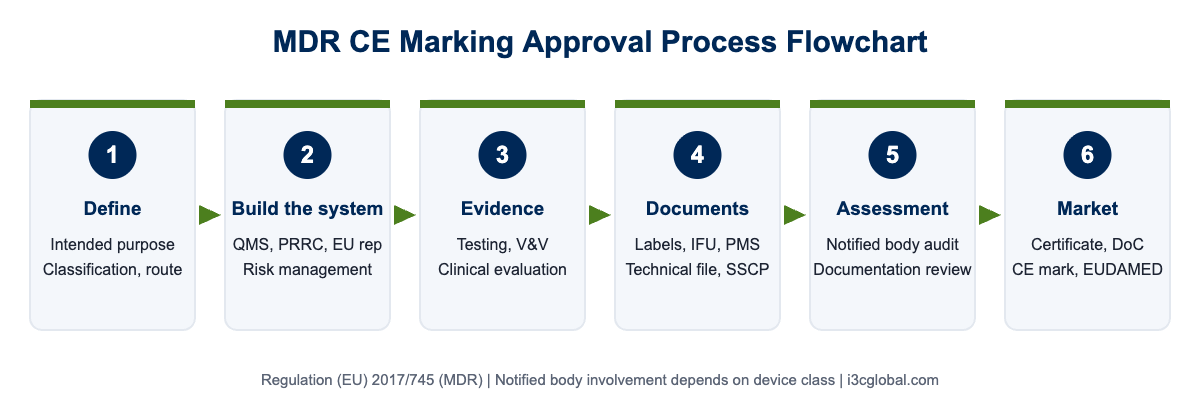
The six phases below show the MDR CE marking approval process from start to market. The table lists what each step covers.
Define
Intended purpose, classification and conformity route.
Build the system
QMS, PRRC, authorised representative and risk management.
Evidence
Verification, testing and clinical evaluation.
Documents
Labels, IFU, post-market plans, SSCP and technical file.
Assessment
Notified body audit and review, where required.
Market
Certificate, declaration of conformity, CE marking, EUDAMED and maintenance.
| Phase | # | Activity | What it covers |
|---|---|---|---|
| 1. Define | 1 | Device description and intended purpose | Intended users, patient population, indications and contraindications |
| 2 | Classification and conformity assessment route | Annex VIII classification rules and the matching conformity assessment annex | |
| 3 | Device identification | Basic UDI-DI and EMDN code | |
| 2. Build the system | 4 | Quality management system and roles | QMS usually based on ISO 13485, PRRC and, for non-EU manufacturers, an EU authorised representative |
| 5 | Risk management | Risk management file, usually based on ISO 14971 | |
| 3. Evidence | 6 | Design, manufacturing and product specifications | Variants, raw materials, accessories and manufacturing process |
| 7 | Verification and testing | Biocompatibility, electrical safety, EMC, sterility and software, where relevant | |
| 8 | Clinical evaluation | Clinical evaluation plan and report (CER) | |
| 9 | General safety and performance requirements | Annex I GSPR checklist with supporting evidence | |
| 4. Documents | 10 | Labels and instructions for use | Including the implant card where relevant |
| 11 | Post-market surveillance plans | PMS plan, PMCF and PSUR for class IIa and above | |
| 12 | Summary of safety and clinical performance | SSCP for class III and implantable devices | |
| 13 | Technical documentation | Annexes II and III | |
| 5. Assessment | 14 | Notified body application, QMS audit and technical documentation review | Not needed for self-declared class I devices |
| 15 | Clinical evaluation consultation, where it applies | Expert panel for certain class III implantable and class IIb active devices | |
| 6. Market | 16 | Certificate, EU declaration of conformity, CE marking and EUDAMED registration | Registration of the actor and the device before placing on the market |
| 17 | Maintain compliance | Surveillance audits, vigilance, PMS and change control |
Timing: MDR CE marking approval typically takes 13 to 18 months from signed notified body agreement to certificate. This was the most commonly reported period in the European Commission’s 20th notified bodies survey, with data to 28 February 2026. Actual time varies with the device, the evidence and notified body capacity. See our CE marking process and timeline for stage-by-stage timing.
What Happens in Each Phase of the MDR CE Marking Approval Process?
Phase 1: Define the device
Start with a clear device description and intended purpose. The intended purpose drives everything that follows: the classification rule, the conformity assessment route, the clinical evidence you need and the claims you can make on the label.
Apply the 22 classification rules in Annex VIII and record your reasoning. If more than one rule applies, the strictest rule decides the class. Then assign a Basic UDI-DI and select the EMDN code that will be used in EUDAMED. See our medical device classification guide for worked examples.
Phase 2: Build the system
Every manufacturer needs a quality management system that covers the elements in Article 10(9) of the MDR. Most manufacturers use ISO 13485 as the framework. You also need a person responsible for regulatory compliance (PRRC) under Article 15 and, if you are based outside the EU, an EU authorised representative under Article 11.
Risk management runs through the whole life cycle. Set up a risk management plan and file, usually following ISO 14971, and link each risk control to the design, labelling and post-market data.
Phase 3: Build the evidence
Verification and testing show that the device meets the general safety and performance requirements in Annex I. Typical evidence includes biocompatibility, electrical safety and EMC, sterilisation validation, shelf life, usability and software verification, depending on the device.
Clinical evaluation follows Article 61 and Annex XIV. The clinical evaluation report must show that the clinical data are sufficient to confirm safety, performance and an acceptable benefit-risk ratio. Read more about EU MDR clinical evaluation.
Phase 4: Prepare the documents
Compile the technical documentation in the structure of Annexes II and III. It includes the device description, labels and instructions for use, design and manufacturing information, the GSPR checklist, benefit-risk analysis, verification and validation data, and the post-market surveillance documentation.
Class III and implantable devices also need a summary of safety and clinical performance (SSCP). Keep the documents consistent: the same intended purpose, indications and warnings should appear in the IFU, the clinical evaluation and the risk file. See our medical device technical file guide.
Phase 5: Complete the conformity assessment
Where a notified body is required, choose one that is designated for your device codes and lodge one application for the procedure. The notified body audits the quality management system and reviews the technical documentation. Expect questions and non-conformities, and plan time and resources to answer them.
For certain class III implantable devices and class IIb active devices intended to administer or remove a medicinal product, the notified body may also need to consult an expert panel on the clinical evaluation.
Phase 6: Place the device on the market
After a successful assessment, the notified body issues the certificate. The manufacturer then signs the EU declaration of conformity, affixes the CE marking with the notified body number where required, and registers the actor and the device in EUDAMED.
CE marking approval is not a one-time event. Keep the quality system running, update the technical documentation, carry out post-market surveillance and vigilance, and notify the notified body about significant changes.
How Does Device Class Change the MDR Conformity Assessment Route?
Article 52 of the MDR sets out the conformity assessment options for each class. The class decides whether a notified body is involved in CE marking approval and how much of the technical documentation it reviews.
| Device class (MDR article) | Main conformity assessment options | Notified body review of technical documentation |
|---|---|---|
| Class I (Art. 52(7)) | EU declaration of conformity after drawing up the technical documentation (Annexes II and III) | None |
| Class Is, Im and Ir (Art. 52(7)) | As class I, plus Annex IX (Chapters I and III) or Annex XI Part A, limited to sterility, metrology or reuse aspects | Limited to those aspects |
| Class IIa (Art. 52(6)) | Annex IX (Chapters I and III), or Annexes II and III with Annex XI Part A or Part B | At least one representative device per category of devices |
| Class IIb (Art. 52(4)) | Annex IX (Chapters I and III), or Annex X type examination with Annex XI | At least one representative device per generic device group; every device for most class IIb implantables |
| Class III (Art. 52(3)) | Annex IX (Chapters I, II and III), or Annex X type examination with Annex XI | Every device |
Most manufacturers of class IIa, IIb and III devices use the Annex IX route, which combines a quality management system audit with technical documentation assessment. Under Annex XI, Part A is production quality assurance, where the notified body audits the manufacturing quality system, and Part B is product verification, where the notified body examines and tests each product or each homogeneous batch.
When Is a Notified Body Needed for MDR CE Marking Approval?
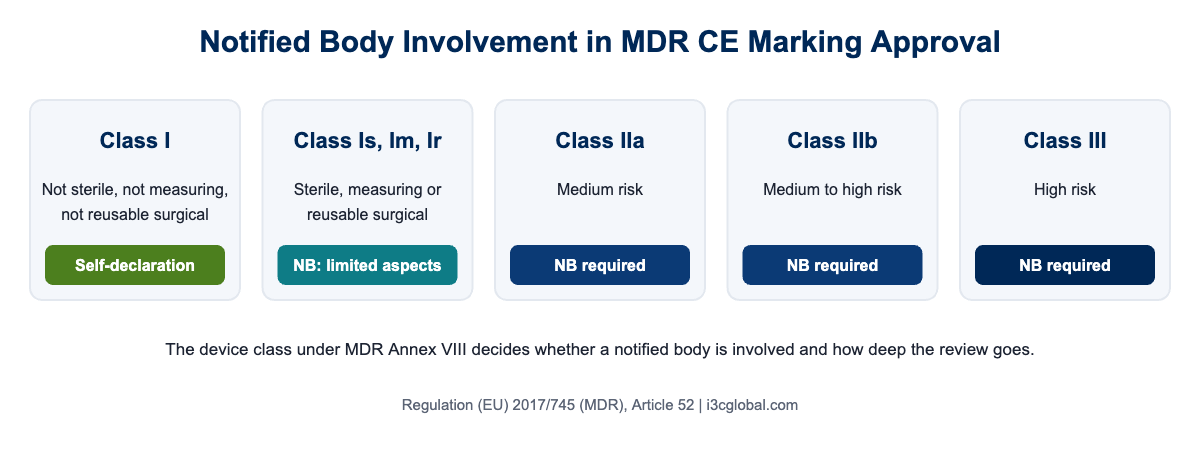
| Device class | Notified body involvement |
|---|---|
| Class I, not sterile, not measuring and not a reusable surgical instrument | Not required; the manufacturer self-declares |
| Class Is, Im and Ir | Limited to sterility, metrology or reuse aspects |
| Class IIa, IIb and III | Required |
Confirm the class first with our medical device classification guide, and compare designations in our notified bodies list.
Need help with MDR CE marking?
Our CE marking consultants support classification, technical documentation, clinical evaluation and notified body submissions.
What Does a Notified Body Check During CE Marking Approval?
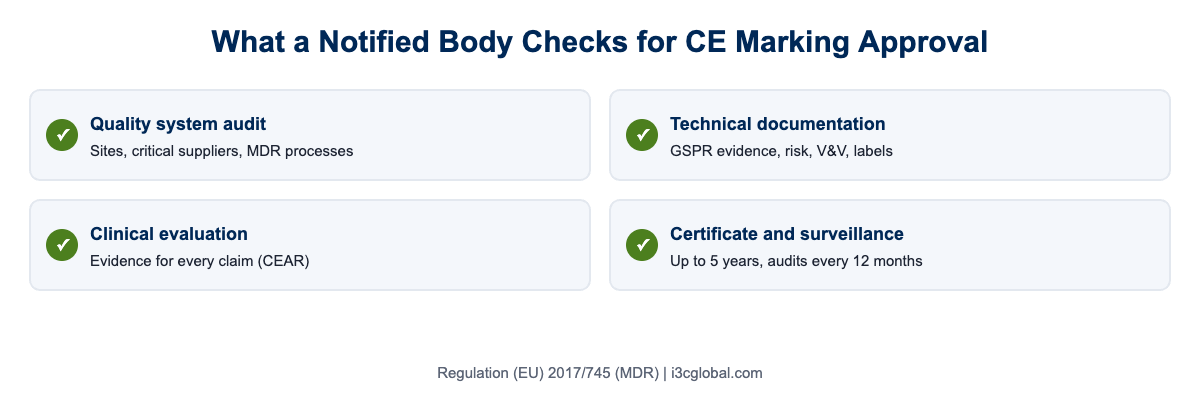
For class IIa, IIb and III devices, CE marking approval depends on a successful notified body assessment. Under the usual Annex IX route, the assessment has two parts: an audit of the quality management system and an assessment of the technical documentation.
Quality system audit
The notified body audits the quality management system at the manufacturer’s sites and, where needed, at critical suppliers and subcontractors. It checks that design, production, PMS and vigilance processes meet the MDR.
Technical documentation review
Reviewers check the device description, GSPR evidence, risk management, verification and validation, labelling and post-market documents. For class III devices, every device is assessed.
Clinical evaluation assessment
The notified body assesses whether the clinical evidence supports every claim and documents its conclusions in a clinical evaluation assessment report.
Certificate and surveillance
Certificates are valid for up to five years. Surveillance audits take place at least every 12 months, with unannounced audits at least once every five years.
Good preparation shortens the CE marking approval timeline. Answer each question with evidence, keep version control across the file and make sure the technical documentation, clinical evaluation and labels tell the same story. Compare designations in our notified bodies list before you apply.
CE Marking Approval for Manufacturers Outside the EU
Manufacturers based outside the EU follow the same MDR CE marking approval process, with a few extra duties before and after the device reaches the market:
- Appoint an EU authorised representative under Article 11 with a written mandate. The authorised representative’s name and address appear on the label.
- Make sure a PRRC is in place. Micro and small enterprises can have a PRRC permanently and continuously at their disposal instead of employing one.
- Work with EU importers, who must check the CE marking, the EU declaration of conformity, the labelling and the EUDAMED registration before they place the device on the market.
- Provide labels and instructions for use in the languages required by each Member State where the device is made available.
- Register the manufacturer and the device in EUDAMED, with the authorised representative verifying the actor registration.
Planning these roles early avoids delays at the end of the CE marking approval project, when the certificate is ready but the supply chain is not.
MDR CE Marking Approval Checklist
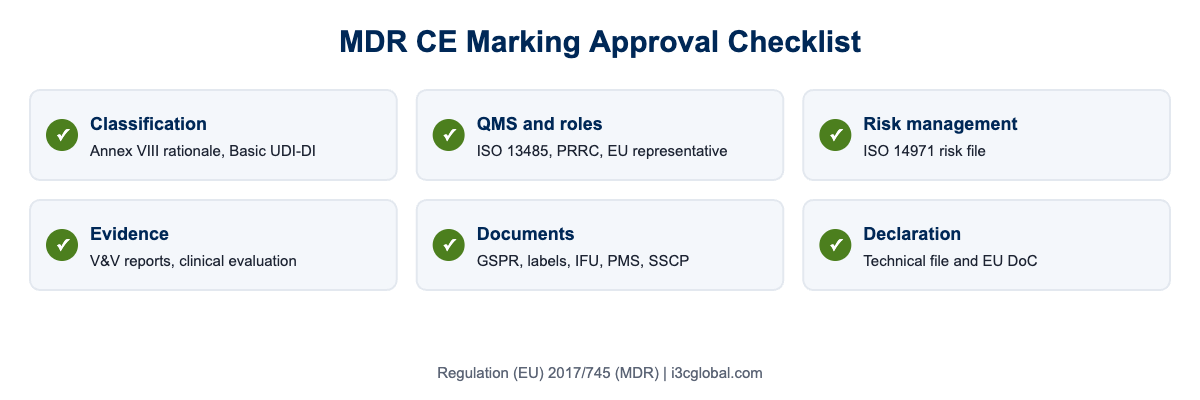
Use this checklist to confirm that the main elements are in place before you apply for CE marking approval with a notified body.
- Device description, intended purpose and classification rationale
- Basic UDI-DI and EMDN code
- Quality management system covering Article 10(9), usually certified to ISO 13485
- PRRC appointed and, for non-EU manufacturers, an EU authorised representative
- Risk management file aligned with ISO 14971
- GSPR checklist with references to evidence
- Verification and validation reports, including biocompatibility, electrical safety, sterilisation and software where relevant
- Clinical evaluation plan and report
- Labels, instructions for use and, where relevant, the implant card
- PMS plan, PMCF plan or justification, and PSUR process
- SSCP for class III and implantable devices
- Technical documentation compiled in the structure of Annexes II and III
- Draft EU declaration of conformity
Common causes of delay: clinical evidence that does not support all claims, weak equivalence justifications, gaps between the GSPR checklist and the evidence, inconsistent labelling, missing PMCF plans and slow responses to notified body questions. A gap assessment before submission helps avoid repeated review rounds.
CE Marking Approval: Frequently Asked Questions
Is there an EU body that grants CE marking approval?
No. The manufacturer is responsible for showing that the device meets the MDR, drawing up the EU declaration of conformity and affixing the CE marking. Where the device class requires it, a notified body assesses the device and issues a certificate.
Does every medical device need a notified body?
No. Class I devices that are not sterile, not measuring and not reusable surgical instruments are self-declared by the manufacturer. Other classes need a notified body to some degree.
What documents are needed for MDR CE marking?
Technical documentation under Annexes II and III of the MDR, including the GSPR checklist, risk management, clinical evaluation, labelling and post-market surveillance documents, and an EU declaration of conformity.
How long does CE marking approval take?
It depends on the device, the evidence and the notified body. In the Commission’s 20th notified bodies survey, the most commonly reported period from signed agreement to certificate was 13 to 18 months.
Who issues the CE certificate?
A notified body designated under the MDR for that device type. Its four-digit number appears next to the CE marking for devices that needed its involvement.
Does a non-EU manufacturer need an EU authorised representative?
Yes. A manufacturer outside the EU must appoint an EU authorised representative before placing a device on the EU market.
What happens to devices with an MDD certificate?
Regulation (EU) 2023/607 extended the MDR transition period. Legacy devices can stay on the market until 31 December 2027 for class III and class IIb implantable devices, and until 31 December 2028 for other classes, if the conditions are met. These include an MDR application to a notified body by 26 May 2024 and a signed written agreement by 26 September 2024.
Do class I devices need EUDAMED registration?
Yes. Manufacturers of all classes register as actors and register their devices in EUDAMED before placing them on the market, even when no notified body is involved.
Is UKCA marking the same as CE marking?
No. UKCA marking is the route for Great Britain, with conformity assessment by UK Approved Bodies. Check current MHRA guidance on whether CE-marked devices can still be placed on the Great Britain market.
Official References and Related Guides
- Regulation (EU) 2017/745 (MDR)
- Your Europe: CE marking
- European Commission: 20th notified bodies survey
- CE Marking Process and Timeline
- Medical Device CE Marking
- Medical Device Classification
- Medical Device Technical File
- EU MDR Clinical Evaluation
- Medical Device Risk Management
- GSPR
- PRRC
- EUDAMED Registration
Updated 12 November 2026 | Author: Sobha Augustine, Founder, I3CGLOBAL | Reviewed by: Asha Johnson, Manager, I3CGLOBAL