
US FDA Labeling Requirements and Compliance Services
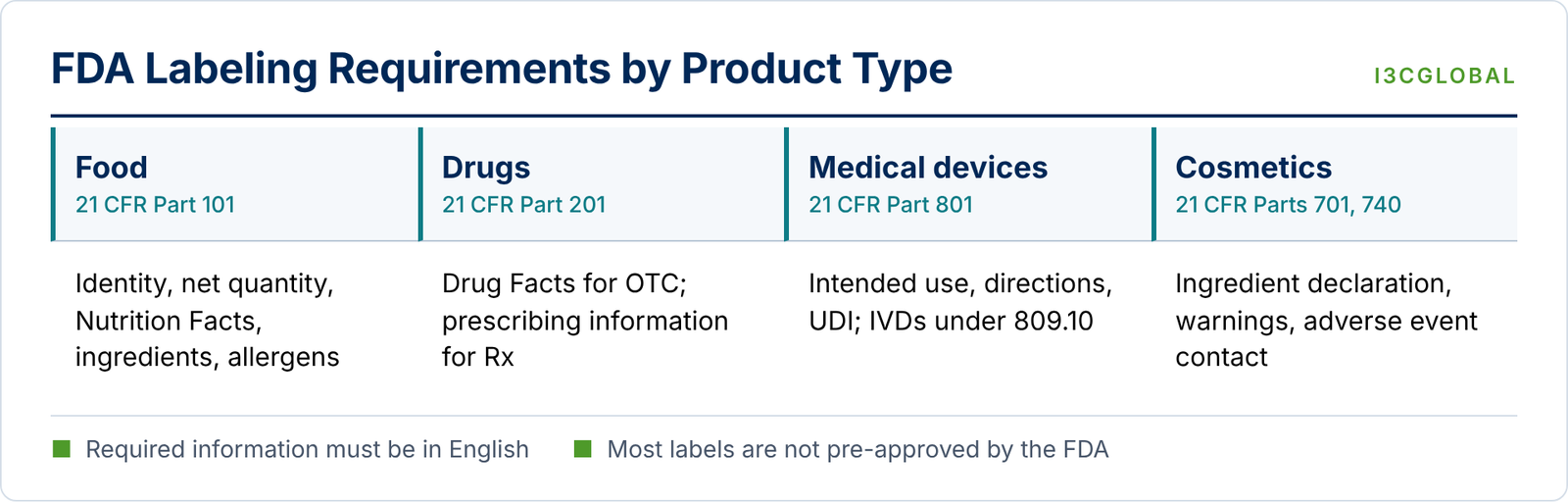
FDA labeling requirements are the US rules that decide what must appear on the label and accompanying material of food, dietary supplements, drugs, medical devices and cosmetics. Each product type has its own regulation in Title 21 of the Code of Federal Regulations, and a product whose label does not comply is misbranded and can be refused entry into the United States. The FDA does not pre-approve most labels, so the manufacturer is responsible. This guide sets out the required elements for each product type and explains how a label review works before export.
Definition
What Are FDA Labeling Requirements?
US law distinguishes the label, which is the written or graphic matter on the immediate container, from labeling, which also includes leaflets, cartons, instructions for use and other material that accompanies the product. Both are regulated. (In British English the same word is spelled labelling.)
A product is misbranded if its labeling is false or misleading or if required information is missing or not prominent enough. Misbranding is defined in section 403 of the FD&C Act for food, section 502 for drugs and devices and section 602 for cosmetics. Imported products are checked against the same rules at the port of entry.
Overview
Which FDA Labeling Rules Apply to Your Product?
| Product type | Main regulation | Core required elements | Related registration |
|---|---|---|---|
| Food and beverages | 21 CFR Part 101 | Statement of identity, net quantity, Nutrition Facts, ingredient list, allergen declaration, name and place of business | FDA Food Facility Registration |
| Dietary supplements | 21 CFR Part 101, including 101.36 | Identity as a dietary supplement, Supplement Facts, ingredients, net quantity, required disclaimer for certain claims | FDA Food Facility Registration |
| OTC drugs | 21 CFR Part 201, including 201.66 | Drug Facts panel: active ingredients, purpose, uses, warnings, directions, inactive ingredients | FDA Drug Establishment Registration |
| Prescription drugs | 21 CFR Part 201 | Prescribing information in the required format, “Rx only”, strength, lot and expiry | FDA Drug Establishment Registration |
| Medical devices | 21 CFR Part 801 | Name and place of business, intended use and directions, UDI, prescription statement where it applies | FDA Medical Device Registration |
| In vitro diagnostics | 21 CFR 809.10 | Intended use, reagents, storage, procedure, limitations and performance information | FDA Medical Device Registration |
| Cosmetics | 21 CFR Parts 701 and 740 | Identity, net quantity, ingredient declaration, warnings, name and place of business, adverse event contact | FDA Cosmetic Registration |
Food
What Are the FDA Food Labeling Requirements?
A packaged food label has two areas: the principal display panel, which the consumer sees first, and the information panel next to it.
- Statement of identity. The common or usual name of the food, on the principal display panel.
- Net quantity of contents. In both US customary and metric units, in the lower part of the principal display panel.
- Nutrition Facts. In the current FDA format, with serving sizes based on reference amounts. Dietary supplements carry a Supplement Facts panel instead.
- Ingredient list. In descending order by weight, using common names.
- Allergen declaration. The major food allergens, including sesame, must be declared.
- Name and place of business. Of the manufacturer, packer or distributor.
- Claims. Nutrient content and health claims are allowed only as the regulations provide. Supplements that make structure or function claims carry the required disclaimer.
Drugs
What Are the FDA Drug Labeling Requirements?
Drug labeling is the most tightly controlled. For over-the-counter drugs the outer package carries the standard Drug Facts panel under 21 CFR 201.66, with headings in a fixed order: active ingredient and purpose, uses, warnings, directions, other information and inactive ingredients. An OTC drug must also follow the wording allowed by its monograph.
Prescription drug labeling follows the approved prescribing information and carries the “Rx only” statement. For every drug, the label text and an image of the package are submitted to the FDA in Structured Product Labeling format as part of drug listing, so the label and the listing must agree.
Medical devices
What Are the FDA Medical Device Labeling Requirements?
- Name and place of business of the manufacturer, packer or distributor (21 CFR 801.1).
- Intended use and adequate directions for use (21 CFR 801.4 and 801.5), unless the device is a prescription device that carries the prescription statement.
- Unique Device Identifier (UDI) on the label and package, with data submitted to the Global UDI Database, unless an exception applies.
- Symbols may be used without explanatory text only where the conditions in 21 CFR 801.15 are met.
- In vitro diagnostics follow the detailed content list in 21 CFR 809.10 for the label and the package insert.
- No approval claims. A label may not suggest that registration or listing is FDA approval.
Device labeling is reviewed by the FDA in a 510(k), De Novo or PMA, and the marketed labeling must stay consistent with the cleared or approved intended use. See FDA 510(k) and Medical Device Symbols.
Cosmetics
What Are the FDA Cosmetic Labeling Requirements?
- Statement of identity and net quantity of contents on the principal display panel.
- Ingredient declaration in descending order of predominance, using the names the regulation requires (21 CFR 701.3).
- Name and place of business of the manufacturer, packer or distributor.
- Warning statements required for certain products under 21 CFR Part 740.
- Adverse event contact. Under MoCRA the label must carry contact information through which the responsible person can receive adverse event reports.
- No drug claims. Words such as treats, heals or prevents turn a cosmetic into a drug.
Service
How Does an FDA Label Review Work?
A label review before printing is cheaper than relabeling goods held at a US port. I3CGLOBAL reviews labels for all four product types.
- Send the artwork and product detailsLabel and carton artwork, formulation or ingredient list, intended use and any claims you plan to make.
- Classification checkWe confirm whether the claims keep the product in the category you intend.
- Line-by-line reviewEach required element is checked against the applicable part of 21 CFR, including placement, type size and wording.
- Written reportYou receive a list of required corrections and recommended changes, with the regulation reference for each.
- Recheck of revised artworkWe review the corrected label before it goes to print.
A private compliance check that reduces the risk of detention and relabeling.
An FDA approval of the label. The FDA does not pre-approve most labels.
Avoidable problems
What Are the Common FDA Labeling Mistakes?
- Using the EU or home-market label unchanged. Nutrition panels, allergen rules, units and ingredient names differ.
- Net quantity in metric units only. US customary units are also required for consumer goods.
- Treatment claims on cosmetics or supplements. These make the product an unapproved drug.
- Missing or wrong Drug Facts order. The headings and their sequence are fixed.
- “FDA approved” or the FDA logo on the label. See FDA Registration Certificate.
- Label that does not match the drug listing or device clearance. The FDA compares them.
Work with I3CGLOBAL
How Does I3CGLOBAL Support FDA Labeling Compliance?
- Label review for food, supplement, drug, device and cosmetic products
- Claim and classification assessment
- Drug Facts, Nutrition Facts and Supplement Facts checks
- UDI and device labeling support
- Combined with US FDA registration and US Agent service
Have your label reviewed before printing
Send us the artwork and product details for a written review.
FAQs
FDA Labeling Requirements: Frequently Asked Questions
What are FDA labeling requirements?
They are the US rules that set what must appear on the label and accompanying material of food, dietary supplements, drugs, medical devices and cosmetics, and how it must be presented. They come from the FD&C Act, the Fair Packaging and Labeling Act and FDA regulations in Title 21 of the Code of Federal Regulations.
Does the FDA approve labels before a product is sold?
For most products, no. Food, supplement, cosmetic, OTC monograph drug and most device labels are not pre-approved; the company is responsible for compliance. Labeling is reviewed by the FDA only as part of an application such as an NDA, ANDA or PMA, or a 510(k) submission.
Must labels for the US market be in English?
Yes. Required label information must appear in English. Another language may be added, but then the required information generally has to appear in both languages.
Which regulations apply to each product type?
Food labeling is in 21 CFR Part 101, drug labeling in Part 201, medical device labeling in Part 801 with IVDs in Part 809, and cosmetic labeling in Parts 701 and 740.
What happens if an imported product has a non-compliant label?
The product is misbranded. The FDA can detain the shipment and refuse admission, and the importer may have to relabel, re-export or destroy the goods.
Is a website part of FDA labeling?
It can be. The FDA looks at claims made on websites and promotional material when deciding the intended use of a product, and claims there can turn a cosmetic or supplement into an unapproved drug.
Do cosmetic labels need new information under MoCRA?
Yes. Cosmetic labels must include contact information through which the responsible person can receive adverse event reports, in addition to the existing identity, net quantity, ingredient and warning requirements.
What is an FDA label review?
It is a check of a draft or existing label against the applicable US regulations before printing or shipping, with a written list of corrections. It is a private service, not an FDA approval.