
US FDA Certificate: Registration Proof and Verification Support
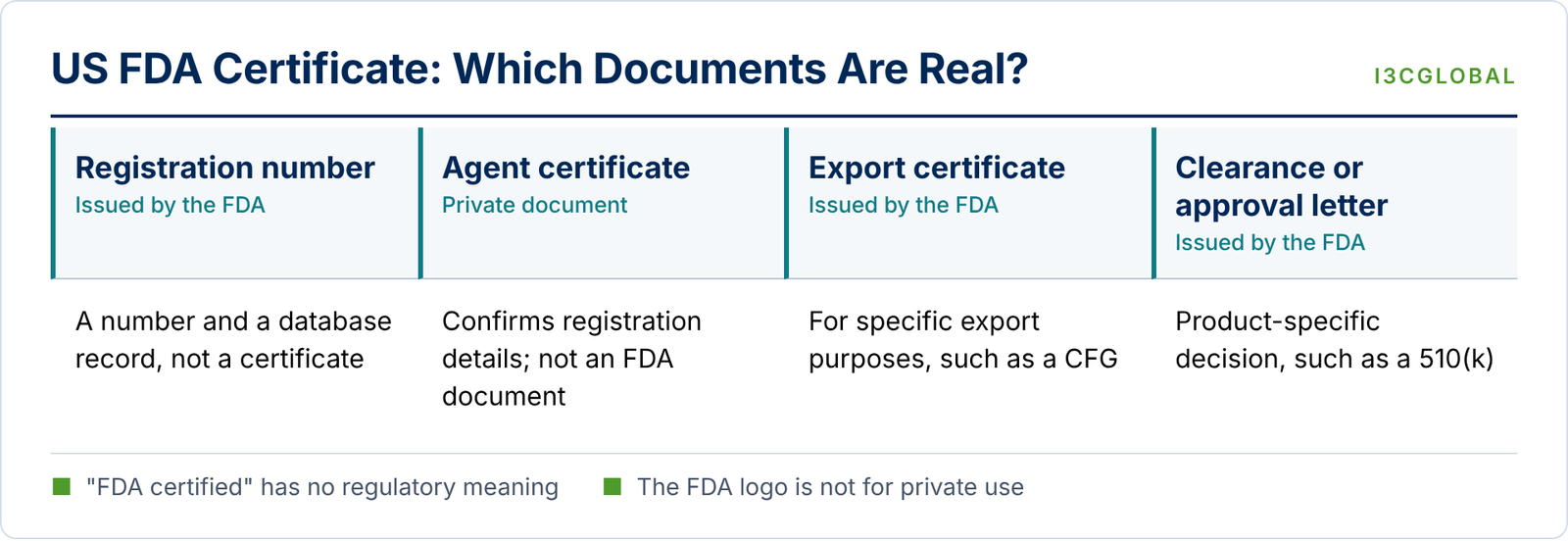
A US FDA certificate is the name buyers, importers and customs brokers use for proof that a company or product is on record with the US Food and Drug Administration. It is not one official document. The FDA does not issue a registration certificate, so an “FDA certificate” is in practice a private confirmation of registration, an official FDA export certificate, or an FDA clearance or approval letter. This guide explains what each one means, which are real FDA documents, how to verify an FDA registration and what to give a customer who asks for proof.
Definition
What Is a US FDA Certificate?
Meaning: FDA stands for Food and Drug Administration, the United States agency that regulates food, drugs, medical devices and cosmetics. A US FDA certificate, also written USFDA certificate or simply FDA certificate, means written evidence of the status of a company or product with that agency.
There is no general document with this name. When a facility registers, the FDA assigns numbers and creates a record. It does not send a certificate, and registering is not an approval. The FDA says so for each product type: it “does not issue a certificate of registration or product status” for food facilities (FDA), it “does not issue any type of device registration certificates to medical device facilities” (FDA), and it “does not issue certificates or other documents to verify compliance” with cosmetic registration and listing (FDA).
Common question
Is There a US FDA Certification?
No. The FDA does not certify companies, facilities or products. It registers establishments, lists products, and clears or approves certain products after review. People search for US FDA certification when they want to know whether a supplier or product is acceptable to the FDA, but the FDA has no status called certified.
The FDA warns that terms such as “FDA registered” and “FDA certified” may be used to mislead, and that they do not mean a product is approved, cleared or authorized (FDA). What a company can truthfully hold is set out below.
| What people call FDA certification | What actually exists | Applies to |
|---|---|---|
| “FDA certified company” | FDA establishment registration | Food, drug, device and cosmetic facilities |
| “FDA certified product” | Product listing; or 510(k) clearance, De Novo or PMA approval; or NDA or ANDA approval | Devices and drugs |
| “FDA certificate for export” | FDA export certificate | Products exported from the USA |
| “FDA GMP certificate” | No GMP certificate comes with registration; compliance is checked by FDA inspection | Drugs, devices, food |
If your product needs a pre-market decision, see the FDA Approval Process.
Sorting the terms
Which Documents Are Called an FDA Certificate?
| Document | Issued by | What it proves | Official FDA document? |
|---|---|---|---|
| Registration number, owner or operator number, FEI | FDA | The facility is registered | Yes, but it is a number, not a certificate |
| Public database entry | FDA | Current registration and listing status | Yes |
| FDA registration certificate (certificate of registration) | Consultant or US Agent | That the agent completed the registration and holds the details | No |
| Certificate to Foreign Government (CFG) | FDA | The product may be legally marketed in the USA | Yes |
| Certificate of Exportability | FDA | The product meets US export requirements although it is not marketed in the USA | Yes |
| 510(k) clearance, De Novo or PMA letter | FDA | The device passed pre-market review | Yes |
| NDA or ANDA approval letter | FDA | The drug is approved | Yes |
| “FDA certified” or “FDA approved facility” certificate | Nobody with authority | Nothing | No |
Private documents
FDA Registration Certificate and FDA Certificate of Registration: What Do You Receive?
The terms FDA registration certificate and FDA certificate of registration mean the same thing: a document confirming that a facility has registered with the FDA. Because the FDA does not issue one, it always comes from a private party, normally the US Agent or consultant that handled the registration. I3CGLOBAL gives clients such a confirmation after registration.
It is useful as a summary of the registration number, the registered name and address, the US Agent and the validity dates. It is a private document. It must not carry the FDA logo, must not use the words approved or certified by the FDA, and must not be offered as an FDA document. The FDA states that food facilities “do not need a certificate of registration” (FDA).
“This confirms that [company] completed FDA establishment registration under number [x] on 2026, with I3CGLOBAL acting as US Agent. Registration does not denote FDA approval.”
A document styled as an official FDA certificate, with the FDA logo, an “FDA approved” statement or a seal suggesting government endorsement.
See Using the FDA Name and Logo for the rules on the logo, and US FDA Registration Services for the registration itself.
Verification
How Do You Verify an FDA Establishment Registration Certificate?
A paper called an FDA establishment registration certificate proves nothing by itself. Verify the registration behind it. How you do that depends on the product type, because the FDA publishes some registration data and keeps other data confidential.
| Product type | Where to check | What you can see |
|---|---|---|
| Medical devices and IVDs | FDA Establishment Registration and Device Listing database; Devices@FDA for cleared and approved devices | Establishment name, registration number, owner or operator, listed devices and status |
| Drugs and APIs | Drug Establishments Current Registration Site and the NDC Directory | Registered establishments, expiry date and listed drugs |
| Food and dietary supplements | No public database | Registration numbers are confidential; confirmation comes from the facility’s own FDA account records |
| Cosmetics | No public search of facility registrations | Confirmation comes from the Cosmetics Direct submission records held by the facility or responsible person |
I3CGLOBAL checks registration status for clients and for importers who need to confirm a supplier before shipping.
By industry
What Does an FDA Certificate Mean for Each Product Type?
What a buyer means by an FDA certificate changes with the product. The four cases below cover most requests.
FDA certificate for medical devices
The FDA does not issue device registration certificates. Proof for a medical device is the establishment registration and device listing entry in the FDA database, plus the 510(k), De Novo or PMA number where the device needs one. See FDA Medical Device Registration, the device registration and listing fee and our FDA 510(k) guide. Most devices also need a UDI on the label.
FDA certificate for food manufacturers
The FDA issues a registration number to a registered food facility and no certificate. Food manufacturers show the registration number to their importer, who uses it for Prior Notice. See FDA Food Facility Registration and the food facility registration form.
FDA certificate for pharmaceutical companies
Proof for a drug or API manufacturer is the entry in the Drug Establishments Current Registration Site, the drug listing in the NDC Directory and, for approved drugs, the NDA or ANDA approval. See FDA Drug Establishment Registration and the drug establishment registration fee. API and excipient makers often also file a US FDA DMF.
FDA certificate for cosmetics
The FDA does not issue certificates to verify cosmetic facility registration or product listing under MoCRA. Proof is the submission record from Cosmetics Direct. See FDA Cosmetic Registration and the cosmetic registration and listing fee.
FDA-issued
Which Export Certificates Does the FDA Really Issue?
The FDA does issue certificates for export. They state the regulatory status of a product so that another country can accept it, and they mainly cover products exported from the United States.
| Product type | FDA export certificates | Source |
|---|---|---|
| Medical devices | Certificate to Foreign Government (CFG); Certificate of Exportability under section 801(e)(1); Certificate of Exportability under section 802; Non-Clinical Research Use Only Certificate | FDA |
| Food | Certificate to a Foreign Government; Certificate of Exportability; Certificate of Free Sale for dietary supplements, medical foods and foods for special dietary use | FDA |
| Cosmetics | Certificate for Cosmetics | FDA |
| Drugs | Electronic Certificate of Pharmaceutical Product (eCPP), valid for 24 months; not issued for human drugs that are not exported from the USA | FDA |
The FDA charges up to USD 175 for the first export certificate, with lower amounts for further certificates in the same request (FDA). A manufacturer outside the USA normally obtains a free sale certificate from its own authority; see Free Sale Certificate for Medical Devices. For the full export and import process, see our US FDA import and export guide.
Practical use
What Should You Give a Buyer Who Asks for an FDA Certificate?
- Ask what they need it forCustoms clearance, a marketplace listing and a tender each need different evidence.
- Give the checkable factsRegistration number or database link, and the 510(k), De Novo, PMA, NDA or ANDA number if the product has one.
- Add the private confirmation if usefulClearly marked as issued by your US Agent or consultant.
- Explain the position in one sentence“The FDA does not issue registration certificates; registration can be verified as follows.”
- Use a free sale certificate where a government document is requiredIssued by your own authority, or an FDA export certificate for products exported from the USA.
Avoidable problems
Which Statements About FDA Certificates Should You Avoid?
- “FDA approved” for a registered facility. Registration is not approval. See the FDA Approval Process.
- “FDA certified”. The FDA does not certify companies or products.
- Using the FDA logo. It is reserved for official use.
- “FDA registered” as a quality claim on the label. It can mislead consumers and can lead to enforcement action. See FDA Labeling Requirements.
- Presenting an agent certificate as an FDA document. Always state who issued it.
Work with I3CGLOBAL
How Does I3CGLOBAL Support FDA Registration Proof and Verification?
- Registration for food, drug, device and cosmetic facilities
- A clear written confirmation of registration for your records and customers
- Verification of the registration status of a supplier
- Guidance on correct wording for labels, websites and tenders
- US Agent service for manufacturers outside the USA
Need proof of FDA registration?
Tell us the product type and what your buyer has asked for.
FAQs
US FDA Certificate: Frequently Asked Questions
What is a US FDA certificate?
A US FDA certificate is the everyday name for a document that shows a company or product has dealt with the US Food and Drug Administration. It can mean a private confirmation of FDA registration, an official FDA export certificate, or an FDA clearance or approval letter. The FDA does not issue a general certificate for registration.
What is the meaning and full form of FDA certificate?
FDA stands for Food and Drug Administration, the United States agency that regulates food, drugs, medical devices and cosmetics. An FDA certificate means written evidence of a company’s FDA status, most often its registration.
Does the FDA issue a registration certificate?
No. The FDA does not issue a certificate of registration for food facilities, does not issue any type of device registration certificate to medical device facilities, and does not issue certificates to verify cosmetic registration or listing. Registration results in a number and a database record.
Is there a US FDA certification?
Not as an official status. The FDA registers establishments, lists products, and clears or approves certain products. It does not certify companies, and the FDA warns that the terms FDA registered and FDA certified may be used to mislead.
What does an FDA certificate cost?
The FDA charges nothing for a registration certificate because it does not issue one. For official export certificates the FDA charges up to USD 175 for the first certificate. A confirmation of registration from a US Agent or consultant is part of that provider’s service fee.
Is an FDA certificate of registration from an agent valid?
It is valid as a private confirmation of the registration details, such as the registration number and dates. It is not issued or endorsed by the FDA and must not be presented as an FDA document or as proof of approval.
How can I verify an FDA establishment registration certificate?
Check the registration itself, not the paper. Medical device establishments appear in the FDA Establishment Registration and Device Listing database and drug establishments in the Drug Establishments Current Registration Site. Food facility registration numbers are confidential and are confirmed from the facility’s own FDA account records.
Can a foreign manufacturer get an FDA export certificate?
FDA export certificates mainly cover products exported from the United States. For example, the FDA does not issue a Certificate of Pharmaceutical Product for human drugs that are not exported from the USA. A foreign manufacturer normally uses a free sale certificate from its own authority.
Can I print the FDA logo on my certificate or product?
No. The FDA logo is for official government use. Private companies may not use it on certificates, labels, websites or marketing material.
What should I send a buyer who asks for an FDA certificate?
Send the facts that can be checked: the registration number or public database entry, the 510(k), NDA or ANDA number where one exists, and a short statement that the FDA does not issue registration certificates.