
UKCA Marking for Medical Devices and IVDs: 2026 Consultant’s Guide
UKCA marking is the Great Britain conformity mark for medical devices and IVDs under the UK Medical Devices Regulations 2002. Since 1 January 2021 it has been the domestic route to the market in England, Scotland and Wales.
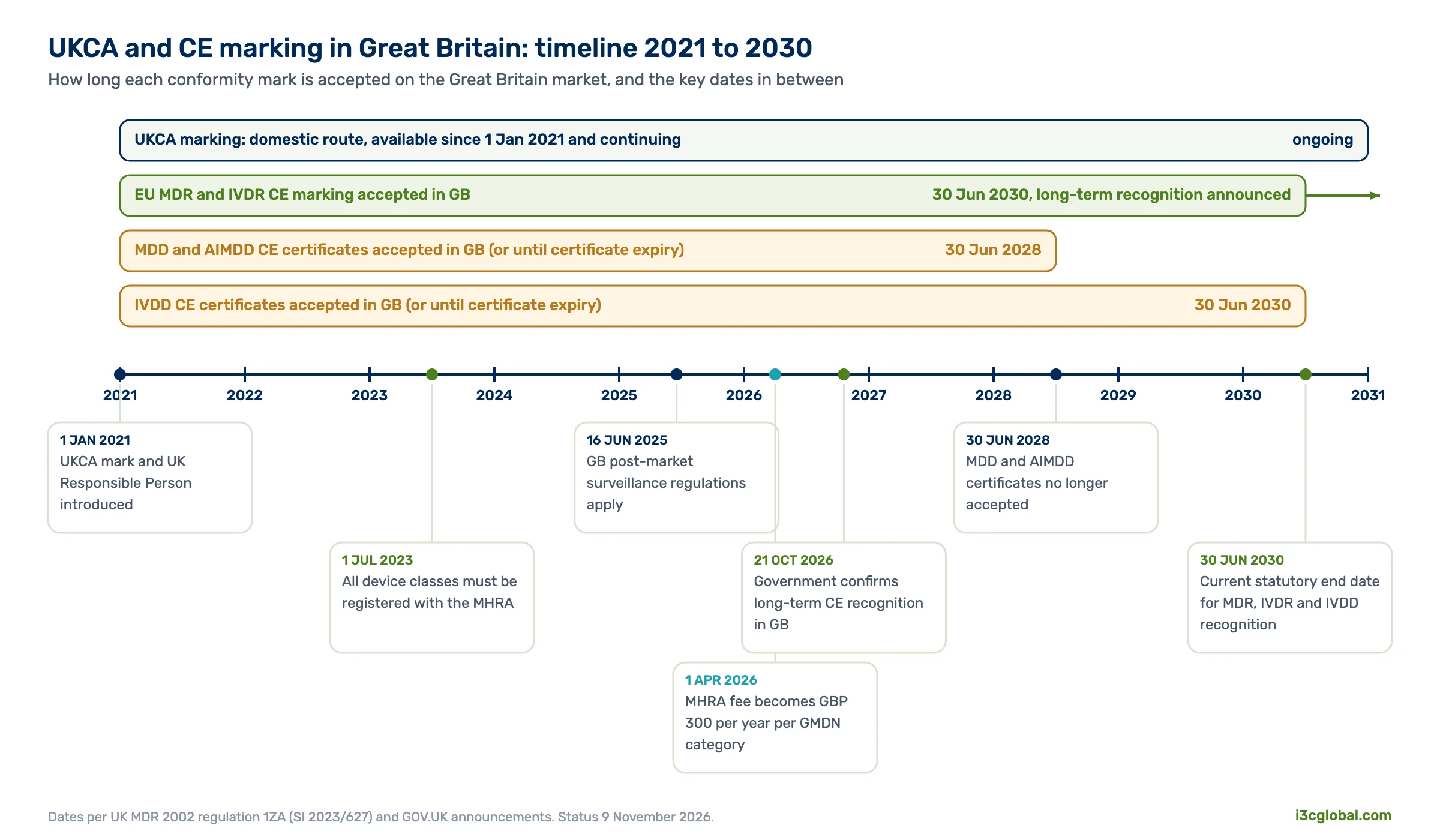
It is not the only route. CE-marked devices are accepted in Great Britain, and on 21 October 2026 the UK government confirmed that CE marking will continue to be recognised on a long-term basis. Every manufacturer must still register with the MHRA and, if based outside the UK, appoint a UK Responsible Person. This guide explains when UKCA marking is required, when CE marking is enough and how UKCA certification works.
Definition
What Is UKCA Marking?
UKCA marking (UK Conformity Assessed) is the product mark that shows a medical device or in vitro diagnostic device meets the requirements of the UK Medical Devices Regulations 2002 (UK MDR 2002, SI 2002/618) as amended. It was introduced on 1 January 2021 when the UK left the EU single market and is used for devices placed on the Great Britain market: England, Scotland and Wales. Northern Ireland follows EU rules and uses the CE mark.
The requirements behind UKCA marking are, for now, those of the EU Medical Devices Directive 93/42/EEC, the Active Implantable Medical Devices Directive 90/385/EEC and the IVD Directive 98/79/EC as transposed into UK law, not the EU MDR 2017/745 or IVDR 2017/746. The MHRA is modernising the UKCA route through a pre-market statutory instrument that will add requirements such as unique device identification (UDI), implant cards and a four-class IVD system.
UKCA marking is affixed by the manufacturer after a conformity assessment. For Class I non-sterile, non-measuring devices and general IVDs the manufacturer self-declares conformity; for all higher classes a UK Approved Body must audit the quality management system and review the technical documentation before the mark is applied.
2026 position
Do You Still Need UKCA Marking in 2026?
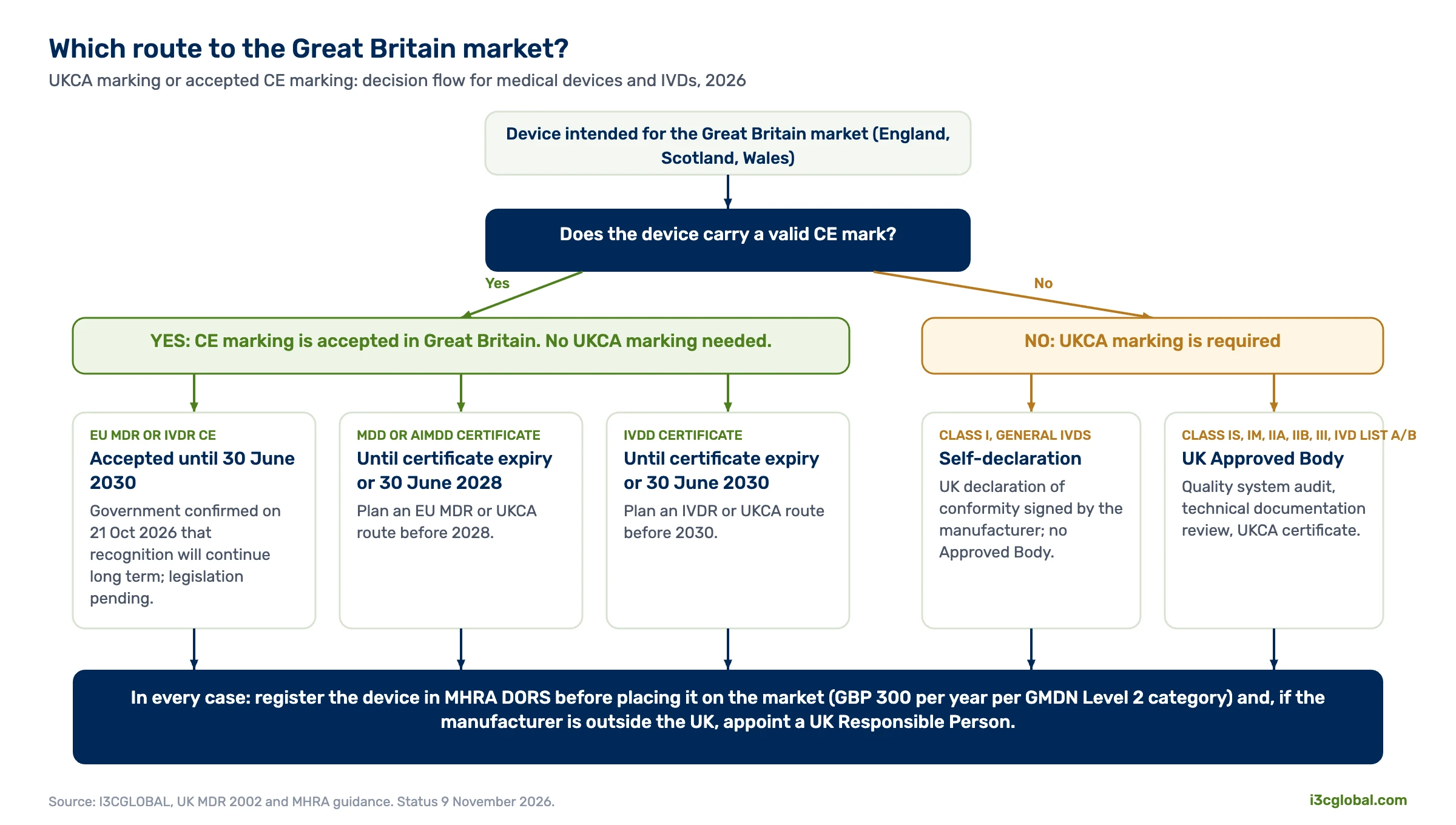
Not necessarily. If your device carries a valid CE mark, you can place it on the Great Britain market without UKCA marking, provided you register it with the MHRA and, if you are outside the UK, appoint a UK Responsible Person. UKCA marking is required only where you have no CE certificate, where your CE certificate falls outside the accepted categories, or where you choose the UK route for commercial reasons. The rules in force today are set by regulation 1ZA of the UK MDR 2002 and MHRA guidance.
| Your device today | Accepted in Great Britain until | Do you need UKCA marking? |
|---|---|---|
| CE marked under EU MDR 2017/745 or IVDR 2017/746 (including MDR self-declared Class I) | 30 June 2030 under current law; the government announced on 21 October 2026 that recognition will continue on a long-term basis | No. Register with the MHRA (GBP 300 per GMDN category per year) and appoint a UKRP if you are outside the UK. |
| CE marked under MDD 93/42/EEC or AIMDD 90/385/EEC with a valid certificate | Certificate expiry or 30 June 2028, whichever is earlier | Not yet. Plan a route for 2028: EU MDR CE marking or UKCA marking. |
| CE marked under IVDD 98/79/EC with a valid certificate | Certificate expiry or 30 June 2030, whichever is earlier | Not yet. Plan for IVDR or UKCA before the deadline. |
| Class I device self-declared under the MDD before 26 May 2021 that now needs a Notified Body under MDR | 30 June 2028 | Not yet, but a UKCA or MDR route will be needed by 2028. |
| No CE mark, or a device for the GB market only | Not applicable | Yes. UKCA marking through self-declaration or a UK Approved Body. |
| Approved by the FDA, Health Canada or the TGA only | Not currently accepted | Yes for now. The MHRA plans international reliance routes for devices approved in the USA, Canada and Australia, but they are not yet in law and no start date is confirmed. |
Status checked 9 November 2026. The government announcement of 21 October 2026 states that CE-marked devices will continue to be accepted and that no additional GB approval will be required for devices already approved for the EU market. The announcement does not give a date for changing the law, so the 2028 and 2030 dates above remain the legal position until the regulations are amended. Whatever route you use, MHRA registration, a UK Responsible Person for non-UK manufacturers, English labelling and the GB post-market surveillance requirements in force since 16 June 2025 apply to every device.
Comparison
UKCA vs CE Marking: What Is the Difference?
UKCA marking and CE marking both declare conformity after a similar process: classification, quality management system, technical documentation, conformity assessment and a declaration of conformity. The differences are the territory, the legal basis, the body that assesses the device and the register the device goes into.
| Topic | UKCA marking | CE marking |
|---|---|---|
| Territory | Great Britain (England, Scotland, Wales) | EU, EEA and Northern Ireland; also accepted in Great Britain |
| Legal basis | UK MDR 2002 as amended (requirements based on MDD, AIMDD and IVDD) | EU MDR 2017/745 and IVDR 2017/746 |
| Assessor | UK Approved Body designated by the MHRA | EU Notified Body designated by a member state |
| Classification | Class I, IIa, IIb, III; IVDs as general, self-test, List B, List A (four-class IVD system planned) | Class I, Is, Im, Ir, IIa, IIb, III; IVD Classes A to D |
| Representative for foreign manufacturers | UK Responsible Person | EU Authorised Representative |
| Registration | MHRA DORS, annual fee per GMDN category | EUDAMED (mandatory from 28 May 2026) |
| Label | UKCA mark, UK Approved Body number, UKRP name and address | CE mark, Notified Body number, EU AR name and address |
| Post-market surveillance | GB PMS Regulations (SI 2024/1368) from 16 June 2025 | MDR and IVDR Chapter VII, PSUR, EUDAMED vigilance |
| Accepted in the other market? | No. UKCA is not recognised in the EU or Northern Ireland. | Yes, in Great Britain, under the dates above and the planned long-term recognition. |
Because the technical requirements overlap, I3CGLOBAL builds one technical file that serves both marks. A manufacturer that already holds EU MDR CE marking can add UKCA marking with a UK Approved Body review rather than a second full project, and a manufacturer starting with UKCA marking can later extend the same documentation to the EU.
Certification process
How Do You Get UKCA Certification?
UKCA certification follows eight steps. Steps one to four are the same for CE marking, which is why most of our UKCA marking projects reuse the client’s existing quality system and technical documentation.
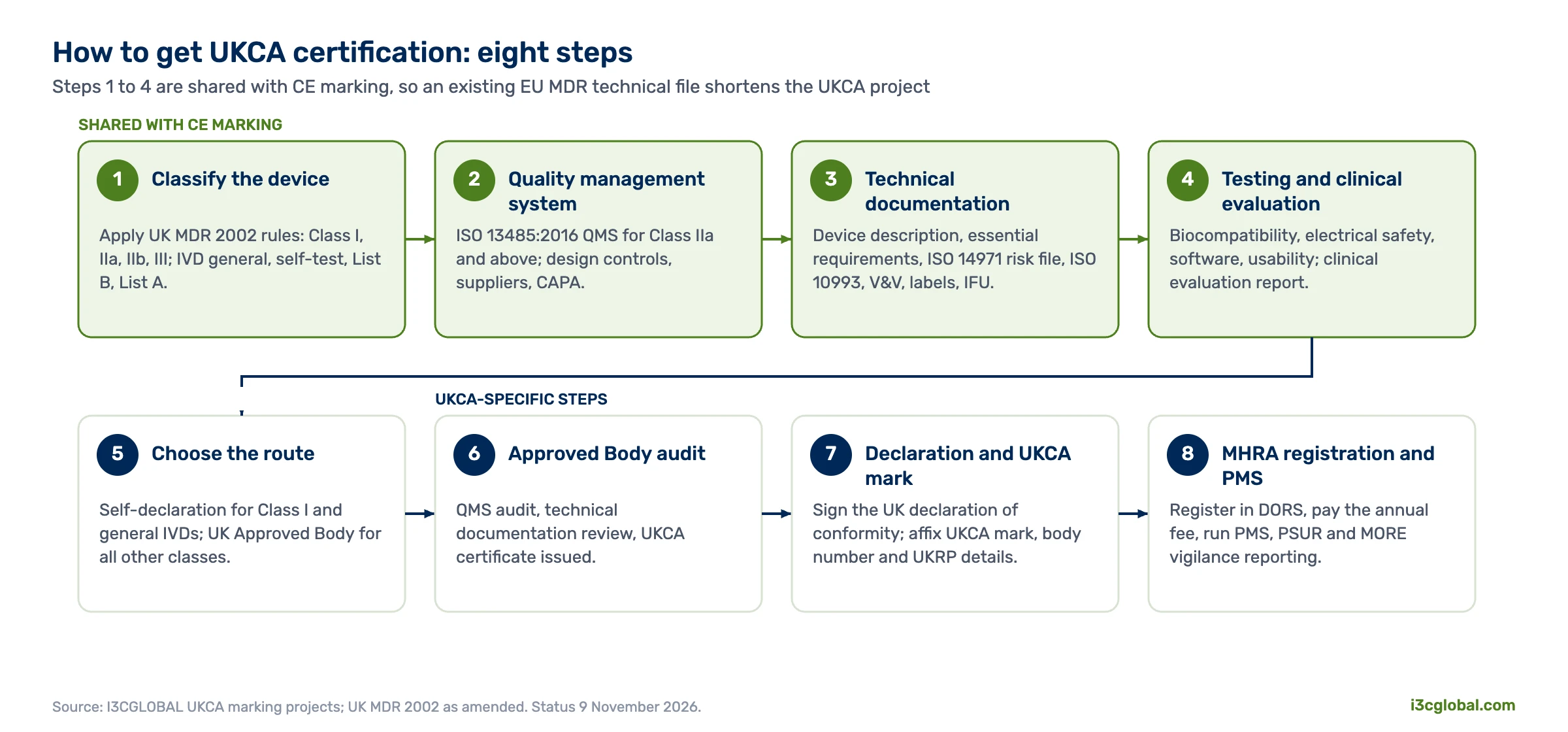
- Classify the device under UK MDR 2002Apply the classification rules to the intended purpose: Class I, IIa, IIb or III for general devices, and general, self-test, List B or List A for IVDs. The class decides whether a UK Approved Body is needed.
- Implement the quality management systemAn ISO 13485:2016 quality management system is the accepted way to meet the UK MDR 2002 quality system requirements for Class IIa and above.
- Compile the technical documentationDevice description, design and manufacturing information, essential requirements checklist, risk management to ISO 14971, biological evaluation, verification and validation, labelling and instructions for use in English, and the clinical evaluation.
- Complete testing and clinical evaluationBiocompatibility, electrical safety, software and usability testing as applicable, and a clinical evaluation report that supports every claim in the intended purpose.
- Choose the conformity assessment routeSelf-declaration for Class I non-sterile, non-measuring devices and general IVDs; full quality assurance or type-examination plus production quality assurance with a UK Approved Body for all other classes.
- UK Approved Body audit and technical reviewThe Approved Body audits the quality system, reviews the technical documentation and issues the UKCA certificate.
- Declaration of conformity and UKCA markSign the UK declaration of conformity, affix the UKCA mark with the Approved Body number where applicable, and add the UK Responsible Person’s name and address to the label or IFU. See our UKCA labelling requirements guide.
- MHRA registration and post-market surveillanceRegister every device in DORS before placing it on the market, pay the annual fee per GMDN category, and run the PMS plan, PSUR and vigilance reporting required since 16 June 2025.
Device classes
Which Devices Can Self-Certify for UKCA Marking?
Under UK MDR 2002 the conformity assessment route depends on the device class. Self-certification means the manufacturer signs the declaration of conformity without a UK Approved Body, then registers the device with the MHRA.
| Device class under UK MDR 2002 | Examples | UKCA route | UK Approved Body needed? |
|---|---|---|---|
| Class I (non-sterile, non-measuring) | Wheelchairs, bandages, stethoscopes, non-invasive examination gloves | Self-declaration plus MHRA registration | No |
| Class I sterile or measuring | Sterile dressings, thermometers | Approved Body review of the sterile or measuring aspects | Yes, limited scope |
| Class IIa | Hearing aids, short-term catheters, dental fillings | Quality system audit plus technical documentation sampling | Yes |
| Class IIb | Infusion pumps, ventilators, bone plates, long-term catheters | Full quality assurance or type-examination plus production QA | Yes |
| Class III and active implantable | Heart valves, hip implants, pacemakers | Full quality assurance with design examination | Yes |
| General IVDs | Clinical chemistry reagents, most laboratory assays | Self-declaration plus MHRA registration | No |
| IVD self-test, List B and List A | Pregnancy tests, blood glucose meters, HIV and blood-grouping reagents | Approved Body assessment, with batch verification for List A | Yes |
Planned change. The MHRA’s July 2025 consultation response confirmed a move to a risk-based IVD classification with Classes A to D, under which Class B IVDs would use a UKCA self-declaration of conformity supported by ISO 13485 quality management system certification. Manufacturers would have three years to meet the new UDI requirements for general medical devices, and five years for UDI and the new classification requirements for IVDs. Our medical device classification guide explains the rules in detail.
Approved bodies
Who Are the UK Approved Bodies for Medical Devices?
A UK Approved Body is a conformity assessment body designated by the MHRA under UK MDR 2002 to audit manufacturers and certify devices for UKCA marking, the equivalent of an EU Notified Body. The MHRA list of UK Approved Bodies, updated 17 July 2026, names nine organisations.
| UK Approved Body | Number | Designation scope |
|---|---|---|
| BSI Assurance UK Ltd | 0086 | General medical devices, active implantable devices, IVDs |
| TUV SUD BABT Unlimited | 0168 | General medical devices, active implantable devices, IVDs |
| SGS United Kingdom Ltd | 0120 | General medical devices, IVDs |
| TUV Rheinland UK Ltd | 2571 | General medical devices, IVDs |
| UL International (UK) Ltd | 0843 | General medical devices, IVDs |
| Intertek Medical Notified Body UK Ltd | 8532 | General medical devices |
| Eurofins E&E CML Limited | 2503 | General medical devices |
| Scarlet NB UK Ltd | 8536 | General medical devices |
| Therapeutic Goods Administration (Australia) | 0805 | General medical devices, designated under the UK–Australia mutual recognition agreement |
Capacity at UK Approved Bodies is limited, so lead times matter. Where a manufacturer already holds an EU MDR certificate, several bodies that also operate as EU Notified Bodies can use the existing audit and technical review to issue the UKCA certificate with less duplication. I3CGLOBAL assesses this case by case and prepares the application so that the Approved Body can rely on the EU work wherever its procedures allow.
Documentation
What Goes in a UKCA Marking Technical File?
The UKCA technical file demonstrates that the device meets the essential requirements of UK MDR 2002. Quality and regulatory teams often struggle to decide how many technical files they need: the correct segmentation, based on intended use, site of application, design and GMDN code, is what makes the Approved Body review fast.
Device description
Intended purpose, indications, variants and accessories, GMDN code, classification rationale and the regulatory history of the device.
Design and manufacture
Design specifications, drawings, software architecture, manufacturing processes, suppliers and process validations, including sterilisation where relevant.
Essential requirements
A checklist mapping every applicable essential requirement to the designated standards used and the evidence held.
Risk and biological evaluation
ISO 14971 risk management file and ISO 10993 biological evaluation, with testing performed in laboratories that I3CGLOBAL coordinates.
Verification and validation
Bench testing, electrical safety and EMC, software verification to IEC 62304, usability to IEC 62366-1 and shelf-life data.
Clinical evaluation and labelling
Clinical evaluation report, post-market surveillance plan, English labels and instructions for use carrying the UKCA mark and UKRP details.
One technical file cannot cover products with different intended uses, classes, materials or designs. Changes such as a new site of application, a major design change, added software or firmware, or new accessories normally mean a new or split file. See our medical device technical file guide for structure and content.
Timelines
How Long Does UKCA Marking Take?
Timelines depend on the device class, the maturity of the existing documentation and the Approved Body’s capacity. The figures below are I3CGLOBAL’s typical experience, not guarantees.
| Stage | Typical duration | What shortens it |
|---|---|---|
| Technical documentation preparation | 3 to 4 months with full manufacturer support; up to 2 months more for implants | Existing EU MDR technical documentation and test reports |
| Biocompatibility testing | About 90 days for most test panels | Reusing valid ISO 10993 data from the CE project |
| UK Approved Body review and audit | Around 8 months after submission | Early application and a body that can rely on the EU Notified Body work |
| Class I or general IVD self-declaration | Weeks rather than months | Complete file and GMDN codes ready for DORS |
| MHRA registration after certification | Usually 4 to 6 working days once the UKRP submits in DORS | Accurate manufacturer, device and GMDN data |
Northern Ireland
How Do UKCA, UKNI and Northern Ireland Fit Together?
Northern Ireland remains aligned with EU medical device law under the Windsor Framework (see the MHRA guidance for Northern Ireland). The EU MDR has applied there since 26 May 2021 and the IVDR since 26 May 2022, so devices placed on the Northern Ireland market need CE marking and, from 28 May 2026, registration in EUDAMED rather than with the MHRA, except custom-made devices which are still registered with the MHRA within 28 days.
UKCA marking, or CE marking under the accepted categories. Register in MHRA DORS. Non-UK manufacturers appoint a UK Responsible Person. GB post-market surveillance regulations apply.
CE marking under EU MDR or IVDR. If a UK Approved Body performs the mandatory third-party assessment, the UKNI indication accompanies the CE mark and the device cannot be sold in the EU. Non-EU manufacturers appoint an EU Authorised Representative; GB manufacturers need an EU or NI based representative.
Qualifying Northern Ireland goods with a valid CE mark can be placed on the Great Britain market indefinitely under the UK Internal Market Act 2020. A UKCA-only device cannot be sold in Northern Ireland or the EU.
Work with I3CGLOBAL
How Do I3CGLOBAL’s UKCA Marking Consultants Help?
I3CGLOBAL has provided CE marking consulting since 1999 and operates a UK entity that acts as UK Responsible Person for manufacturers in more than 30 countries. Our UKCA marking consultants handle every device class and both routes to the Great Britain market.
- Route strategy: CE recognition, UKCA marking or both, with the 2028 and 2030 dates mapped for your certificates
- Technical documentation, risk management, biological evaluation and clinical evaluation for UKCA certification
- UK Approved Body selection, application and response to review questions
- UK Responsible Person appointment and MHRA DORS registration
- Post-market surveillance plans, PSURs and MORE portal vigilance reporting under the 2024 regulations
Request your proposal
Tell us your device, class and current certificates and we will recommend the fastest compliant route to Great Britain.
FAQs
UKCA Marking: Frequently Asked Questions
Is UKCA marking still required for medical devices in 2026?
Only if you do not have an accepted CE mark. CE-marked devices under EU MDR or IVDR are accepted in Great Britain until 30 June 2030 under current law, and on 21 October 2026 the government confirmed that recognition will continue on a long-term basis; no date for changing the law has been announced. Devices with MDD or AIMDD certificates are accepted until certificate expiry or 30 June 2028. UKCA marking remains the domestic route for devices without a CE mark or for manufacturers who choose it.
Has UKCA marking been scrapped for medical devices?
No. The government's 21 October 2026 statement says the UKCA route remains the current domestic approval route and is being modernised through a pre-market statutory instrument. What changed is that CE marking will be accepted long term, so UKCA marking is a choice rather than a deadline for most CE-marked manufacturers.
What is the difference between UKCA marking and CE marking?
UKCA marking shows conformity with the UK Medical Devices Regulations 2002 for the Great Britain market and is assessed by a UK Approved Body; CE marking shows conformity with EU MDR or IVDR for the EU, EEA and Northern Ireland and is assessed by an EU Notified Body. The technical requirements overlap heavily, so one technical file can usually support both marks.
How long does UKCA marking take?
In I3CGLOBAL's experience, technical documentation takes three to four months with full manufacturer support, biocompatibility testing about 90 days, and the UK Approved Body review around eight months after submission. Class I devices and general IVDs that self-declare can be registered within weeks.
How much does UKCA certification cost?
Costs depend on device class and route. Class I and general IVD self-declaration involves consulting and MHRA registration fees only; higher classes add UK Approved Body audit and review fees plus any testing. The MHRA registration fee for 2026-27 is GBP 300 per year for each GMDN Level 2 category and is reviewed annually. Request a proposal for a fixed quote for your device.
Who issues UKCA certificates for medical devices?
UK Approved Bodies designated by the MHRA. The MHRA list of 17 July 2026 names nine bodies, including BSI Assurance UK (0086), TUV SUD BABT (0168), SGS United Kingdom (0120), TUV Rheinland UK (2571), UL International UK (0843), Intertek Medical Notified Body UK (8532), Eurofins E&E CML (2503), Scarlet NB UK (8536) and Australia's Therapeutic Goods Administration (0805) under a mutual recognition agreement.
Can my EU Notified Body certificate be used for UKCA marking?
Not directly, because only UK Approved Bodies can issue UKCA certificates. However, several Approved Bodies are also EU Notified Bodies and can use existing audit results and technical documentation reviews to reduce duplication. I3CGLOBAL checks what each body will accept before you apply.
Do I need a UK Responsible Person for UKCA marking?
Yes if your company is based outside the United Kingdom. The UK Responsible Person registers your devices with the MHRA, holds the technical documentation and acts as the MHRA's point of contact. Its name and address must appear on the label, packaging or instructions for use of UKCA-marked devices.
Does a CE-marked device need MHRA registration?
Yes. Registration with the MHRA through DORS is required for every device placed on the Great Britain market, whether it carries UKCA or CE marking. Since 1 April 2026 the fee is GBP 300 per year per GMDN Level 2 category.
Is UKCA marking accepted in Northern Ireland or the EU?
No. Northern Ireland follows EU MDR and IVDR and requires CE marking, with the UKNI indication where a UK Approved Body carried out the assessment. UKCA marking is valid only in Great Britain.
Will the UK accept FDA, Health Canada or TGA approvals instead of UKCA marking?
The MHRA has confirmed plans for international reliance routes based on approvals from the United States, Canada and Australia. No start date has been confirmed. These routes are not yet in law, so today such devices need UKCA marking or an accepted CE mark, plus MHRA registration and a UK Responsible Person.
Can a device carry both UKCA and CE marking?
Yes. MHRA guidance allows both marks on the labelling, provided neither impedes the visibility of the other and the requirements for each are met. If the manufacturer is outside the UK, a dual-marked label must also show the UK Responsible Person's name and address. The CE mark covers the EU and Northern Ireland; the UKCA mark covers Great Britain only.
What is UKNI marking?
UKNI is an indication placed next to the CE mark when a UK notified body carries out the mandatory third-party conformity assessment for the Northern Ireland market. CE UKNI marked devices are valid in Northern Ireland but cannot be placed on the EU market.
Does I3CGLOBAL prepare the UKCA technical file?
Yes. We prepare the technical documentation for all our clients, submit it to the UK Approved Body and answer the reviewer's questions. We also coordinate biocompatibility and safety testing, act as UK Responsible Person and complete MHRA registration.