
US FDA Approval and Regulatory Compliance Services
FDA approval is a decision by the US Food and Drug Administration, after reviewing scientific evidence, that a specific product may be marketed in the United States for a stated use. Only some products need it: new drugs, biologics and high-risk medical devices are approved, most moderate-risk devices are cleared through a 510(k), and food, dietary supplements and cosmetics are generally not approved at all. Registration of a facility is never an approval. This guide maps each product type to its correct FDA pathway and shows foreign manufacturers where to start.
Definition
What Is FDA Approval?
FDA approval is product-specific. The FDA looks at data on safety and effectiveness for one product and one intended use and issues a decision letter. It does not approve companies, factories or quality systems, and it does not issue a general approval certificate.
Whether a product needs approval, a lighter form of review or no pre-market review depends on its legal category and risk. Getting the category right is the first regulatory decision, because the same physical product can be a cosmetic, a device or a drug depending on what is claimed for it.
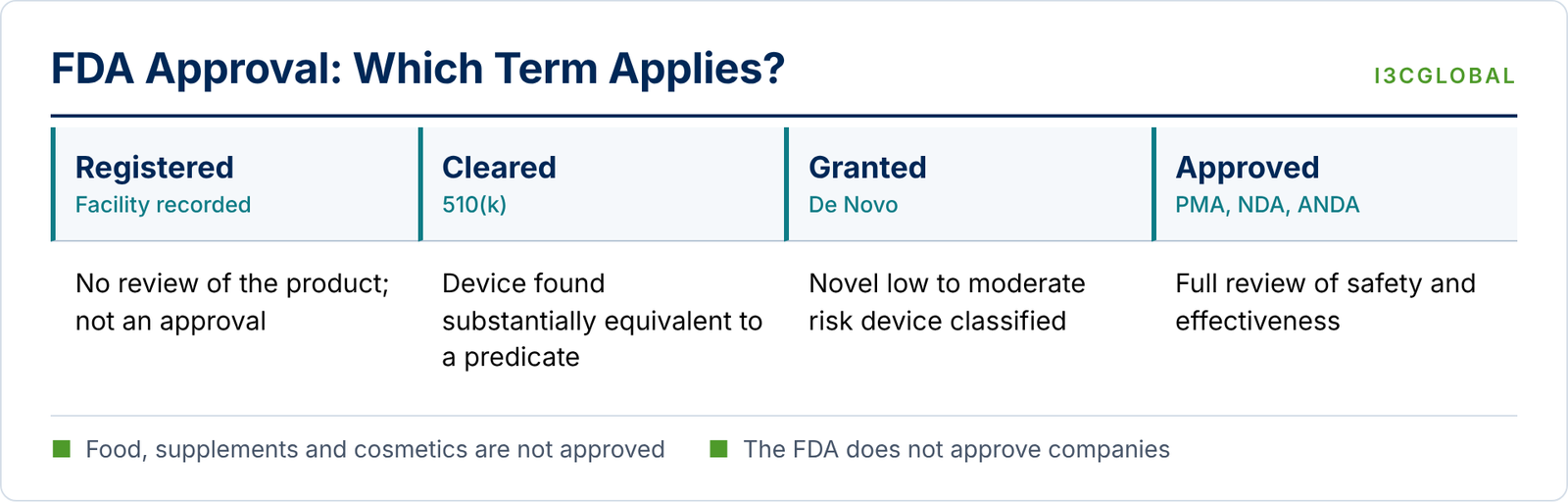
Terminology
What Is the Difference Between Registered, Listed, Cleared and Approved?
| Term | What the FDA did | Applies to | Correct wording |
|---|---|---|---|
| Registered | Recorded the facility | Food, drug, device and cosmetic facilities | “FDA registered establishment” (not a quality claim) |
| Listed | Recorded the product made at a registered facility | Drugs, devices, cosmetics | “Listed with the FDA” |
| Cleared | Found a device substantially equivalent to a legally marketed device | Most Class II devices | “FDA 510(k) cleared” |
| Granted | Classified a novel device as Class I or II | De Novo devices | “De Novo granted” |
| Approved | Decided the product is safe and effective after full review | PMA devices, NDA, ANDA and BLA products | “FDA approved” |
| Authorized | Allowed use under specific conditions | For example emergency use authorisations | “FDA authorized” |
Using the wrong term is a misbranding risk. See US FDA Registration Services for what registration does and does not mean.
Overview
Which FDA Pathway Applies to Your Product?
| Product type | Pre-market requirement | FDA decision |
|---|---|---|
| Class I medical device (most) | Usually exempt from 510(k); register and list | None |
| Class II medical device (most) | 510(k) premarket notification | Clearance |
| Novel low to moderate risk device | De Novo request | Granted |
| Class III medical device | Premarket Approval (PMA) | Approval |
| New drug | New Drug Application (NDA) | Approval |
| Generic drug | Abbreviated New Drug Application (ANDA) | Approval |
| Biologic | Biologics License Application (BLA) | Licence |
| OTC drug under a monograph | No application; must conform to the monograph | None |
| Food and beverages | None for the product; facility registration | None |
| Dietary supplements | Notification only for a new dietary ingredient | None |
| Cosmetics | None for the product; registration and listing under MoCRA | None |
| Colour additives and food additives | Petition or notification | Listing or authorisation |
Medical devices
What Are the FDA Pathways for Medical Devices?
Devices are placed in Class I, II or III by risk. The class and the product code decide the pathway.
510(k) premarket notification
The manufacturer shows that the device is substantially equivalent to a legally marketed predicate. The result is a clearance letter. See FDA 510(k) and 510(k) submission.
De Novo classification
For a novel device with no predicate and low to moderate risk. If granted, the device becomes a predicate for later 510(k)s.
Premarket Approval (PMA)
For Class III devices. Requires valid scientific evidence, usually clinical data, and an inspection of the manufacturing site.
After the decision, the establishment registers and lists the device; see FDA Medical Device Registration. The quality system must meet the FDA QMSR.
Drugs
What Are the FDA Approval Pathways for Drugs?
- New Drug Application (NDA). For a new active ingredient, indication, dosage form or strength, supported by clinical studies.
- Abbreviated New Drug Application (ANDA). For a generic version of an approved drug, based on pharmaceutical equivalence and bioequivalence.
- Biologics License Application (BLA). For vaccines, blood products and other biological products.
- OTC monograph. An over-the-counter drug that follows an FDA monograph for its active ingredients, strengths, claims and labeling can be marketed without an application.
- Drug Master File (DMF). A confidential file, often from an API manufacturer, that the FDA reviews only in connection with an application. A DMF is not approved on its own. See US FDA DMF.
Every manufacturing site named in an application must also complete FDA Drug Establishment Registration and drug listing.
Food and cosmetics
Do Food, Supplements and Cosmetics Need FDA Approval?
In general, no. The company is responsible for the safety and labeling of these products, and the FDA acts after they are on the market.
| Product | What is required | Guide |
|---|---|---|
| Food and beverages | Facility registration; safe ingredients; compliant label | FDA Food Facility Registration |
| Dietary supplements | Facility registration; notification for a new dietary ingredient; compliant label | FDA Food Facility Registration |
| Food additives and colour additives | FDA authorisation of the substance before use | Contact us |
| Cosmetics | Facility registration and product listing under MoCRA; safety substantiation | FDA Cosmetic Registration |
A food, supplement or cosmetic that is promoted to treat or prevent a disease is regulated as a drug and then does need approval. Label wording therefore matters; see FDA Labeling Requirements.
Outside the USA
How Do Foreign Manufacturers Obtain FDA Approval or Clearance?
The FDA applies the same standards to foreign and US applicants. Companies outside the USA normally name a US Agent for their applications and registrations, pay the same user fees, and must expect FDA inspection of their sites.
Manufacturers in India
Indian device makers most often start with a 510(k); pharmaceutical companies with ANDAs and DMFs. Existing CDSCO or ISO 13485 evidence helps but is not accepted in place of FDA review.
Manufacturers elsewhere in Asia
Contract manufacturers are named in their customers’ submissions and must be ready for inspection even when they hold no clearance themselves.
Manufacturers in Europe
CE marking under the MDR or IVDR is not recognised by the FDA. Much of the technical and clinical evidence can be reused in a 510(k) or PMA.
I3CGLOBAL provides US FDA Agent Services alongside submission support.
Avoidable problems
Which FDA Approval Claims Should You Avoid?
- “FDA approved” for a 510(k) cleared device. Use “cleared”.
- “FDA approved” for a registered facility. Facilities are registered, not approved.
- “FDA approved” for a cosmetic or supplement. These products are not approved.
- Using the FDA logo. See Using the FDA Name and Logo.
- Presenting a registration certificate as approval. See FDA Registration Certificate.
Work with I3CGLOBAL
How Does I3CGLOBAL Support FDA Approval and Clearance?
- Product classification and pathway assessment
- 510(k), De Novo and PMA support for devices and IVDs
- Drug establishment registration, listing and DMF support
- US Agent service for foreign applicants
- Registration and labeling handled by the same team
Not sure which FDA pathway applies?
Send us the product description, intended use and claims for a pathway assessment.
FAQs
FDA Approval: Frequently Asked Questions
What does FDA approval mean?
FDA approval means the US Food and Drug Administration has reviewed the evidence for a specific product and decided that its benefits outweigh its known risks for the intended use. It applies to products such as new drugs, biologics and high-risk medical devices, not to companies or facilities.
Is FDA registration the same as FDA approval?
No. Registration identifies a facility to the FDA and involves no review of the product. Approval is a decision on a specific product after the FDA has evaluated the evidence.
What is the difference between FDA cleared and FDA approved?
Cleared is used for medical devices that reach the market through a 510(k) by showing substantial equivalence to an existing device. Approved is used for devices that pass a PMA and for drugs and biologics with an approved application.
Does the FDA approve food products?
Generally no. Food products and food facilities are not approved. Certain ingredients, such as food additives and colour additives, need FDA authorisation, and some products such as infant formula require a notification before marketing.
Does the FDA approve cosmetics?
No. Cosmetic products and ingredients, other than colour additives, do not need FDA approval before they are sold. The company is responsible for safety.
Are dietary supplements FDA approved?
No. Dietary supplements are not approved by the FDA before marketing. A notification is required only when a supplement contains a new dietary ingredient.
Can a foreign manufacturer apply for FDA approval?
Yes. Foreign companies submit the same applications as US companies. They normally name a US Agent, and their manufacturing sites must be registered and are subject to FDA inspection.
Can I say my company is FDA approved?
No. The FDA does not approve companies or facilities. Claims should refer to the specific product and the exact decision, for example a 510(k) clearance number.