
510k Consultants for Medical Devices, IVD and SaMD
I3CGLOBAL’s 510k consultants take full ownership of your FDA premarket notification, from device classification and predicate selection to the eSTAR file, FDA review questions and clearance. With 120+ FDA 510k clearances worldwide, and 85% of our files moving straight to substantive review with no RTA or screening hold, our services work on a fixed fee with no hourly billing.
The role
What Do 510k Consultants Do for Manufacturers?
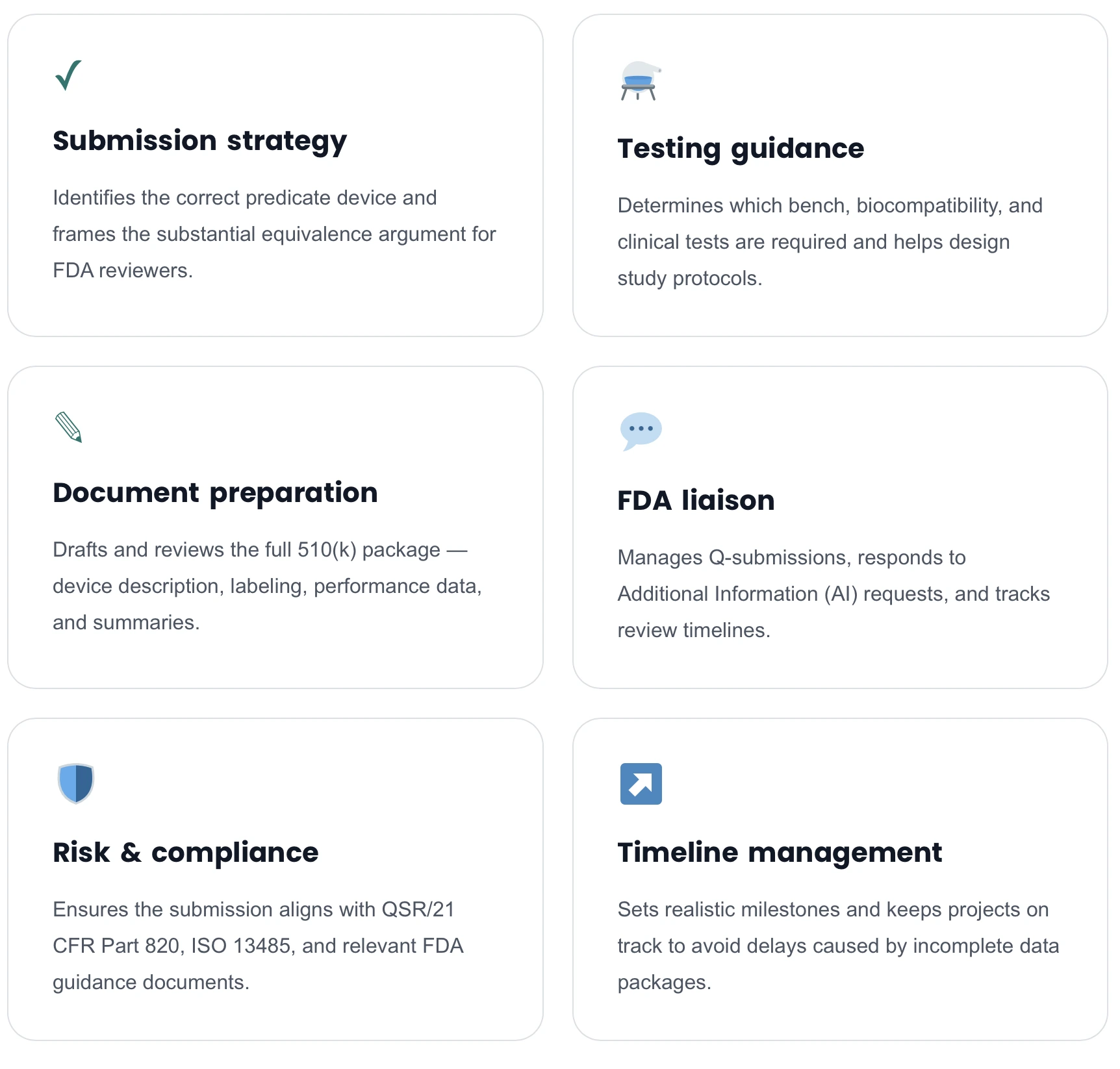
510k consultants plan, prepare and manage the FDA 510(k) premarket notification for a medical device, IVD or software product. A good consultant decides the regulatory strategy, builds the substantial equivalence argument, coordinates the testing evidence, assembles the eSTAR and handles every FDA question until the clearance letter arrives.
Our 510k submission consultants do all of this for you; if you want to understand the steps first, read our guide to the FDA 510k submission process.
The choice of consultant directly affects clearance speed, cost and success rate. Without experienced support, manufacturers risk the three outcomes that derail most files: a technical screening hold before review starts, Additional Information (AI) requests that stop the FDA review clock, and a Not Substantially Equivalent (NSE) decision that blocks market entry.
- FDA 510k documentation and eSTAR preparation
- Predicate device search and substantial equivalence strategy
- Pre-Submission (Q-Sub) packages and FDA meetings
- Test planning: biocompatibility, electrical safety, EMC, software and performance
- FDA review coordination and AI responses until clearance
- US FDA agent service and establishment registration
- UDI, labeling and QMSR support
Timing
When Should You Bring In Expert Help?
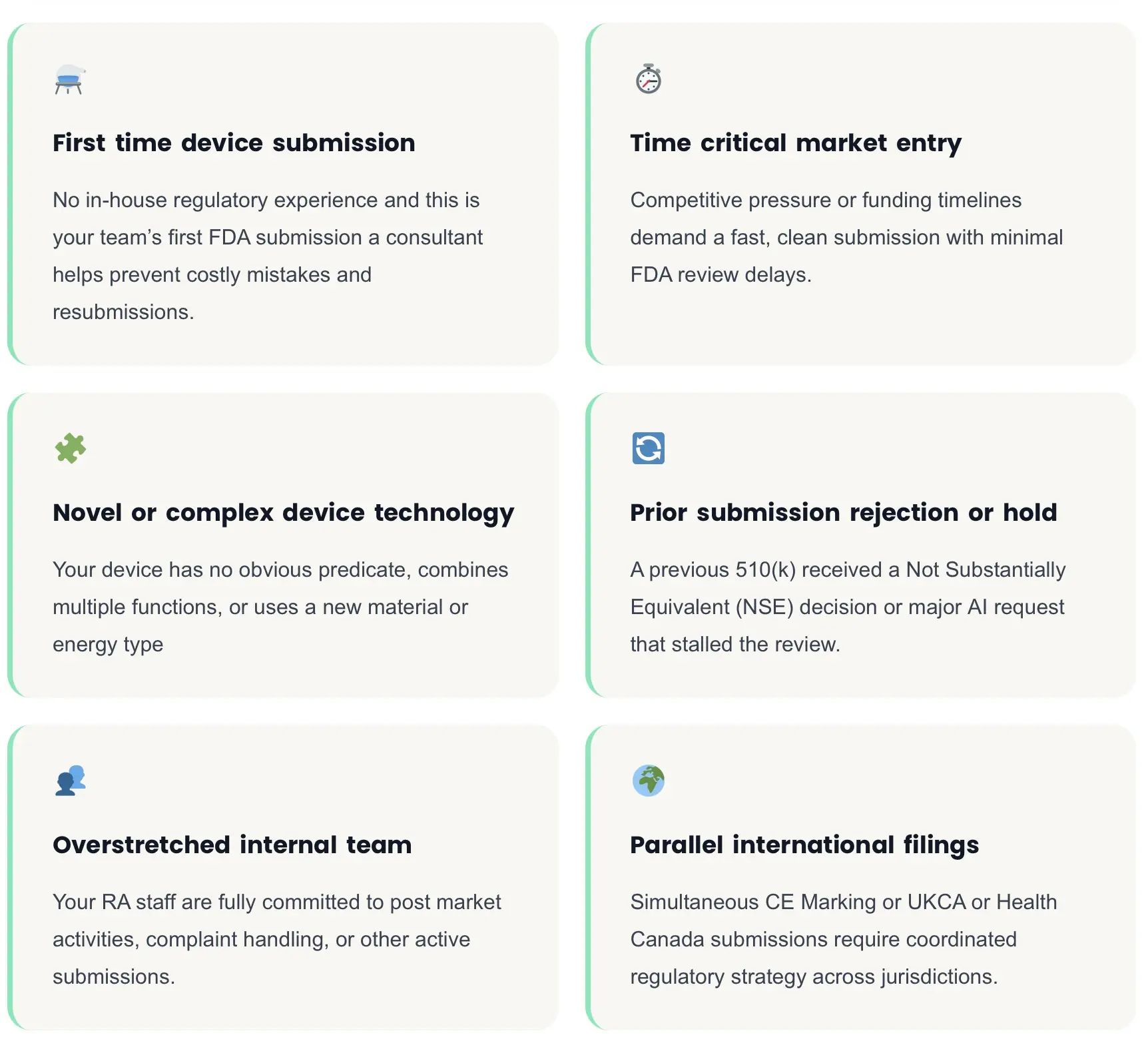
Bring in expert help before you commit to testing. The predicate choice and test plan decide most of the cost and timeline of an FDA file, and mistakes there are expensive to undo later. Typical triggers are:
- First 510(k): your team has not submitted to FDA before.
- Foreign manufacturer: you need a US contact for FDA communications and a US agent for registration.
- Complex technology: software, AI, wireless, implants or novel materials.
- Weak or unclear predicate: you need a strategy, or a De Novo instead.
- Previous screening hold, RTA or NSE: you need the file rebuilt and the FDA concerns resolved.
- Device changes: you need to decide whether a change needs a new 510(k).

US agent and 510(k) correspondent: foreign manufacturers must name a US FDA agent for establishment registration. This is a different role from the 510(k) correspondent, who handles FDA communications about the submission itself. I3CGLOBAL can act as both and run your 510k project, so FDA has one point of contact before and after submission.
Recent clearances we supported: K253111, K252634, K252458, K252028, K251872, K250984 See more in our medical device case studies.
How we work
How We Run Your 510k Project

Every 510k project runs through the same six stages shown above. For each stage, this is what our team delivers and what we need from yours. For FDA’s own review steps, clocks and timelines, see our FDA 510k submission guide.
- 1. PathwayWe deliver: a written pathway rationale with the device class, product code, regulation number and special controls, and why a 510(k) fits rather than De Novo or PMA, checked against FDA’s Premarket Notification 510(k) requirements.
You provide: the device description, intended use and any earlier FDA correspondence. - 2. Predicate and strategyWe deliver: a predicate search, a recommended predicate with a side-by-side comparison and the substantial equivalence strategy, plus a Q-Sub package when the device is novel or the predicate is weak.
You provide: technical specifications, materials and any competitor devices you already know. - 3. Gap analysis and testingWe deliver: a gap analysis against the predicate and FDA guidance, a test plan for biocompatibility, electrical safety, EMC, software (IEC 62304) and bench testing, and review of every protocol and report.
You provide: existing test reports, test samples and the laboratory contracts. We are not a testing laboratory. - 4. eSTAR fileWe deliver: drafted technical sections, including the device description, substantial equivalence discussion, labeling review, risk management (ISO 14971) and software and cybersecurity documentation, assembled in FDA’s eSTAR template and checked against FDA’s acceptance criteria.
You provide: design files, labels and IFU, and review and sign-off of each draft. - 5. FDA reviewWe deliver: submission as your 510(k) correspondent if you wish, responses to holds and additional information requests, and all FDA liaison until the decision.
You provide: the FDA user fee payment and any new data FDA asks for. - 6. ClearanceWe deliver: establishment registration, device listing and US agent service if you need it.
You provide: the establishment registration fee and your post-market contacts.
Build or buy
Outside Experts vs an In-House Team: Which Is Right for You?
Hiring outside experts or building an in-house regulatory team can both work. The right choice depends on how often you submit and what you want to spend.
Outside consultants suit startups and small and mid-sized manufacturers: lower cost, no full-time overhead and experience across many product codes. An in-house team makes financial sense once you run several submissions a year and need regulatory input built into development.
Many companies now use a hybrid model: permanent regulatory leadership in house, with external specialists for new device types, software, IVD or peak workloads. This keeps fixed costs low while giving each submission specialist experience across FDA review divisions and product codes. The table below breaks down the differences.
| Factor | Outside consultant | In-house team |
|---|---|---|
| Cost structure | Fixed fee agreed in a signed contract | Salary and benefits, an ongoing cost after the submission |
| Speed to start | Fast: work starts soon after signing | Slower: hiring and training take 2–5 months |
| Device breadth | Consultants matched to your device type and technology | Strong product knowledge, narrower 510(k) experience |
| Best for | Startups and small or mid-sized companies, single submissions or novel devices | Established companies with several 510(k) submissions a year |
| Knowledge retention | Full handover at the end of the project | Knowledge stays in your QA/RA team |
| FDA experience | Broad familiarity across product codes and review divisions | Experience specific to your product family |
| Scalability | High: engage only when needed | Fixed capacity; overtime or hiring needed for peaks |
Device classes
Support for Class I, II and III Medical Devices
Our team takes file responsibility and guides manufacturers step by step, making sure every FDA requirement is met for Class I, Class II and Class III devices that need a 510(k). The work covers:
Regulatory strategy
Device class, product code and regulation number; predicate identification; applicable guidance and the right 510(k) type (Traditional, Special or Abbreviated).
Testing plan
Biocompatibility and performance tests, sampling plans, stability and shelf life, sterilisation, and device-specific software, EMC and electrical safety requirements.
File preparation
Indications for Use, declarations of conformity, risk management review, labeling review, the 510(k) summary and the predicate comparison.
FDA interaction
Pre-Submission, eSTAR technical screening, substantive and interactive review, device listing, registration and US agent services.
Want more detail on our services?
Submit your email and receive the information within two minutes. View our Privacy Policy.
Diagnostics
510k Support for In Vitro Diagnostics (IVD)
IVD devices follow the 510(k) pathway, but FDA clearance depends on analytical and clinical performance data rather than bench testing alone. Our team guides and supports the studies; we are not a testing laboratory.
- Analytical performance: precision and reproducibility, LoD/LoQ, interference, linearity and reportable range, designed to CLSI guidelines.
- Clinical validation and method comparison: performance across sample types and clinical sensitivity and specificity to support substantial equivalence.
- IVD labeling: labels and instructions for use that meet 21 CFR 809.10, from intended use and reagents to limitations and performance summaries.
- CLIA: CLIA categorisation, CLIA waiver by application and Dual 510(k) submissions. See CLIA waiver consulting.
2026 updates for IVD manufacturers: the Quality Management System Regulation (QMSR), aligned with ISO 13485:2016, applies from 2 February 2026, and every IVD 510(k) must be submitted as an eSTAR. FDA’s 2024 rule on laboratory developed tests was vacated by a federal court in March 2025, so LDT plans should be reviewed case by case. See the 510k IVD submission workflow.
Digital health
SaMD and Software Developers
Software as a Medical Device (SaMD) brings its own 510(k) challenges, especially when agile development has to stay aligned with evolving FDA expectations on software safety, cybersecurity and lifecycle management. We support:
- Software life cycle and IEC 62304: requirements, architecture, verification, validation, traceability and software risk documentation at FDA’s Basic or Enhanced level.
- Cybersecurity: threat modelling, SBOM, vulnerability management and secure design controls for cyber devices under section 524B of the FD&C Act.
The SaMD submission roadmap below summarises the key deliverables. For the full statement of work, see the SaMD 510k process.
By device type
Services by Device Type
Each device type has its own evidence package. Choose your device type to see the detailed process and the split of work between our team and yours.
Active devices
IEC 60601 electrical safety, EMC, software and cybersecurity. Active device 510k
Non-active devices
Biocompatibility, sterility, shelf life and bench testing. Non-active device 510k flow chart
Software (SaMD)
IEC 62304, cybersecurity and validation. SaMD 510k process
In vitro diagnostics
Analytical and clinical performance and CLIA. IVD 510k workflow
No predicate
Novel low to moderate risk devices. FDA De Novo submission
Gowns, gloves and masks
Personal protective medical devices. 510k services for PPE
Why I3CGLOBAL
Why Small and Mid-Sized Companies Choose I3CGLOBAL
For startups and growing manufacturers, every regulatory decision carries outsized risk. One technical screening hold or a long FDA review can derail a launch, strain investor timelines and burn limited budgets. I3CGLOBAL was built for this reality.
Track record
120+ FDA 510k clearances supported, with rigorous internal pre-screening against FDA’s eSTAR technical screening and acceptance criteria and deep experience in SaMD, AI-enabled diagnostics and implantable devices.
Dedicated consultants
Every project is led by a senior consultant who stays your single point of contact, with subject experts for testing, risk, clinical and software topics, so the substantial equivalence argument stays consistent through every FDA interaction.
End to end until clearance
We do not just advise by phone and email. Our team prepares the file, takes full ownership and stays with it through FDA questions until the clearance letter, at a fixed fee.
Global customers can work with the nearest I3CGLOBAL office in Germany, India, Malaysia, Portugal, Thailand, Turkey, the UK, the USA or Vietnam for faster regional support.
Track record
Recent FDA 510k Clearances We Supported
Each of these clearances is public in FDA’s 510(k) database, where I3CGLOBAL is listed as the 510(k) correspondent. Click a K-number to open the FDA record.
Radiological image processing software
K253111: product code LLZ, 21 CFR 892.2050, Radiology panel. Traditional 510(k), found substantially equivalent on 13 March 2026.
Radiological image processing software suite
K252634: product code QIH (subsequent LLZ), 21 CFR 892.2050, Radiology panel. Traditional 510(k), found substantially equivalent on 16 January 2026.
Medical recirculating air cleaner
K251872: product code FRF, 21 CFR 880.5045, General Hospital panel. Traditional 510(k), found substantially equivalent on 14 November 2025.
For more projects, see our medical device case studies.
Buyer’s checklist
How to Choose an FDA 510k Consultant
Not every consultant offers the same service. Before you sign, ask these questions. A strong partner will answer each one clearly and in writing.
- Who prepares the file? Some firms only review documents your team writes. Ask whether the consultant drafts the eSTAR sections and owns the file until clearance.
- Relevant clearances: ask for K-numbers in your device area. FDA publishes every clearance in its 510(k) database, so you can check them yourself.
- Fee structure: a fixed fee should state what is included, such as Pre-Submissions, AI responses and US agent services, and what is not, such as testing and the FDA user fee.
- Team and continuity: confirm who leads the project and who answers FDA if the reviewer calls.
- Testing knowledge: the consultant should plan biocompatibility, electrical safety, software and bench testing with your laboratory, not after the reports arrive.
- Post-clearance support: registration, device listing, labeling, UDI and change assessments for future 510(k)s.
Why 510k files fail, and how good consultants prevent it
Most holds and additional information requests come from a short list of avoidable gaps, from a weak predicate comparison to labeling that does not match the Indications for Use form. We check every eSTAR against FDA’s acceptance criteria and fix those gaps before submission; see the full list of common 510k submission deficiencies.
Fixed fees
How Much Do 510k Consultants Cost?
Our 510k consulting fees are fixed by device type and cover guidance, technical file preparation, Q-Submissions, eSTAR submission and FDA liaison through clearance, with no hourly billing and no extra charge for answering FDA review questions. The FDA user fee is paid separately to FDA.

Consulting, non-active devices
From USD 18,500Fixed fee for devices without an energy source.
Consulting, active and implant
USD 25,000Powered, software-driven or implantable devices.
FDA 510(k) user fee, FY 2027
USD 28,653USD 7,163 for a qualified small business, paid to FDA.
IVD tests seeking a CLIA waiver are at the top of the range, at USD 30,500. See the full breakdown by device type on our FDA 510k fees page, or use the 510k cost calculator. Fee source: FDA user fee rates for FY 2027.
Work with I3CGLOBAL
Ready to Start Your 510k Project?
Tell us about your device, predicate and timeline. We will confirm the pathway and send a fixed-fee proposal.
- Pathway and predicate strategy
- Testing plan and eSTAR file
- FDA review support until clearance
Request your proposal
Share your device details, and we will prepare a fixed-fee proposal.
FAQs
Frequently Asked Questions
What do 510k consultants do?
510k consultants plan and prepare the FDA 510(k) premarket notification: they confirm the pathway, select the predicate, plan testing, build the eSTAR file and manage FDA questions until clearance.
How much does FDA 510k consulting cost?
At I3CGLOBAL, fixed 510k consulting fees range from USD 18,500 for non-active devices to USD 30,500 for IVD tests with a CLIA waiver. The FDA user fee for fiscal year 2027 is USD 28,653, or USD 7,163 for a qualified small business, and is paid separately.
Do I need an FDA 510k consultant or can I submit independently?
Any manufacturer can submit a 510(k) itself. First-time submitters, foreign manufacturers and companies with complex predicates or software usually save time with 510k consultants, because errors in the predicate, testing or eSTAR increase the risk of a technical screening hold or AI request.
How long does it take to prepare a 510k file?
Preparation usually takes about 90 to 150 days, including critical internal and external testing, depending on the device type, product code and testing needs. FDA’s review goal is then 90 FDA days.
How long do I have to respond to FDA questions?
For most Additional Information requests, FDA allows up to 180 calendar days for a complete response. An experienced team usually prepares the response within days or weeks, depending on the questions.
How do I find the right product code and regulation number?
Search FDA’s Product Classification database by device name and intended use, then confirm the regulation number, class and 510(k) exemption status. We document this in a written classification rationale.
How many people will work on my project?
A dedicated team lead with senior and junior consultants works on each project, with subject experts added for risk analysis, clinical evaluation and software documentation, depending on the device.
Do you support IVD and SaMD 510k files?
Yes. We support IVD analytical and clinical performance studies, labeling under 21 CFR 809.10 and CLIA, and SaMD documentation to IEC 62304 with FDA cybersecurity requirements.
Can I3CGLOBAL act as our US agent?
Yes. I3CGLOBAL can act as your US FDA agent for establishment registration and as your 510(k) team, giving FDA a single point of contact.
What companies offer consulting services for FDA 510k clearance?
Many regulatory consulting firms offer FDA 510(k) support. They differ in whether they prepare the file themselves or only review your drafts, how they charge, and their experience with your device type. I3CGLOBAL prepares the full file, from predicate selection to the eSTAR and FDA questions, at a fixed fee for manufacturers worldwide.
Can you take over a 510(k) that FDA put on hold?
Yes. We review the hold or Additional Information letter, identify each gap and prepare a complete response within FDA’s 180-day deadline. If the predicate or testing strategy is the problem, we advise whether to fix the file or plan a new submission.
Do you work with manufacturers outside the United States?
Yes. Most of our 510(k) clients are manufacturers based outside the US. We can also act as your US agent for FDA establishment registration, so FDA has one contact before and after clearance.
Can a 510k consultant guarantee FDA clearance?
No. FDA alone decides whether a device is substantially equivalent, so no consultant can guarantee clearance. A good consultant lowers the risk of holds and NSE decisions by choosing a strong predicate, planning the right tests and checking the eSTAR before submission.
What should we prepare before contacting a 510k consultant?
A short device description, the intended use, any predicate you have in mind, existing test reports and your target launch date. With these, we can confirm the pathway and send a fixed-fee proposal.
How can I check a 510k consultant’s track record?
Ask for K-numbers in your device area and look them up in FDA’s 510(k) database. Each record shows the product code, the decision date and the correspondent who handled the submission.