
EU MDR Regulation 2017/745
The EU MDR Regulation (EU) 2017/745 is the European Union’s medical device regulation. It sets the rules a manufacturer must meet to place a medical device on the EU market and keep it there. This guide explains who the MDR applies to, how devices are classified, the core requirements, the key dates and how to move from MDD certificates to MDR certification.
The basics
What Is the EU MDR Regulation (2017/745)?
Regulation (EU) 2017/745 on medical devices, known as the EU MDR, is the law that governs medical devices placed on the market in the European Union. It was adopted on 5 April 2017 and has applied since 26 May 2021. It replaced the Medical Devices Directive (MDD 93/42/EEC) and the Active Implantable Medical Devices Directive (AIMDD 90/385/EEC).
Because it is a regulation rather than a directive, the MDR applies directly in every EU Member State without being rewritten into national law. It also applies in the EEA countries: Iceland, Liechtenstein and Norway.
The EU medical device regulation covers the whole device life cycle, from design and clinical evidence to manufacturing, labelling, post-market surveillance and vigilance. In vitro diagnostic devices follow a separate law, the IVDR 2017/746. You can read the full MDR text on EUR-Lex.
Key dates
What Are the Key EU MDR Dates and Transition Deadlines?
The MDR has been in force since 2017. Certificates issued under the old directives can still be used for a limited time, but only if the manufacturer meets the conditions in Regulation (EU) 2023/607.
| Date | What happens |
|---|---|
| 25 May 2017 | The MDR entered into force. |
| 26 May 2021 | Date of application. It was postponed by one year by Regulation (EU) 2020/561 because of COVID-19. |
| 26 May 2024 | Deadline for legacy devices to have an MDR quality management system and to lodge a formal application with a notified body. |
| 26 September 2024 | Deadline for legacy devices to sign a written agreement with a notified body. |
| 10 January 2025 | Manufacturers must give advance notice of supply interruptions that could cause serious harm (Article 10a, added by Regulation (EU) 2024/1860). |
| 26 May 2026 | End of the transition for class III custom-made implantable devices. |
| 28 May 2026 | The first four EUDAMED modules became mandatory. |
| 31 December 2027 | End of the transition for class III and class IIb implantable devices, with some listed exceptions. |
| 31 December 2028 | End of the transition for other class IIb, class IIa and class I devices that need a notified body. |
The extension applies only while the device still complies with the MDD and has no significant change in design or intended purpose. See the detailed MDR transition timeline for each device group.
MDD vs MDR
What Changed from MDD to MDR 2017/745?
MDR 2017/745 keeps the core ideas of the MDD but adds detail and new obligations. Most requirements became stricter or more specific, and several are completely new.
| Topic | MDD 93/42/EEC | EU MDR 2017/745 |
|---|---|---|
| Legal form | Directive, transposed into national law | Regulation, applies directly in all Member States |
| Scope | Devices with a medical purpose | Adds certain products without a medical purpose (Annex XVI), reprocessed single-use devices and products for cleaning, disinfecting or sterilising devices |
| Safety requirements | Essential Requirements | General Safety and Performance Requirements (GSPR), Annex I |
| Clinical evidence | Clinical evaluation, often based on equivalence | Stricter equivalence rules, continuous clinical evaluation and PMCF; expert panel consultation for some high-risk devices |
| Traceability | No EU-wide system | Unique Device Identification (UDI) and the EUDAMED database |
| Post-market surveillance | General vigilance duties | PMS plan, PMS report or PSUR, and stricter vigilance timelines |
| Responsible person | Not required | Person Responsible for Regulatory Compliance (PRRC) |
| Notified bodies | Designated under the directives | Stricter designation, closer scrutiny and unannounced audits |
| Transparency | Limited public information | Summary of Safety and Clinical Performance (SSCP) for implantable and class III devices |
Scope
Who Must Comply With the EU Medical Device Regulation?
The EU medical device regulation places obligations on every economic operator in the supply chain, not only on the manufacturer. Manufacturers outside the EU, for example in the US, India or China, must meet the same requirements as EU manufacturers.
- Manufacturers (Article 10): quality management system, risk management, clinical evaluation, technical documentation, conformity assessment, post-market surveillance and vigilance.
- PRRC (Article 15): every manufacturer and authorised representative needs at least one person responsible for regulatory compliance.
- EU authorised representatives (Article 11): required for non-EU manufacturers. The EU representative holds a written mandate and shares liability for defective devices.
- Importers (Article 13): check the CE marking, declaration of conformity, labelling and registration before placing a device on the market.
- Distributors (Article 14): verify the CE marking, labelling, UDI and instructions for use before supplying a device.
- Health institutions: must meet conditions for in-house devices (Article 5(5)) and for reprocessing single-use devices (Article 17).
Classification
How Are Devices Classified Under the MDR?
The MDR uses 22 classification rules in Annex VIII. The class depends on the intended purpose, how invasive the device is, how long it is in contact with the body and whether it is active. The class decides the conformity assessment route and whether a notified body is involved.
| Class | Risk | Examples | Notified body |
|---|---|---|---|
| Class I | Low | Non-sterile dressings, walking aids | No, the manufacturer self-declares |
| Class Is, Im, Ir | Low, with a sterile, measuring or reusable surgical function | Sterile examination gloves, clinical thermometers, reusable surgical instruments | Yes, for the sterile, measuring or reuse aspects only |
| Class IIa | Medium | Hearing aids, diagnostic ultrasound | Yes |
| Class IIb | Medium to high | Ventilators, infusion pumps, bone fixation plates | Yes |
| Class III | High | Heart valves, coronary stents, breast implants | Yes, with the strictest review |
Software has its own rule, Rule 11, which moved many software products from class I to class IIa or higher. Read more about medical device classification under the MDR.
Requirements
What Are the Core Requirements of MDR 2017/745?
Every device needs the same building blocks. The depth of evidence grows with the device class.
| Requirement | Where in the MDR | What you need |
|---|---|---|
| GSPR | Annex I | Show how each applicable requirement is met, with standards and evidence. |
| Technical documentation | Annexes II and III | Device description, design and manufacturing, GSPR, benefit-risk analysis, verification, validation and PMS. |
| Risk management | Annex I, Sections 1 to 9 | A documented risk management system across the life cycle, usually following EN ISO 14971. |
| Clinical evaluation | Article 61 and Annex XIV | A clinical evaluation plan and report, updated with PMS and PMCF data. |
| Quality management system | Article 10(9) | A QMS that covers the MDR, usually aligned with EN ISO 13485. |
| Post-market surveillance | Articles 83 to 86 | A PMS plan, plus a PMS report for class I or a PSUR for class IIa, IIb and III. |
| Vigilance | Articles 87 to 92 | Report serious incidents and field safety corrective actions within set timelines. |
| Labelling and IFU | Annex I, Chapter III | Label, instructions for use, symbols and the UDI carrier. |
| UDI and registration | Articles 27 to 31 | Assign the Basic UDI-DI and UDI-DI and register in EUDAMED. |
Process
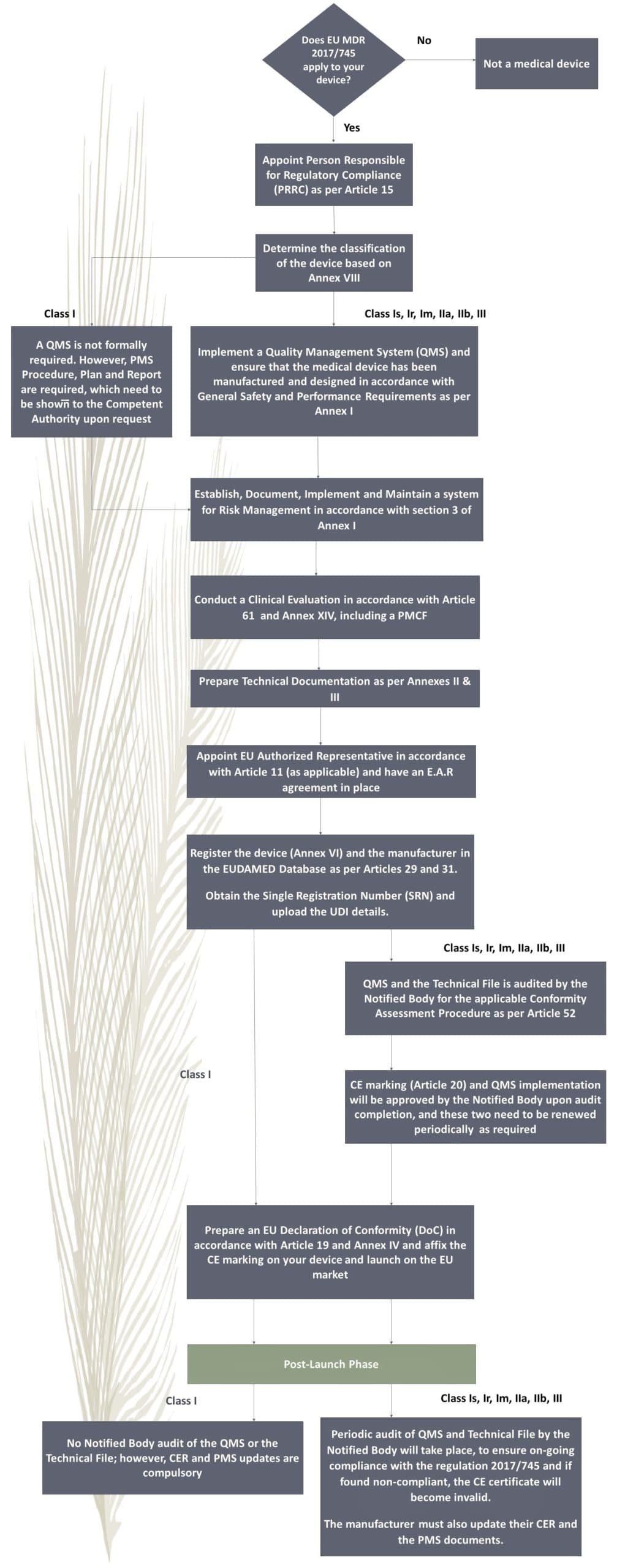
EU MDR 2017/745 Process Flow Chart
The flow chart shows the main steps to CE mark a device under MDR 2017/745. The order is the same for every class; the notified body steps apply to class Is, Im, Ir and above.
- Confirm qualification and classCheck the product meets the medical device definition and apply the Annex VIII rules.
- Set up the QMSImplement an MDR quality management system, usually to EN ISO 13485.
- Appoint key rolesName a PRRC and, for non-EU manufacturers, an EU authorised representative.
- Build the technical documentationPrepare the Annex II and III files, including risk management and clinical evaluation.
- Apply to a notified bodyChoose a notified body with the right scope and sign an agreement.
- Pass the audit and file reviewClose findings from the QMS audit and the technical documentation assessment.
- Declare conformity and CE markSign the EU declaration of conformity, affix the CE mark and register in EUDAMED.
- Maintain complianceRun PMS, PMCF and vigilance, and update the documentation when anything changes.
For timings and fees at each step, see the CE marking process and CE certification cost.
Conformity assessment
What Role Do Notified Bodies Play Under the MDR?
Notified bodies are independent organisations designated by EU Member States to assess class Is, Im, Ir, IIa, IIb and III devices. Designated bodies and their scopes are listed in the European Commission’s NANDO database.
- Assessment routes: Annex IX (QMS and technical documentation assessment), or Annex X type examination combined with Annex XI production quality assurance or product verification.
- Class III and class IIb implantable devices: the technical documentation is assessed for every device.
- Some high-risk devices: the clinical evaluation goes through a consultation with an EU expert panel (Article 54).
- Surveillance: annual surveillance audits, plus unannounced audits at least once every five years.
Capacity is limited and reviews take time, so apply early. Compare options in our list of MDR and IVDR notified bodies.
EUDAMED and UDI
What Do EUDAMED and UDI Mean for Manufacturers in 2026?
EUDAMED is the European database on medical devices. Commission Decision (EU) 2025/2371, published on 27 November 2025, confirmed that four of its six modules work as intended. Using them became mandatory on 28 May 2026.
| EUDAMED module | Status |
|---|---|
| Actor registration | Mandatory since 28 May 2026 |
| UDI and device registration | Mandatory since 28 May 2026. Devices already on the market must be registered by 28 November 2026. |
| Notified bodies and certificates | Mandatory since 28 May 2026. Earlier certificates must be added by 28 May 2027. |
| Market surveillance | Mandatory since 28 May 2026 |
| Vigilance and post-market surveillance | Not yet mandatory |
| Clinical investigations | Not yet mandatory |
Deadline: if your devices were on the EU market before 28 May 2026 and are still being sold, register them in EUDAMED by 28 November 2026. Our team handles EUDAMED registration and UDI assignment.
What’s next
Is the EU MDR Changing?
Yes, but not yet. On 16 December 2025 the European Commission adopted a targeted revision of the MDR and IVDR, COM(2025) 1023 (procedure 2025/0404(COD)), to simplify the rules and reduce the burden on manufacturers and notified bodies. Key proposed changes for the MDR include:
- Removing the five-year maximum validity of notified body certificates, with risk-based periodic reassessment instead.
- More risk-based sampling of technical documentation for certain class IIa and IIb devices.
- A new “well-established technology” concept with lighter requirements for proven devices.
- Clearer rules on which device and QMS changes need prior notified body approval.
Status (November 2026): the proposal is still being negotiated by the European Parliament and the Council under the ordinary legislative procedure. No amending regulation has been adopted, so MDR 2017/745 and its current transition deadlines apply as they stand.
Our advice: plan against the current MDR text. Follow the proposal, but do not delay certification work or transition deadlines in the hope of future changes.
Common gaps
Why Do Manufacturers Struggle With MDR Compliance?
Most findings from notified bodies come from a small set of recurring problems.
- Clinical evidence that relies on weak equivalence claims or old literature.
- Technical documentation still structured for the MDD, with no clear GSPR mapping.
- PMS plans that do not define data sources, indicators or PMCF activities.
- Risk management, clinical evaluation and labelling that do not match each other.
- Missing or incorrect UDI assignment and EUDAMED registration.
- Late applications to notified bodies, leaving little time before the 2027 and 2028 deadlines.
Check your own file with our MDR technical file gap analysis checklist.
Our services
How Does I3CGLOBAL Help With the EU MDR?
I3CGLOBAL supports manufacturers worldwide from classification to certification and post-market compliance. For full project support, see our EU MDR consultants.
MDR gap assessment
Review MDD files and your QMS against MDR 2017/745.
Technical documentation
Prepare Annex II and III files and GSPR checklists.
Clinical evaluation
Write clinical evaluation plans and reports, and PMCF plans.
Notified body support
Choose a notified body, prepare for audits and answer findings.
EU representative and PRRC
Act as your EU authorised representative and support PRRC duties.
EUDAMED and UDI
Register actors and devices and assign UDI.
Work with I3CGLOBAL
Plan Your EU MDR 2017/745 Certification
Tell us about your device, its class and your current certificates, and our team will suggest the next step.
- MDR classification and conformity route
- MDD to MDR transition plan
- Technical documentation and clinical evaluation
- Notified body audit support
Request your proposal
Share your device details and we will prepare an MDR proposal.
FAQs
EU MDR Regulation: Frequently Asked Questions
What is the EU MDR?
The EU MDR is Regulation (EU) 2017/745, the law that governs medical devices on the EU market. It has applied since 26 May 2021 and replaced the MDD 93/42/EEC and the AIMDD 90/385/EEC.
Is there a difference between the MDR and MDR 2017/745?
No. 2017/745 is the official number of the EU Medical Device Regulation, so MDR, EU MDR and MDR 2017/745 all describe the same law.
When did the MDR replace the MDD?
The MDR applied from 26 May 2021. Legacy MDD certificates may still be used until 31 December 2027 or 31 December 2028, depending on the device class, if the conditions of Regulation (EU) 2023/607 are met.
Does the MDR apply to manufacturers outside the EU?
Yes. Any manufacturer placing devices on the EU market must comply. Manufacturers based outside the EU must also appoint an EU authorised representative.
Do class I devices need a notified body under the MDR?
Not usually. Class I manufacturers self-declare conformity. Sterile (Is), measuring (Im) and reusable surgical instrument (Ir) devices need a notified body for those aspects.
Is the MDR the same as the IVDR?
No. In vitro diagnostic devices are covered by a separate regulation, the IVDR 2017/746, which has its own classification rules and timelines.
Is EUDAMED registration mandatory under the MDR?
Yes, for the actor, UDI and device, notified body and certificate, and market surveillance modules since 28 May 2026. Devices already on the market must be registered by 28 November 2026.
How long does MDR certification take?
It often takes 12 to 18 months or longer. The time depends on the device class, how ready the documentation is and the notified body’s workload.
Is the EU MDR being simplified?
The European Commission proposed a targeted revision in December 2025. It must be agreed by the European Parliament and the Council before it applies, so the current MDR remains in force.