
MHRA Registration for Medical Devices and IVDs
MHRA registration is the legal requirement to register every medical device and in vitro diagnostic device with the Medicines and Healthcare products Regulatory Agency before it is placed on the Great Britain market. Registration is made in the MHRA’s Device Online Registration System (DORS), applies to UKCA-marked and CE-marked devices alike, and since 1 April 2026 carries an annual fee of GBP 300 for each GMDN Level 2 category. Manufacturers outside the UK cannot register themselves: their UK Responsible Person submits and maintains the registration. This guide explains who must register, the DORS process step by step, the documents required, the 2026 fee model, timelines and the different rules for Northern Ireland.
Definition
What Is MHRA Registration?
MHRA registration is the formal notification to the UK regulator that a device is being placed on the market in England, Scotland and Wales. It is required by Part II of the Medical Devices Regulations 2002 (UK MDR 2002) as amended after the UK left the EU, and has applied to all device classes since the transitional registration deadlines ended on 1 July 2023. The MHRA is the competent authority for medical devices, IVDs and medicines in the UK and runs market surveillance, vigilance and enforcement for Great Britain.
Registration is not approval. The MHRA does not review the design or the clinical evidence when it registers a device; it records who the manufacturer is, which devices are on the market under which GMDN terms and which conformity route was used. Conformity assessment, whether UKCA marking or accepted CE marking, must be complete before registration, and manufacturers may not use the MHRA logo or describe a registered device as MHRA approved. Registered manufacturers and devices are published in the Public Access Registration Database (PARD).
Scope
Who Must Complete MHRA Registration?
UK MDR 2002 places the registration duty on the person who places the device on the market under their own name. For a manufacturer established in the UK that is the manufacturer itself. For a manufacturer outside the UK it is the UK Responsible Person, who registers from its own DORS account on the manufacturer’s behalf. Only one account may exist per organisation, and a foreign manufacturer cannot hold one.
| Who | Devices covered | Registers in DORS as |
|---|---|---|
| UK-based manufacturer | All classes of general medical devices, active implantable devices and IVDs | Manufacturer |
| Manufacturer outside the UK | All classes; the UKRP registers each device | UK Responsible Person on behalf of the manufacturer |
| Own-brand labeller or rebrander | Devices placed on the market under its own name or trademark | Manufacturer |
| Assembler of systems or procedure packs | Packs containing CE or UKCA marked devices combined for a medical purpose | Manufacturer of the pack |
| Manufacturer of custom-made devices | Devices made to a written prescription for a named patient | Manufacturer or UKRP, with a custom-made statement |
| Importer of IVDs for performance evaluation | IVDs supplied in Great Britain for performance studies | Importer |
Distributors and importers that do not place devices on the market under their own name do not register in DORS, but since 16 June 2025 they have their own obligations under the Great Britain post-market surveillance regulations, including keeping records of the devices they supply and passing on complaints to the manufacturer or UKRP.
Process
How Does MHRA Registration Work in DORS? Eight Steps
The steps below describe a first registration by a UK Responsible Person for a manufacturer outside the UK. A UK manufacturer follows the same steps without step two.
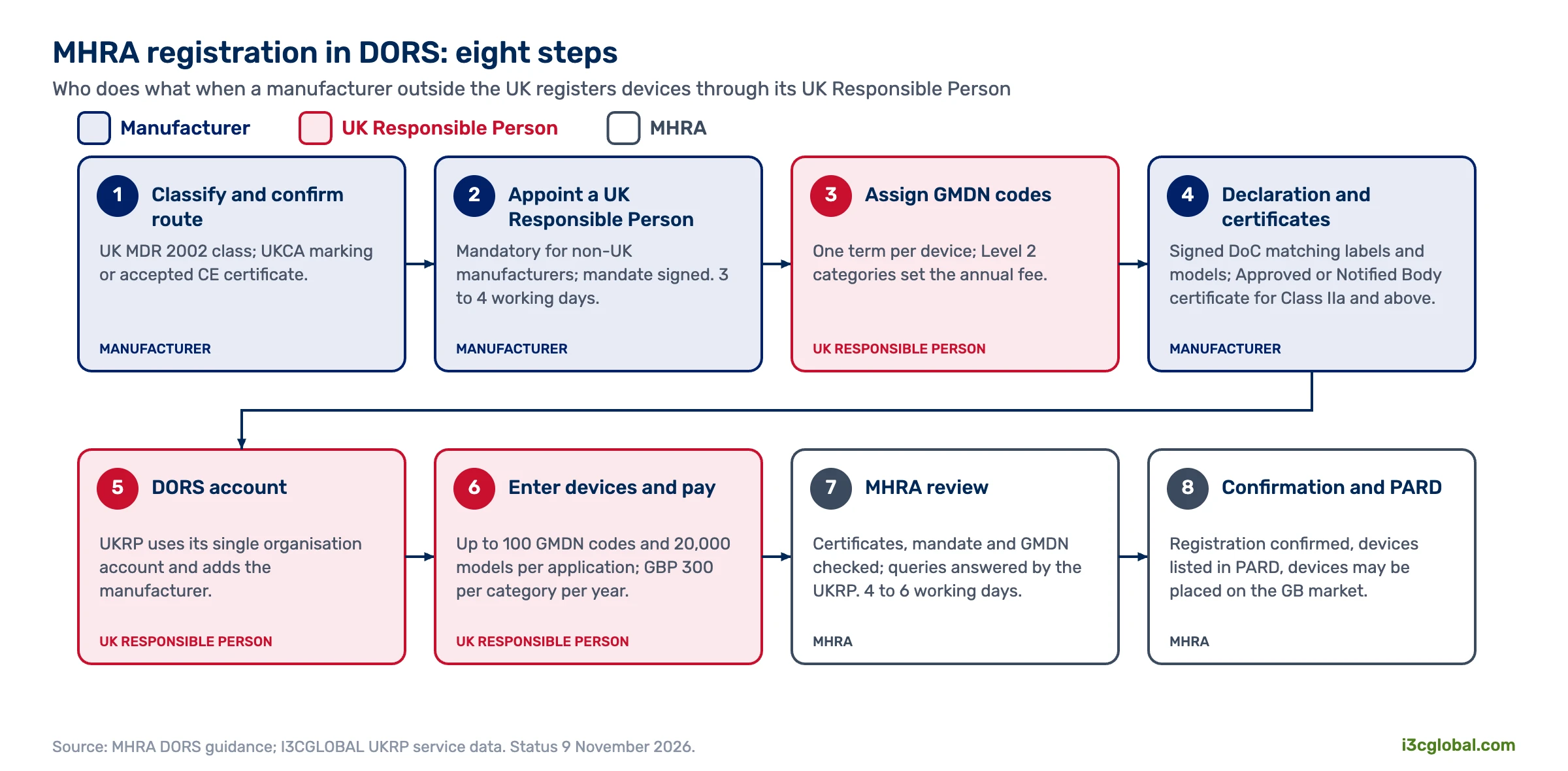
- Classify the device and confirm the conformity routeApply the UK MDR 2002 classification rules and confirm whether the device will rely on UKCA marking or on an accepted CE certificate. Our classification guide covers the rules.
- Appoint a UK Responsible PersonMandatory for every manufacturer outside the UK. The signed mandate is uploaded to DORS. I3CGLOBAL completes this step in 3 to 4 working days.
- Assign GMDN codesEach device needs a Global Medical Device Nomenclature term. The Level 2 category of each GMDN term decides the number of annual fees, so accurate coding matters; I3CGLOBAL identifies GMDN codes at no extra charge.
- Prepare the declaration of conformity and certificatesThe declaration must match the labels, models and GMDN terms exactly. Class IIa and above, and higher-risk IVDs, also need the UK Approved Body or EU Notified Body certificate.
- Create or access the DORS accountThe UKRP uses its single organisation account and adds the manufacturer as a represented organisation with the legal name and address shown on the labels.
- Enter the devices and pay the feeDevices are added individually or by bulk spreadsheet; one application can contain up to 100 GMDN codes and 20,000 product models. The statutory fee is paid in DORS by card or invoice.
- MHRA reviewThe MHRA checks the certificate validity, the mandate, the GMDN terms and the consistency of the data. Queries are raised in DORS and answered by the UKRP. A complete submission is typically confirmed in 4 to 6 working days.
- Confirmation and PARD listingThe registration is confirmed, the manufacturer and devices appear in PARD and the devices may be placed on the Great Britain market. The UKRP keeps the record current and pays the annual fee each year.
Documentation
What Information Does MHRA Registration Require?
DORS asks for manufacturer, device and conformity data. The MHRA compares the entries with the uploaded certificates and declaration, so the registration must use the exact legal name, trade names and models that appear on the labelling.
| Information or document | Notes | Status |
|---|---|---|
| Legal manufacturer name, address, telephone and email | Must match the device label | Required |
| Contact person for MHRA communications | Usually the UKRP for non-UK manufacturers | Required |
| Signed UKRP mandate (Letter of Designation) | Non-UK manufacturers only | Conditional |
| Activity of the registering organisation | Manufacturer, UKRP, system or procedure pack assembler, importer | Required |
| Device trade name, models and versions | Bulk spreadsheet accepted for large catalogues | Required |
| GMDN code and term for each device | Determines the Level 2 categories and the annual fee | Required |
| Risk class and conformity assessment route | UK MDR 2002 class, UKCA or CE route | Required |
| UK Approved Body or Notified Body name, number and certificate | Class I sterile or measuring, IIa, IIb, III and higher-risk IVDs | Conditional |
| Signed and dated declaration of conformity | Current revision referencing UK MDR 2002 or EU MDR/IVDR | Required |
| Sterilisation method, latex and phthalate information, MRI compatibility | Where applicable | Conditional |
| Instructions for use or catalogue reference | English language | Required |
| Basic UDI-DI | Not yet mandatory in Great Britain | Recommended |
The technical file is not uploaded to DORS, but the UKRP must hold it or have guaranteed access so that it can be produced for the MHRA on request.
Costs
What Is the MHRA Registration Fee in 2026?
The MHRA changed its device registration fee model on 1 April 2026. Until 31 March 2026 the fee was a one-off GBP 261 per application. From 1 April 2026 the fee is an annual charge of GBP 300 for each GMDN Level 2 category in which a manufacturer has registered devices, calculated on the categories held on 31 March each year and invoiced for the fee year starting 1 April. New registrations made during the year are charged pro rata for the remaining months. For 2026/27 the first annual invoices were due on 6 November 2026 and are paid through DORS.
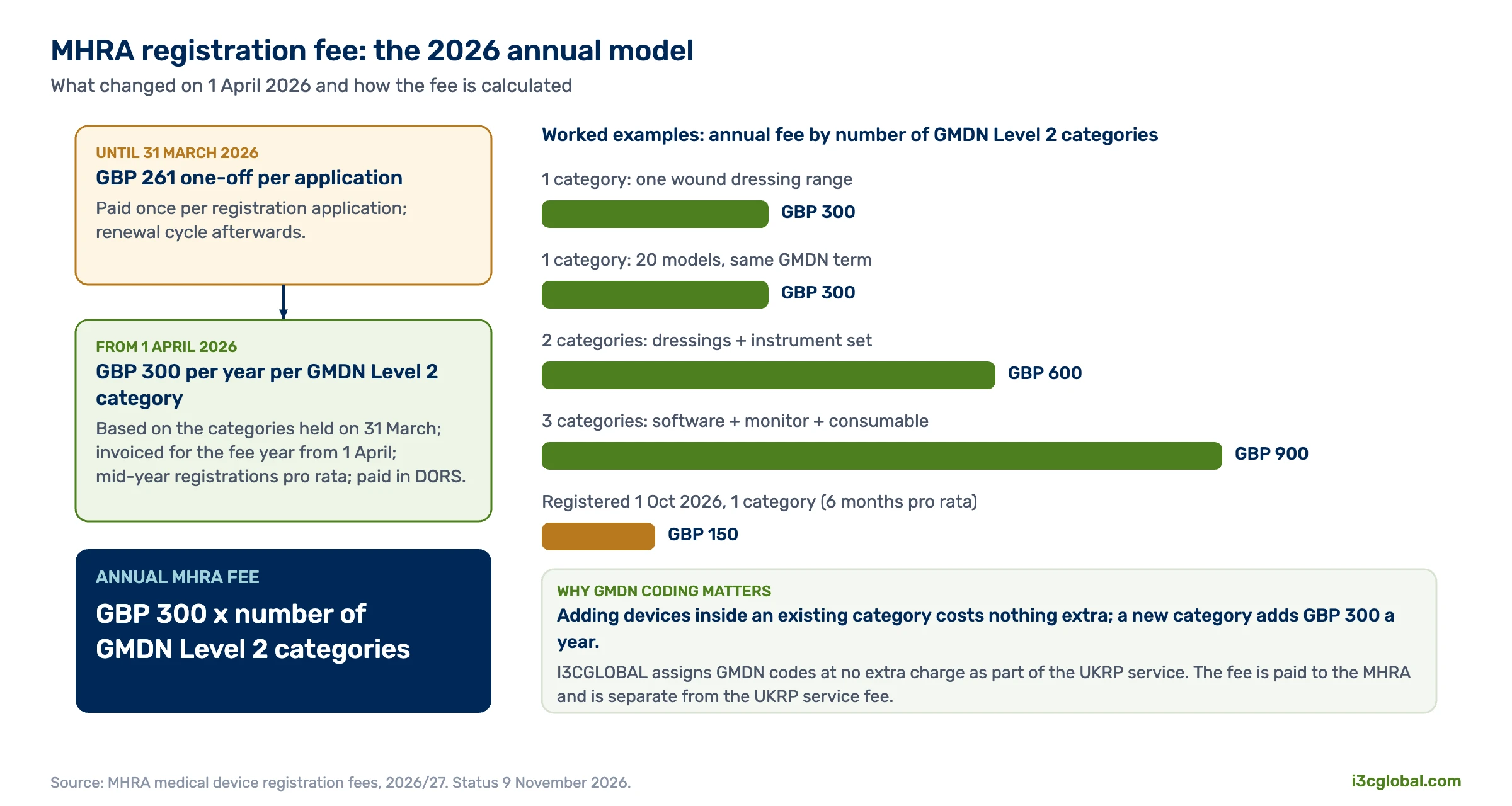
| Scenario | GMDN Level 2 categories | Annual MHRA fee |
|---|---|---|
| One wound dressing range | 1 | GBP 300 |
| Dressings plus a surgical instrument set | 2 | GBP 600 |
| Twenty models that all fall under one GMDN category | 1 | GBP 300 |
| Software, a monitor and a consumable in three categories | 3 | GBP 900 |
| Device registered on 1 October 2026 in one category | 1 | GBP 150 (pro rata for six months), then GBP 300 per year |
The fee is a statutory fee paid to the MHRA and is separate from the UK Responsible Person’s service fee. Because the number of Level 2 categories drives the cost, accurate GMDN coding at registration directly affects what a manufacturer pays every year. Current UKRP service fee bands and a combined calculator are on our UKRP fee and MHRA fee page.
Timelines
How Long Does MHRA Registration Take?
The MHRA’s published target for assessing a registration is five working days; I3CGLOBAL’s experience is four to six working days for a complete submission. The total time from first contact to a confirmed registration depends almost entirely on how quickly the manufacturer can supply consistent documents.
| Stage | Typical duration | Depends on |
|---|---|---|
| UKRP agreement and appointment | 3 to 4 working days | Signature and company documents |
| Document review and GMDN coding | 2 to 5 working days | Declaration of conformity, certificates and labels matching |
| DORS data entry and fee payment | 1 to 2 working days | Number of devices; bulk upload for large catalogues |
| MHRA review and confirmation | 4 to 6 working days | Completeness; queries add a few days each |
| Total with documents ready | About 2 to 3 weeks | Most delays come from incomplete or inconsistent DORS submissions |
Maintenance
What Happens After MHRA Registration?
Once confirmed, the registration stays valid for as long as the annual fee is paid and the information is kept current. There is no periodic re-registration; the previous renewal cycle was replaced by the annual fee model in April 2026. The UK Responsible Person is responsible for keeping the record accurate.
PARD listing
The manufacturer, UKRP and device GMDN terms are published in the Public Access Registration Database, which distributors, hospitals and customs use to verify that a device is lawfully on the market.
Changes to the registration
New models, new GMDN terms, certificate renewals, address changes and label changes must be updated in DORS. Adding a device in an existing Level 2 category does not add an annual fee; a new category does.
Annual fee payment
The MHRA invoices the fee for the categories held on 31 March. Unpaid fees lead to removal of the registration, after which devices cannot lawfully be supplied until a new registration is made.
Deregistration
Discontinued devices should be removed so that they do not attract the fee and do not mislead PARD users. A change of UKRP is treated as a new registration under the new UKRP’s account.
Post-market
Which Post-Market Obligations Follow MHRA Registration?
Registration is the start of the manufacturer’s relationship with the MHRA, not the end. The Medical Devices (Post-market Surveillance Requirements) (Amendment) (Great Britain) Regulations 2024 (SI 2024/1368) have applied since 16 June 2025 and require every manufacturer with devices in Great Britain to run a documented post-market surveillance system.
- A post-market surveillance plan for every device, with data collection proportionate to the risk class.
- Periodic safety update reports for Class IIa and above and for higher-risk IVDs, and a PMS report for Class I and general IVDs.
- Serious incident reporting to the MHRA through the MORE portal within 15 days, 10 days for serious public health threats and 2 days for deaths or unanticipated serious deteriorations in health.
- Field safety corrective actions and field safety notices reported to the MHRA before or at the time they are implemented.
- Trend reporting of non-serious incidents and expected side effects.
I3CGLOBAL prepares post-market surveillance plans and reports and supports MORE portal reporting as part of its UKRP service.
Territories
MHRA Registration in Great Britain vs Northern Ireland
The United Kingdom has two device regimes. Great Britain follows UK MDR 2002 and registers in DORS; Northern Ireland follows EU MDR and IVDR under the Windsor Framework and, from 28 May 2026, registers in EUDAMED. The MHRA remains the competent authority for both, but the registration route, the representative and the conformity mark differ.
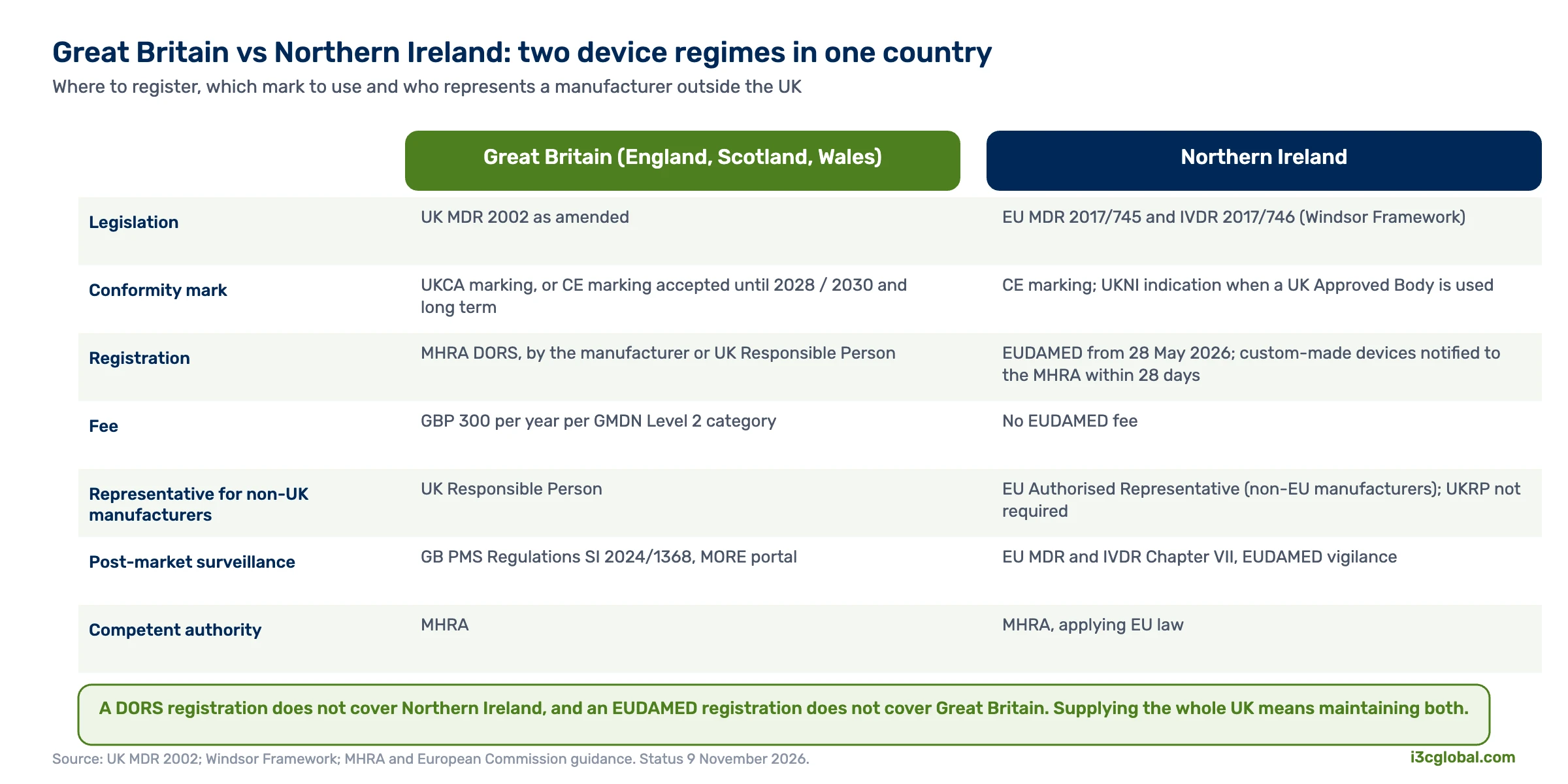
UK MDR 2002. UKCA marking or accepted CE marking. Registration in MHRA DORS by the manufacturer or UK Responsible Person, with the annual fee per GMDN category. Great Britain PMS Regulations apply.
EU MDR 2017/745 and IVDR 2017/746. CE marking, with the UKNI indication where a UK Approved Body is used. Registration in EUDAMED from 28 May 2026; custom-made devices still notified to the MHRA within 28 days. Non-EU manufacturers appoint an EU Authorised Representative.
A device registered in DORS for Great Britain is not registered for Northern Ireland, and an EUDAMED registration does not cover Great Britain. Manufacturers supplying the whole UK therefore maintain both.
Getting started
How Do You Start MHRA Registration with I3CGLOBAL?
Four steps, and you only need to act in the first three. From a complete set of documents to a confirmed registration normally takes about two weeks.
- 1
Send us your device listUse the proposal request form or email the device names, classes and any certificates. Within one working day we confirm the UKRP fee, the MHRA fee for your GMDN categories and the documents we need.
- 2
Sign the UKRP agreement and payThe agreement doubles as the Letter of Designation for DORS. Payment is made in advance by bank transfer, PayPal or card; the appointment is complete in 3 to 4 working days.
- 3
Send the documentsSigned declaration of conformity, certificates, labels and instructions for use, company registration certificate and a contact person. We review them, assign GMDN codes and fix inconsistencies before anything reaches the MHRA.
- 4
We register, you receive the confirmationWe enter the devices in DORS, pay the statutory fee and answer any MHRA queries. You receive the confirmation and the PARD listing, usually 4 to 6 working days after submission, and can start selling in Great Britain.
Work with I3CGLOBAL
How Does I3CGLOBAL’s MHRA Registration Service Work?
I3CGLOBAL’s UK company is listed in DORS as an active UK Responsible Person and has completed MHRA registration for manufacturers in more than 30 countries. We handle the registration end to end and stay responsible for the record for as long as we are your UKRP.
- Document review before submission so the MHRA receives a consistent declaration, certificates and labels
- GMDN code identification included, which also minimises the number of Level 2 categories charged each year
- DORS data entry, fee payment, response to MHRA queries and confirmation within about two weeks of complete documents
- Annual fee reminders, registration updates and deregistration of discontinued devices
- Post-market surveillance plans, PSURs and MORE portal reporting support
- UK Free Sale Certificates ordered from the MHRA for export, once your devices are registered in DORS
Start your MHRA registration
Send us your device list, classes and certificates and we will confirm the fee, the documents needed and the timeline within one working day.
FAQs
MHRA Registration: Frequently Asked Questions
What is MHRA registration for medical devices?
MHRA registration is the mandatory notification of a medical device or IVD to the Medicines and Healthcare products Regulatory Agency before it is placed on the Great Britain market, made through the Device Online Registration System (DORS). It records the manufacturer, the UK Responsible Person, the devices and their GMDN terms and the conformity route. It is not an approval of the device.
Do CE-marked devices need MHRA registration?
Yes. CE marking is accepted in Great Britain, but every device placed on the Great Britain market must be registered in DORS regardless of whether it carries UKCA or CE marking. Recognition of the CE mark does not remove the registration or UK Responsible Person requirements.
How much is the MHRA registration fee in 2026?
From 1 April 2026 the MHRA charges an annual fee of GBP 300 for each GMDN Level 2 category in which a manufacturer has registered devices, based on the categories held on 31 March and charged pro rata for registrations made during the year. This replaced the one-off GBP 261 application fee that applied until 31 March 2026.
How long does MHRA registration take?
The MHRA's target for assessing a submission is five working days, and I3CGLOBAL typically sees confirmation within four to six working days of a complete submission. Including UK Responsible Person appointment and document review, most manufacturers are registered within two to three weeks of providing consistent documents.
Can a foreign manufacturer register directly with the MHRA?
No. Manufacturers outside the UK cannot hold a DORS account. They must appoint a UK Responsible Person established in the UK, who registers the manufacturer and devices from its own account and maintains the registration.
What is DORS?
DORS is the MHRA Device Online Registration System, the portal through which manufacturers and UK Responsible Persons register devices, update records, deregister devices and pay the statutory fee. Registered data is published in the Public Access Registration Database (PARD).
Does MHRA registration need to be renewed?
Not in the previous sense. Since 1 April 2026 registration remains valid while the annual fee is paid and the record is kept current. If the fee is not paid the MHRA removes the registration and a new application with the fee is needed before supply can resume.
What is a GMDN code and why does it matter for MHRA registration?
The Global Medical Device Nomenclature code is the standard term that describes a device's type. Every device registered in DORS needs one, and the GMDN Level 2 category of each term determines how many annual fees of GBP 300 a manufacturer pays. I3CGLOBAL identifies GMDN codes for its UKRP clients at no extra charge.
Is MHRA registration the same as MHRA approval?
No. The MHRA does not approve devices at registration and manufacturers may not claim MHRA approval or use the MHRA logo. Conformity is demonstrated by UKCA marking or an accepted CE mark; registration simply records the device and its manufacturer with the regulator.
Does MHRA registration cover Northern Ireland?
No. DORS registration covers Great Britain only. Devices for Northern Ireland follow EU MDR and IVDR and are registered in EUDAMED from 28 May 2026, except custom-made devices, which are still notified to the MHRA. Non-EU manufacturers need an EU Authorised Representative for Northern Ireland.
What happens if I change my UK Responsible Person?
The MHRA treats a change of UKRP as a new registration. The new UKRP registers the manufacturer and devices from its own DORS account and pays the statutory fee, and the former UKRP deregisters the devices. Keep the old mandate in force until the new registration is confirmed.
Is I3CGLOBAL approved by the MHRA to register devices?
The MHRA does not approve or accredit UK Responsible Persons. I3CGLOBAL's UK company is a registered UK business listed in DORS as an active UKRP, and our status can be verified on our UK verification page.