
IVDR Class A Sterile Devices
IVDR Class A sterile devices are low-risk in vitro diagnostic devices that are placed on the market in a sterile state. They sit in the lowest risk class under Rule 5, but unlike non-sterile Class A products they cannot be fully self-declared: a notified body must assess the aspects related to establishing, securing and maintaining sterile conditions. This guide explains the requirements, the conformity assessment route, the 2029 transition deadline and how I3CGlobal supports sterile IVD manufacturers.
What is an IVDR Class A Sterile Device?
A Class A sterile device is a Rule 5 product, such as a specimen receptacle, culture medium or laboratory accessory, that the manufacturer supplies sterile. The risk class stays A, but the sterile state brings additional safety requirements and notified body oversight.
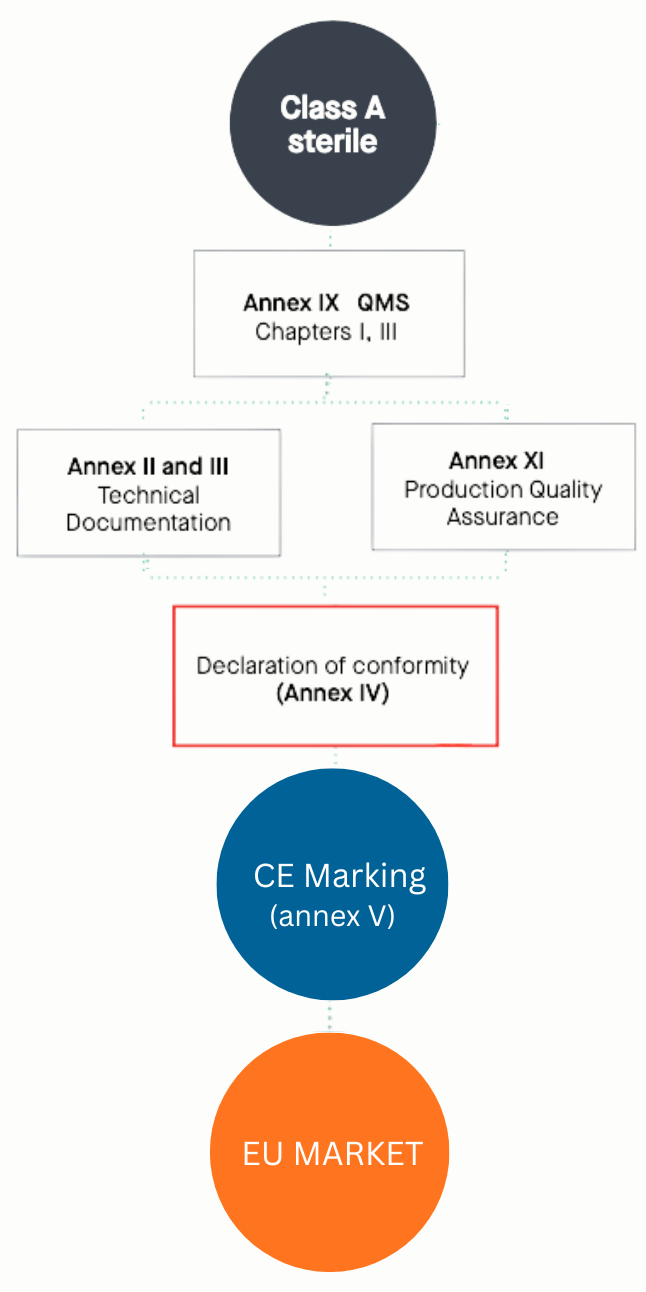
Under Article 48(9) of Regulation (EU) 2017/746, manufacturers of Class A devices placed on the market in sterile condition follow either:
- Annex IX (quality management system and technical documentation assessment), or
- Annex XI (production quality assurance).
In both cases the notified body’s involvement is limited to the aspects of manufacture concerned with securing and maintaining sterile conditions. The rest of the device is covered by the manufacturer’s own declaration of conformity, so the full technical documentation must still be complete. For the non-sterile version of the same product, see IVDR Class A.
Typical IVDR Class A Sterile Devices
These products are commonly placed in IVDR Class A sterile. The final class depends on the intended purpose in the labelling and instructions for use.
Sterile specimen containers
Sterile urine, sputum and stool containers intended to hold and preserve human specimens for IVD examination.
Swab and transport systems
Sterile swabs with transport tubes or media used to collect and preserve specimens for laboratory testing.
Evacuated blood collection tubes
Sterile blood collection tubes with or without additives intended for IVD specimen collection.
Sterile culture media
General and transport culture media supplied sterile for microbiological IVD procedures.
Sterile laboratory accessories
Sterile pipettes, loops, Petri dishes and sample cups intended for use with a specific IVD procedure.
Sterile kit components
Sterile collection components supplied in a Class A kit where the kit itself has no higher-class reagent.
Key Requirements for IVDR Class A Sterile Certification
Manufacturers must meet the Annex I GSPRs, run an EN ISO 13485 QMS aligned with the IVDR and prepare complete Annex II and III technical documentation. On top of the usual Class A content, the file must prove sterility assurance.
Sterilisation validation
Validated sterilisation process and routine control to the relevant standard, for example EN ISO 11135 (ethylene oxide), EN ISO 11137 (radiation) or EN ISO 17665 (moist heat).
Sterile barrier & packaging
Packaging validation to EN ISO 11607-1 and -2, with seal strength, integrity and transport testing of the sterile barrier system.
Shelf life & stability
Real-time or accelerated ageing data supporting the expiry date for sterility, packaging and device performance.
Bioburden & environment
Bioburden and, where relevant, endotoxin testing, cleanroom or controlled environment monitoring and batch release criteria.
Technical documentation (Annex II & III)
Device description, design and manufacturing, GSPR checklist, risk management (ISO 14971), performance evaluation and PMS. See IVDR technical documentation.
Labelling, UDI & EUDAMED
Sterile symbols and sterilisation method on the label, IVDR-compliant IFU, UDI assignment and EUDAMED registration.
IVDR Class A Sterile Conformity Assessment Route
The manufacturer chooses Annex IX or Annex XI. Either way, the notified body looks only at sterility. It does not review the device’s performance evaluation or general design.
Annex IX route
- QMS audit focused on processes that establish and maintain sterility
- Review of sterilisation validation, packaging validation and environmental controls
- Surveillance audits over the certificate cycle
Annex XI route
- Production quality assurance audit of the manufacturing site
- Assessment of sterile production, batch release and routine monitoring
- Suits manufacturers whose main risk sits in production rather than design
Where a manufacturer has several sterile products using the same sterilisation process and packaging, the notified body may assess a representative product. If materials, processes, packaging or intended use differ, expect each to be reviewed separately. After certification the manufacturer signs the declaration of conformity and applies the CE mark with the notified body number.
How to CE Mark an IVDR Class A Sterile Device, Step by Step
- Confirm the classDocument the Annex VIII rationale showing Rule 5 applies and the device is supplied sterile.
- Validate sterilityComplete sterilisation, packaging and shelf-life validations, with bioburden and environmental monitoring in place.
- Upgrade the QMSAlign your EN ISO 13485 system with the IVDR, including PMS, vigilance, UDI and a PRRC.
- Build the technical documentationCompile Annex II and III documentation, the GSPR checklist, risk management file and performance evaluation.
- Apply to a notified bodyChoose Annex IX or Annex XI and complete the sterility-focused assessment.
- Declare conformity and registerSign the declaration of conformity, apply the CE mark with the NB number and register in EUDAMED.
Common Gaps in IVDR Class A Sterile Files
Outdated sterilisation validation
Validation reports older than the current process, product family or load configuration, with no requalification.
Packaging not validated
No transport simulation or ageing data for the sterile barrier system, or validation done on a different packaging format.
Weak shelf-life claims
Accelerated ageing without real-time confirmation, or expiry dates that do not match the stability evidence.
Supplier control
Outsourced sterilisation without a quality agreement, audit evidence or batch release review.
Risk management gaps
Loss of sterility and its effect on results not analysed, or controls not traced to validation evidence.
PMS not planned
No PMS plan or report covering sterility complaints, packaging failures and trend reporting.
IVDR Class A Sterile Transition Deadlines
Sterile devices that were self-declared under the IVD Directive now need a notified body for the sterility aspects. Regulation (EU) 2024/1860 gives these legacy devices the same extended timeline as Class B, provided they had a valid IVDD declaration of conformity before 26 May 2022:
| Milestone | Deadline | What it means |
|---|---|---|
| QMS aligned with the IVDR | 26 May 2025 | Your EN ISO 13485 system must already meet IVDR requirements. |
| Formal application lodged with a notified body | 26 May 2027 | The application for Annex IX or Annex XI assessment must be submitted. |
| Written agreement signed with the notified body | 26 September 2027 | A signed contract covering the devices in the application. |
| End of transition | 31 December 2029 | Legacy sterile Class A devices may be placed on the market until this date if the conditions are met. |
IVDR Class A Sterile Compared with Class A and Class B
| Class A | Class A sterile | Class B | |
|---|---|---|---|
| Notified body | No: self-declaration | Yes, sterility aspects only | Yes: QMS audit plus sampled technical documentation |
| Route | Article 48(10) | Article 48(9): Annex IX or Annex XI | Annex IX, or Annex X + XI |
| Extra evidence | None beyond core IVDR file | Sterilisation, packaging and shelf-life validation | Full performance evaluation reviewed by NB |
| Legacy device deadline | None | 31 December 2029 | 31 December 2029 |
Do you need an email containing full details about IVDR Class A Sterile within 2 minutes? Share your email below. Privacy Policy
One Partner for Everything IVDR Class A Sterile
Regulatory guidance and product technical support combined. We prepare your documentation, coordinate with the notified body on the sterility assessment, and stay with you after the CE mark.
- Sterilisation and packaging validation review
- Technical documentation and performance evaluation
- QMS upgrade to IVDR and PRRC support
- Notified body application, audit and query support
IVDR Class A Sterile: Frequently Asked Questions
Does a Class A sterile device need a notified body?
Yes, but only for the aspects related to establishing, securing and maintaining sterile conditions. The rest of the device is covered by the manufacturer’s declaration of conformity.
Which conformity assessment route applies?
Article 48(9) lets the manufacturer choose Annex IX or Annex XI. The notified body’s involvement is limited to sterility in both routes.
Is sampling applicable during the notified body review?
It may be. If several devices share the same sterilisation process, packaging and controls, the notified body may assess a representative product. Differences in materials, process, packaging or intended use usually mean separate review.
What is the transition deadline for legacy Class A sterile devices?
31 December 2029, provided the device had a valid IVDD declaration of conformity before 26 May 2022, the QMS was IVDR-aligned by 26 May 2025, an application is lodged by 26 May 2027 and a written agreement is signed by 26 September 2027.
What are common challenges in Class A sterile submissions?
Gaps usually arise in sterilisation validation, packaging validation, shelf-life evidence, PMS planning, risk management traceability and labelling.
Can I3CGlobal help with IVDR Class A sterile certification?
Yes. We support technical file preparation, sterilisation validation review, notified body communication, labelling review, EU authorised representative services and EUDAMED registration.
Updated | Author: Sobha Augustine, Founder, I3CGLOBAL | Reviewed by: Swathi Tummala, Senior Regulatory Consultant, I3CGLOBAL