
IVDR Class A Devices
IVDR Class A is the lowest risk class for in vitro diagnostic devices under Regulation (EU) 2017/746. It covers general laboratory products, IVD instruments, specimen receptacles and similar items under Rule 5. Non-sterile Class A devices are self-declared by the manufacturer without a notified body, but the full IVDR still applies: technical documentation, performance evaluation, a QMS, UDI, EUDAMED and post-market surveillance. This guide explains what that means in practice and how I3CGlobal helps you get there quickly.
What is an IVDR Class A Device?
Under the IVDR, in vitro diagnostic devices are placed in four risk classes, A to D. IVDR Class A devices present a low risk to the individual patient and a low risk to public health. They usually do not give a diagnostic result on their own; they support an examination that is carried out with other devices or reagents.
Class A comes from Annex VIII, Rule 5, which covers:
- Products for general laboratory use and accessories without critical characteristics, buffer solutions, washing solutions, general culture media and histological stains, when the manufacturer intends them to be suitable for IVD procedures relating to a specific examination.
- Instruments intended by the manufacturer specifically to be used for in vitro diagnostic procedures.
- Specimen receptacles intended to hold and preserve specimens from the human body for IVD examination.
Rule 5 only applies if no higher rule fits. Check Rules 1 to 4, 6 and 7 first on our IVDR classification guide. If your Class A product is placed on the market sterile, see IVDR Class A sterile, because a notified body is then involved.
Typical IVDR Class A Devices
These products are commonly placed in IVDR Class A. The final class always depends on the intended purpose you state in the labelling and instructions for use.
IVD instruments & analysers
Clinical chemistry and immunoassay analysers, PCR cyclers, centrifuges, readers and incubators intended specifically for IVD procedures.
Specimen receptacles
Blood collection tubes, urine and stool containers, swab transport tubes and other receptacles that hold and preserve human specimens.
Buffers & washing solutions
Wash buffers, diluents and system liquids intended for use with IVD procedures, without critical characteristics of their own.
General culture media
Non-selective culture media and transport media used in microbiology laboratories for IVD examinations.
Histological stains
General stains such as haematoxylin and eosin, Gram stain kits and similar reagents for general laboratory use in diagnosis.
Accessories
Pipette tips, cuvettes, slides and sample cups intended by the manufacturer for use with a specific IVD system.
Not sure whether your product is Class A or Class B? Compare with the IVDR Class B guide, or ask our IVDR consultants for a written classification rationale. Instrument software that drives or influences a device is covered in IVDR software classification.
Key Requirements for IVDR Class A Devices
No notified body does not mean fewer obligations. A Class A manufacturer must meet the same core IVDR requirements as other classes and keep the evidence ready for inspection by a competent authority at any time.
GSPR compliance (Annex I)
A GSPR checklist showing how each applicable requirement is met, including electrical safety, EMC and, where relevant, radio and machinery requirements for instruments.
Quality management system
A QMS under Article 10(8), usually based on EN ISO 13485:2016, covering design, production, PMS, vigilance and a person responsible for regulatory compliance (PRRC).
Technical documentation (Annex II & III)
Device description, design and manufacturing information, risk management, verification and validation, labelling and PMS documentation. See our IVDR technical documentation service.
Performance evaluation
Every IVD needs one under Article 56, including Class A. For instruments and accessories it focuses on analytical performance with the reagents they are used with. See performance evaluation report (PER).
Labelling, UDI & EUDAMED
IVDR-compliant labels and IFU, a Basic UDI-DI and UDI for each device (UDI carriers on Class A labels from 26 May 2027), and EUDAMED registration.
Post-market surveillance
A PMS plan and a PMS report under Article 80, updated when necessary, plus vigilance and trend reporting procedures.
IVDR Class A Self-Declaration Route
Under Article 48(10), manufacturers of non-sterile Class A devices declare conformity themselves after drawing up the technical documentation in Annexes II and III. There is no notified body certificate and no notified body number next to the CE mark.
- Prepare the technical documentation and the performance evaluation, and keep them up to date for the lifetime of the device.
- Sign the EU declaration of conformity in line with Annex IV, naming the device, its Basic UDI-DI and the applicable regulation and standards.
- Affix the CE mark on the device or its packaging and in the instructions for use.
- Register the manufacturer and devices in EUDAMED and assign UDIs.
Competent authorities can ask for the technical documentation at any time, and market surveillance checks of Class A files are increasing. A self-declared file must therefore be as complete and well organised as a file reviewed by a notified body.
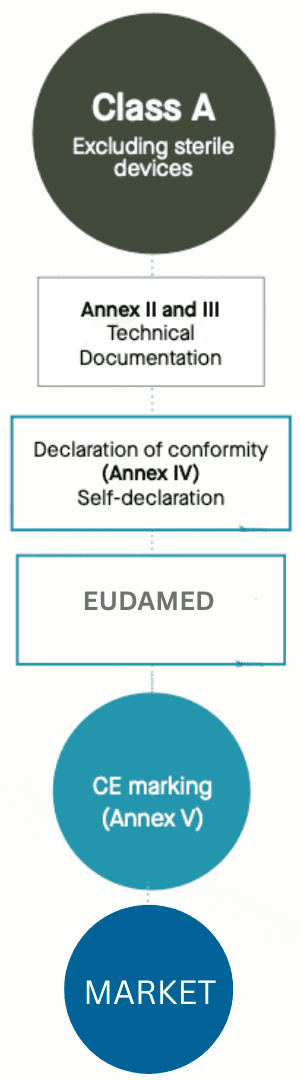
How to CE Mark an IVDR Class A Device, Step by Step
- Confirm the classApply Annex VIII Rules 1 to 7 and document why only Rule 5 applies. Note whether the device is supplied sterile.
- Set up the QMSImplement an EN ISO 13485-based QMS with IVDR procedures and appoint a person responsible for regulatory compliance.
- Build the technical documentationCompile Annex II and III documentation, the GSPR checklist, risk management file, performance evaluation and test reports.
- Appoint an EU authorised representativeRequired for manufacturers outside the EU before devices are placed on the market.
- Declare conformity and CE markSign the Annex IV declaration of conformity and affix the CE mark to the device, packaging and IFU.
- Register and maintainAssign UDIs, register in EUDAMED, then run PMS, vigilance and periodic updates of the technical documentation.
Upgrading IVDD General Devices to IVDR Class A
Most low-risk laboratory products were “general” or “other” devices under the IVD Directive 98/79/EC and were self-declared. Non-sterile Class A devices did not receive an extended transition period: they have had to meet the IVDR in full since 26 May 2022. If your file still follows the IVDD, these are the gaps we close most often:
Missing performance evaluation
The IVDD had no PER requirement for these products. A scientific validity and analytical performance rationale must now be documented.
GSPR instead of Essential Requirements
The old ER checklist must be rewritten against Annex I GSPRs, with current harmonised standards and evidence.
Labelling and IFU
Labels need IVDR content, symbols and UDI. IFU must reflect Annex I Chapter III, including the intended purpose wording.
PMS and vigilance
A PMS plan and PMS report, trend reporting and EUDAMED vigilance processes are now mandatory.
QMS and PRRC
The QMS must cover Article 10 obligations and name a qualified PRRC.
Economic operators
Importers, distributors and the EU authorised representative each have defined IVDR obligations that must be agreed in writing.
IVDR Class A Compared with Class A Sterile and Class B
| Class A | Class A sterile | Class B | |
|---|---|---|---|
| Risk | Low individual, low public | Low individual, low public | Moderate individual, low public |
| Notified body | No: self-declaration | Yes, limited to sterility aspects | Yes: QMS audit plus sampled technical documentation |
| Classification rule | Rule 5 | Rule 5, supplied sterile | Rules 4 (exceptions), 6 and 7 |
| Legacy device deadline | None: IVDR applies since 26 May 2022 | 31 December 2029 | 31 December 2029 |
Need a budget? Our IVDR CE certification cost page gives indicative costs by class.
Do you need an email containing full details about IVDR Class A within 2 minutes? Share your email below. Privacy Policy
One Partner for Everything IVDR Class A
Regulatory guidance and product technical support combined. We prepare your documentation, coordinate with the notified body where one is needed, and stay with you after the CE mark.
- Classification rationale and GSPR checklist
- Technical documentation and performance evaluation
- QMS set-up to IVDR and PRRC support
- EU authorised representative, UDI and EUDAMED registration
Get your Class A device CE marked
Share your device details and get a tailored proposal. See typical IVDR certification costs.
IVDR Class A: Frequently Asked Questions
Does an IVDR Class A device need a notified body?
No, not if it is supplied non-sterile. The manufacturer self-declares conformity under Article 48(10) after preparing the technical documentation. A notified body is only involved for the sterility aspects of Class A sterile devices.
Do we need technical documentation for Class A devices?
Yes. Manufacturers of every IVDR class, including Class A, must draw up and keep up to date technical documentation under Annexes II and III and make it available to competent authorities on request.
Is a performance evaluation required for Class A?
Yes. Article 56 applies to all IVDs. For instruments and general laboratory products the evaluation focuses on analytical performance and on how the device supports the examinations it is used for.
Is there a transition period for Class A devices?
Not for non-sterile Class A devices: they must comply with the IVDR in full since 26 May 2022. Legacy Class A sterile devices can benefit from the extended transition to 31 December 2029 if the conditions of Regulation (EU) 2024/1860 are met.
When are UDI carriers required on Class A labels?
UDI carriers must be placed on the labels of Class A devices from 26 May 2027. The Basic UDI-DI and EUDAMED registration are needed before that.
Can I3CGlobal help with IVDR Class A compliance?
Yes. We provide complete consulting support including technical file preparation, performance evaluation, labelling review, EU authorised representative services and EUDAMED registration.
Updated | Author: Sobha Augustine, Founder, I3CGLOBAL | Reviewed by: Swathi Tummala, Senior Regulatory Consultant, I3CGLOBAL