
Quick Contact
Medical Device Cybersecurity
Medical Device Cybersecurity is no longer a footnote in your regulatory file it is a mandatory safety requirement enforced by the US FDA under Section 524B of the FD&C Act and by the EU MDR / IVDR General Safety and Performance Requirements.
“cyber device” seeking FDA 510(k) clearance, and every connected medical device or IVD seeking CE marking, must now demonstrate a documented, evidence-based medical device cybersecurity program spanning design, premarket submission, and postmarket surveillance.
I3CGLOBAL helps medical device and IVD manufacturers build that program end to end threat modeling, Software Bill of Materials (SBOM), penetration testing, and the exact regulatory documentation that FDA reviewers and EU Notified Bodies expect to see before they clear or certify a device.
Why Medical Device Cybersecurity Is Now Mandatory for CE Marking and FDA 510(k) Clearance?
In the United States, Section 524B of the FD&C Act and the FDA’s 2026 premarket medical device cybersecurity guidance require every “cyber device” any device with software and network connectivity to submit a reviewer-ready evidence package as part of its 510(k), De Novo, or PMA submission.
That package must include a system description, a threat model tied to patient safety, security requirements traced to test results, a machine-readable SBOM, a secure update design, and a Coordinated Vulnerability Disclosure (CVD) process. Submissions that omit this evidence are commonly issued a Refuse-to-Accept (RTA) or additional information (AI) request, adding months to clearance timelines.
In the European Union, the MDR (2017/745) and IVDR (2017/746) fold medical device cybersecurity into the General Safety and Performance Requirements in Annex I specifically clauses 17.2, 17.4, and 23.4 and MDCG 2019-16 guidance interprets exactly what a Notified Body will expect to see in your technical documentation.
IEC 81001-5-1:2022 is now the reference standard Notified Bodies use to assess whether your software lifecycle processes demonstrate compliance. Devices without this evidence do not clear technical file review, regardless of how strong the clinical or performance data is. The takeaway for manufacturers: cybersecurity documentation is not an optional add-on you prepare after your device works it has to be built into your technical file and premarket submission from day one, on both sides of the Atlantic.
With the FDA now mandating a comprehensive medical device cybersecurity evidence package, threat model, SBOM, and vulnerability disclosure procedure for all connected devices seeking 510(k) clearance, and the EU MDR/IVDR requiring equivalent documentation for CE marking.
Don’t wait until your submission is flagged: request your free medical device cybersecurity gap assessment from I3CGLOBAL today. Manufacturers who disregard security as an afterthought are at risk of costly Refuse-to-Accept letters and delayed Notified Body reviews.
Our Medical Device Cybersecurity Consulting Services
- Medical device cybersecurity Risk Assessment & Threat Modeling — identify assets, attack surfaces, and patient-safety-linked threats, and document the risk analysis FDA reviewers and Notified Bodies require.
- Software Bill of Materials (SBOM) Generation & Management — build and maintain a machine-readable SBOM covering commercial, open-source, and third-party components, with known-vulnerability tracking.
- Secure Product Development Framework (SPDF) Documentation — document your Secure Product Development Framework (SPDF) aligned to your QMS (ISO 13485 / QMSR) across the total product lifecycle.
- Penetration Testing & Vulnerability Scanning — security feature testing, vulnerability scanning, fuzz testing, and simulated-attack penetration testing for connected and wireless devices.
- FDA Premarket medical device cybersecurity submission package — assemble the complete cyber device evidence package for 510(k), De Novo, or PMA submissions, including pre-submission (Q-Sub) support.
- EU MDR / IVDR Cybersecurity Technical Documentation — prepare evidence for GSPR 17.2/17.4/23.4, documentation aligned to MDCG 2019-16 and IEC 81001-5-1 technical files for Notified Body review.
- Postmarket Cybersecurity Management Plan & Coordinated Vulnerability Disclosure (CVD) — implement vulnerability monitoring, incident response, and a formal CVD process to satisfy ongoing FDA and MDR post-market obligations.
- Legacy Device Cybersecurity Risk Assessment — risk assessment and remediation roadmap for cleared devices that predate current cybersecurity expectations.
Regulatory Frameworks & Standards We Work With
- FDA Section 524B of the FD&C Act and the 2026 Premarket Cybersecurity Guidance
- EU MDR 2017/745 and IVDR 2017/746 — Annex I, GSPR clauses 17.2, 17.4, 23.4
- MDCG 2019-16 — Guidance on medical device cybersecurity
- IEC 62304 — Medical Device Software Lifecycle Processes
- IEC 81001-5-1:2022 — Health Software and Health IT Systems Safety, Security, and Effectiveness
- ISO 14971 (Risk Management) and ISO/IEC 80001 (Networked Medical Devices)
- UKCA marking and UK MHRA cybersecurity expectations
- IMDRF Principles and Practices for Medical Device Cybersecurity
Our Medical Device Cybersecurity Consulting Process
- Gap Assessment — review your current documentation against FDA and MDR/IVDR medical device cybersecurity expectations and flag submission-blocking gaps.
- Threat Modeling & Risk Documentation — build the threat model and risk documentation tied to patient safety outcomes.
- SBOM & Technical File Build — generate the SBOM and compile the medical device cybersecurity sections of your technical file.
- Testing & Validation — run penetration testing, vulnerability scanning, and fuzz testing, and document results traceably.
- Submission Support & Postmarket Plan — prepare the FDA submission package or Notified Body technical file, and stand up your postmarket cybersecurity management plan.
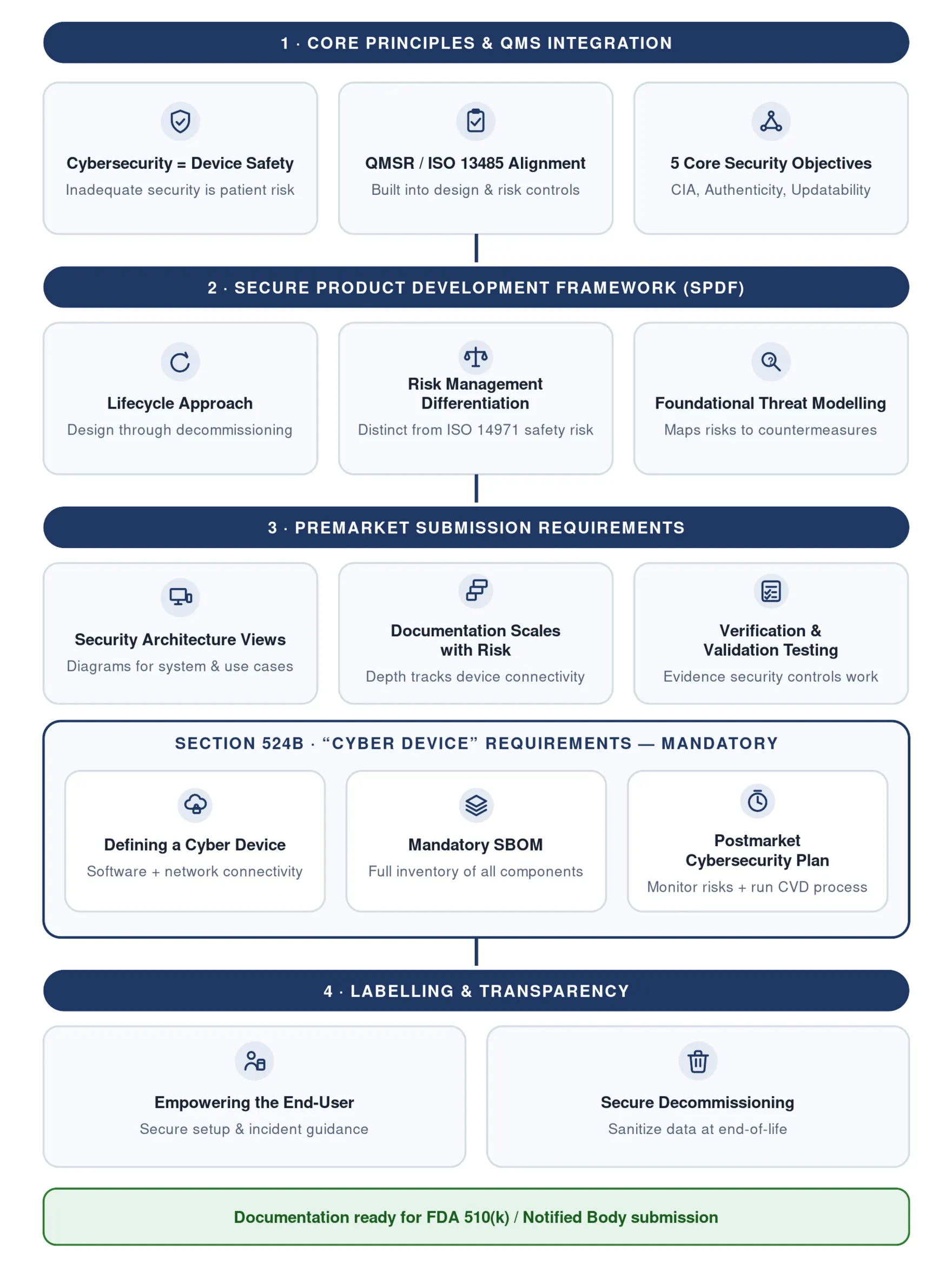
Medical Device Cybersecurity Compliance Road Map
Why I3CGLOBAL
I3CGLOBAL has supported medical device and IVD manufacturers with FDA 510(k), EU MDR/IVDR CE marking, ISO 13485, and UKCA compliance since 1999, with regulatory teams across the United States, United Kingdom, India, Germany, Portugal, South Korea, Malaysia, and beyond. Unlike IT-only security vendors, our medical device cybersecurity consulting team work alongside our regulatory affairs and technical file teams so your risk assessment, SBOM, and test evidence are built in the format FDA reviewers and Notified Bodies actually expect, not just a generic security audit. One team, from threat model to submission to postmarket surveillance.
Frequently Asked Questions
Is medical device cybersecurity documentation mandatory for FDA 510(k) clearance?
Yes. Under Section 524B of the FD&C Act, any device with software and network connectivity — a “cyber device” — must include a complete cybersecurity evidence package in its 510(k), De Novo, or PMA submission, or the FDA will issue a Refuse-to-Accept or request additional information.
What medical device cybersecurity documentation does EU MDR/IVDR require for CE marking?
Manufacturers must demonstrate compliance with Annex I GSPR clauses 17.2, 17.4, and 23.4, supported by MDCG 2019- 16-aligned risk management documentation and, increasingly, evidence against IEC 81001-5-1:2022. This documentation is reviewed by your Notified Body as part of technical file assessment.
What is a Software Bill of Materials (SBOM) and do I need one??
An SBOM is a structured, machine-readable inventory of every software component in your device — commercial, opensource, and third-party — including known vulnerabilities. The FDA requires an SBOM for cyber device submissions, and it is increasingly expected in EU technical files as well.
Do legacy (already-cleared) devices need cybersecurity updates?
Yes, in most cases. Both FDA and MDCG guidance expect manufacturers to assess legacy devices against current cybersecurity risks and take reasonable remediation steps — through software updates, labeling changes, or documented risk communication — even if the device was cleared before current requirements applied.
How long does a medical device cybersecurity risk assessment take?
Timelines depend on device connectivity and complexity, but a typical gap assessment and threat model can be completed in a few weeks, with SBOM generation, testing, and full submission documentation following in parallel with your regulatory timeline. Contact us for a project-specific estimate.
What is a Coordinated Vulnerability Disclosure (CVD) program?
A CVD program is the documented process by which a manufacturer receives, evaluates, and responds to reported vulnerabilities from researchers or users. It’s a required element of FDA’s postmarket medical device cybersecurity expectations and is referenced in MDCG and IMDRF guidance as postmarket best practice.