
Medical Device Usability Engineering
Medical device usability determines whether intended users can operate a device safely and effectively in its real use environment. I3CGLOBAL is a regulatory consulting company that helps manufacturers plan usability engineering to IEC 62366-1, carry out evaluations and build the usability file needed for EU MDR, IVDR and FDA submissions.
The basics
What Is Medical Device Usability?
Medical device usability, also described as human factors engineering, applies knowledge of human behaviour, capabilities and limitations to the design of a user interface. The aim is a device that people can use safely, effectively and as intended.
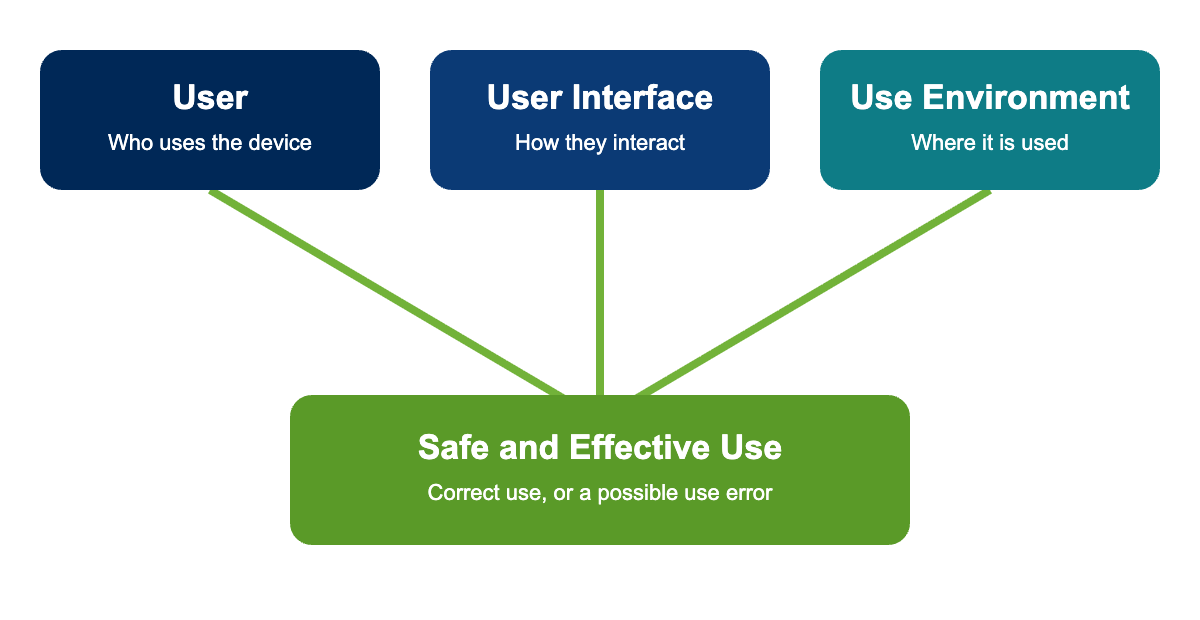
Usability depends on three elements: the user, the user interface and the use environment. How they interact decides whether the outcome is correct use or a use error, and a use error can lead to unsafe or ineffective use. Medical device usability engineering is therefore a required part of EU technical documentation for devices and in vitro diagnostics, not an optional add-on.
How Do I3CGLOBAL Medical Device Usability Consultants Help?
A third-party consultant adds independent review and current regulatory knowledge. Our medical device consultants support your team in these areas:
Procedure development
Prepare the usability engineering procedure and plan in line with IEC 62366-1.
Gap assessment
Review existing medical device usability files and identify gaps in evidence and traceability.
Use specification
Define users, use environments, user interface characteristics and potential use errors.
Evaluation planning
Plan formative and summative evaluation, including user groups and acceptance criteria.
File preparation
Document the medical device usability engineering process and connect it with the risk file.
GSPR support
Map usability evidence to the correct MDR or IVDR Annex I GSPR checklist.
Which Human Factors Principles Improve Medical Device Usability?
Human factors work studies how real people make choices under stress, along with their cognitive limits and physical abilities such as grip strength or vision. Good medical device usability design takes these limits into account, so that a device is logical, efficient and forgiving of mistakes.
User-centred design
Consider how real users will handle the device in every intended setting.
Iterative testing
Test mock-ups and products with intended users, not only experts or developers.
Simplicity
Remove extra steps, confusing symbols and hidden features.
Clear feedback
Make sure every action leads to a clear and understandable response.
What use errors commonly cause harm?
- Misreading a screen and giving the wrong dose
- Pressing the wrong button because controls look too similar
- Skipping a step because instructions are unclear
- Failing to notice an alarm
The consequences range from minor inconvenience to serious injury or death. Medical device usability engineering aims to find and fix these problems before a device reaches the market.
Where Is Medical Device Usability Engineering Required?
Under Regulation (EU) 2017/745 and Regulation (EU) 2017/746, manufacturers must show that use-related risks are identified, reduced and validated before a device can carry the CE mark. The obligation sits in the General Safety and Performance Requirements (GSPRs) in Annex I.
| Source | Requirement | What It Means for You |
|---|---|---|
| EU MDR Annex I, Section 5 | Reduce as far as possible the risks related to ergonomic features and the use environment, and consider the technical knowledge, experience, education, training and use environment of intended users. | Define lay, professional and other user groups, and design for them. |
| EU MDR Annex I, Section 22 | Devices for lay persons must be safe and accurate at all stages of the procedure, reduce the risk of unintended cuts and pricks such as needle-stick injuries, and reduce the risk of user error. | Lay-use devices need stronger evidence on handling and instructions. |
| IVDR Annex I, Section 5 | The IVDR equivalent ergonomics requirement, covering intended users and the use environment. | Include usability evidence in your IVDR technical documentation. |
| IVDR Annex I, Section 19 | Self-testing devices must perform appropriately for lay persons. Near-patient testing devices must perform appropriately in the relevant setting, such as a home, ambulance or emergency unit. | Generate performance data in these conditions, not only in a professional laboratory. |
| US FDA | FDA human factors guidance and the 2026 final guidance on human factors content set expectations for design work and submissions. | Use the FDA submission categories to plan your FDA 510(k). |
In practice, MDR usability risk concentrates on physical interaction and lay-use handling. IVDR usability risk concentrates on specimen handling, result interpretation and self-testing accuracy outside a laboratory.
Which Standard Applies to Medical Device Usability Engineering?
Notified Bodies expect medical device usability work to follow a recognised method, and IEC 62366-1 is the main reference for both devices and IVDs.
- IEC 62366-1:2015 + AMD1:2020: the core standard specifying the usability engineering process, Application of usability engineering to medical devices.
- IEC/TR 62366-2:2016: a technical report offering implementation guidance. It is not itself a requirement.
A manufacturer can show compliance by another route, but it then needs alternative evidence that may be harder to defend at audit. The scope covers medical device software under MDR and software-driven IVDs under IVDR, including decision-support screens, alerts and result-interpretation workflows.
What Are the 9 Steps of Medical Device Usability Engineering?
IEC 62366-1 Clause 5 sets out nine steps, from preparing the use specification to performing summative evaluation. It is one iterative, risk-based process for both devices and IVDs, and the activities follow the sequence below.
- Prepare the use specificationDefine the intended medical indication, patient population, users, use environment and operating principle.
- Identify safety-related characteristicsList user interface characteristics related to safety and the potential use errors.
- Identify hazardsIdentify known or foreseeable hazards and hazardous situations related to use.
- Describe hazard-related use scenariosDescribe the task sequences in which a use error could lead to harm.
- Select scenarios for evaluationChoose the hazard-related use scenarios for summative evaluation.
- Establish the user interface specificationSet testable requirements for the user interface and any training or instructions.
- Establish the evaluation planDefine formative and summative methods, participants and acceptance criteria.
- Design and run formative evaluationImplement the design and refine it through iterative formative evaluation.
- Perform summative evaluationConfirm safe use of the final user interface and record the results in the file.
If summative evaluation shows unacceptable residual risk or surfaces new use-related risks, the process loops back to redesign and re-test. For IVDR self-testing devices, this loop also connects to performance evaluation, because a failure in result interpretation is also a performance failure.
Which Medical Device Usability Terms Should You Know?
Clear definitions help your team and your reviewer read the medical device usability file in the same way.
| Term | Meaning |
|---|---|
| User | A person interacting with, meaning operating or handling, the device. |
| User group | A subset of users differentiated by factors likely to influence their interactions, such as age, culture or expertise. |
| User interface | The means by which a user and the device interact. |
| Use environment | The actual setting and conditions in which users interact with the device. |
| Use error | A user action or lack of action that leads to a different result from the one intended by the manufacturer or expected by the user. |
| Use scenario | A specific sequence of tasks by a specific user in a specific use environment, and the resulting response of the device. |
| Critical task | A task in a hazard-related use scenario where a use error can lead to significant harm. |
How Does Medical Device Usability Differ Between MDR and IVDR?
The process is shared, but the clauses, risk drivers and evidence differ.
| Aspect | MDR 2017/745 | IVDR 2017/746 |
|---|---|---|
| Main Annex I sections | Section 5 and Section 22 | Section 5 and Section 19 |
| Core usability risk | Physical handling, ergonomics and injury risk, such as needle-stick | Specimen handling, result interpretation and self-testing accuracy |
| Highest-scrutiny devices | Self-injection, home monitoring and alarm-based devices | Self-test kits, such as glucose, pregnancy or infectious disease, and near-patient testing devices |
| Evidence tie-in | ISO 14971 risk management file | ISO 14971 risk file and performance evaluation (Annex XIII) |
| GSPR checklist | Maintained per MDR Annex I | Maintained per IVDR Annex I |
Is Medical Device Usability Evidence Required for an FDA 510(k)?
It depends on the device and the change. FDA expects manufacturers to assess use-related risk, but the amount of human factors information submitted varies. The FDA final guidance on human factors content, issued on 29 May 2026, gives a risk-based framework for 510(k)s, De Novo requests, PMAs and HDEs.
| Submission Category | Typical Situation | What to Submit |
|---|---|---|
| Category 1 | A modified device with no change to the user interface, users, uses, use environment, training or labeling | A conclusion and high-level summary of the human factors evaluation |
| Category 2 | No critical tasks, or no new or affected critical tasks. It can also apply where existing evidence justifies not submitting validation data | Category 1 content, plus users, uses, environments, training, user interface, known use problems, preliminary analyses and a rationale |
| Category 3 | Critical tasks exist or are affected, and validation data should be submitted | Category 2 content, plus a use-related risk analysis and human factors validation testing of the final design |
When is human factors validation testing likely?
- The user interface is complex, for example with programming, monitoring or changing settings
- The device type has known use error issues
- Risk has changed, new risk information has emerged, or the severity of harm has increased
- New critical tasks are introduced, or existing critical tasks are affected
How do FDA guidance and IEC 62366-1 compare?
Both expect safe and effective use to be shown with representative users, and both rely on real evidence rather than paperwork alone. Many companies use IEC 62366-1 as the foundation for medical device usability work, then add FDA-specific expectations for US devices. This can help you reach several markets without rebuilding the process.
What are the best practices for a 510(k)?
- Start early: integrate usability engineering from the first design sketches.
- Involve real users: test with intended users in realistic settings.
- Focus on critical tasks: identify and test the steps where errors could harm patients.
- Iterate: use feedback to fix flaws, then retest.
- Document everything: record studies, feedback, risk analyses and final changes.
Need support for a US submission? Request a 510(k) proposal with a statement of work.
What Is the Difference Between Formative and Summative Evaluation?
| Aspect | Formative Evaluation | Summative Evaluation |
|---|---|---|
| Purpose | Iteratively refine the user interface during development | Confirm the final user interface is safe and effective for intended users |
| Timing | Early and throughout design and development | Once the design is final, before CE marking submission |
| Participants | Small samples, informal or moderated sessions | Representative user groups, with sample size justified by risk and critical tasks |
| Output | Design changes and risk control updates | Objective evidence for the usability file and GSPR checklist |
IEC 62366-1 does not set a fixed number of summative participants for MDR or IVDR devices. The number is justified by user groups and critical tasks. FDA’s 2016 human factors guidance is often used as a practical reference, with at least 15 participants per distinct user group, and comparable rigour is commonly expected for higher-risk devices.
What Goes in Medical Device Usability Files?
Medical device usability files record the whole process and the evidence behind it. They are often called the usability engineering file (UEF), and they can reference other technical documents rather than repeat them.
- Use specification and user profiles
- User interface characteristics and potential use errors
- Known and foreseeable hazards and hazardous situations
- Hazard-related use scenarios and those selected for evaluation
- User interface specification and evaluation plan
- Formative evaluation records and resulting design changes
- Summative evaluation protocol, results and residual risk analysis
To start from a structured format, see our UEF templates.

Which Medical Device Usability Gaps Do Reviewers Flag?
A defensible medical device usability file keeps clear traceability across the full chain. These are common weak points to check before submission.
| Common Finding | What a Compliant File Does Instead |
|---|---|
| Weak traceability from user tasks to use errors, hazards, controls and evidence | Maintains one traceability matrix linking every critical task to its risk control and validation evidence |
| Usability treated as separate from risk management | Cross-references the usability file and the ISO 14971 risk file so use-related hazards feed the risk analysis |
| Summative evaluation run on the wrong user population | Justifies participant selection against the defined intended-user profile, such as lay or professional |
| IVDR performance data generated only in a professional laboratory | Validates performance under the applicable Section 19 conditions, such as home, ambulance or emergency unit |
| No justification for GSPR clauses marked not applicable | Documents the rationale for each usability-related clause in the correct checklist |
How Does Medical Device Usability Connect to Other Technical Files?
Medical device usability engineering does not stand alone. Use-related hazards feed your medical device risk management file, and risk controls then return to the user interface specification for evaluation.
The results also support your MDR technical file, clinical evaluation or performance evaluation, and labelling and instructions for use. After launch, complaints and incident data can reveal use errors that were not foreseen, so review them and update the file. For the US, see the 510(k) human factors expectations.
What if a user interface has unknown provenance?
IEC 62366-1 Annex C gives a route for legacy user interfaces that were not developed under the standard. It uses post-production information and risk review to assess them, and its applicability should be justified for your device.
Why Choose I3CGLOBAL for Medical Device Usability Engineering?
I3CGLOBAL is a global regulatory consulting company for medical devices, IVDs and life sciences. For medical device usability projects, that means one team can connect your usability work with your wider regulatory plan.
EU and US together
Plan one usability process, then map evidence to MDR, IVDR and FDA expectations.
Connected documents
Link your usability file with the risk file, technical documentation and post-market data.
Flexible support
Choose full preparation, a gap assessment, or editable UEF templates for your own team.
How Do You Start a Medical Device Usability Project?
A good start to medical device usability work saves redesign later. To scope support accurately, prepare the following:
- Device description, intended purpose and target patient population
- Device class and target markets
- Intended users, training assumptions and use environments
- Current user interface, prototypes, labelling and instructions for use
- Existing risk management file and any usability records
- Complaints and post-market data for marketed devices
Medical device usability works best when it starts at the design stage, while the user interface can still change at reasonable cost. For marketed devices, a structured gap assessment can identify what needs to be added before your next review.
Work with I3CGLOBAL
Get Your Medical Device Usability File Reviewed
Our regulatory team can prepare your usability documents or close the gaps in existing files before a Notified Body or FDA review.
- Usability engineering plan and procedure
- Gap assessment and remediation support
- Formative and summative evaluation planning
- GSPR mapping for MDR and IVDR
Request your proposal
Tell us about your device and target market, and we will recommend the right scope of support.
FAQs
Medical Device Usability: Frequently Asked Questions
What is medical device usability?
Medical device usability is the characteristic of the user interface that helps intended users perceive information, understand it and act correctly. It supports safe and effective use in the intended use environment, with acceptable learnability, efficiency and user satisfaction.
What is usability engineering?
Usability engineering, also called human factors engineering, applies knowledge about human behaviour, abilities and limitations to the design of medical devices, including software, systems and tasks, to achieve adequate usability.
Is usability engineering required for both MDR and IVDR devices?
Yes. Both regulations include usability-related requirements in Annex I: Sections 5 and 22 of the MDR, and Sections 5 and 19 of the IVDR. IEC 62366-1 is the standard most often used to demonstrate how these requirements are met.
Is IEC 62366-1 a harmonised standard?
Not under the MDR at the time of our last check (November 2026): EN 62366-1:2015+A1:2020 does not appear in the published lists of harmonised standards for Regulation (EU) 2017/745, so it does not give a presumption of conformity under Article 8. Check the current Official Journal lists for the MDR and IVDR before you rely on any listing. IEC 62366-1 remains the widely used state-of-the-art reference for usability engineering.
Can one usability engineering file cover both device and IVD products?
The underlying process can be shared, but the GSPR checklist and objective evidence must map back to each regulation separately. MDR and IVDR products each need their own Annex I checklist, even when the activities are run jointly.
What is a primary operating function?
A primary operating function is a function directly related to the safety of the device. Amendment 1 (2020) clarifies that these functions are defined in product-specific safety standards, and that they are an input to the usability engineering process.
What is a usability test?
A usability test is a method for exploring or evaluating a user interface with intended users within a specified intended use environment.
When should usability engineering start?
At the concept stage, before the user interface is fixed. Changes found late in summative testing are costly and can delay CE marking or FDA clearance.
Can usability evidence be reused for a modified device?
Yes, if the change does not affect users, uses, use environments, training, labelling or the user interface, and you document the rationale. Under the 2026 FDA guidance, this situation usually falls into Category 1.
What is the difference between IEC 62366-1 and IEC/TR 62366-2?
IEC 62366-1 sets out the required usability engineering process. IEC/TR 62366-2 is a technical report with guidance on how to carry it out, and it is not a requirement in itself.
Who should take part in summative evaluation?
Representative intended users from each distinct user group, working under realistic use conditions. The people who designed the device should not take part.
Does IEC 62366-1 apply to software?
Yes. Software falls within the device definition under both MDR and IVDR, so the process applies to decision-support screens, alerts and result-interpretation workflows as well as to physical controls.
What is different about usability risk for IVDR self-testing devices?
Under IVDR Annex I, Section 19, self-testing devices must perform appropriately when used by lay persons, and near-patient testing devices must perform appropriately in the relevant use environment. This links usability evaluation directly to performance evaluation evidence.
How many participants are needed for summative usability testing?
Neither MDR, IVDR nor IEC 62366-1 sets a fixed number. The sample must be justified against user groups and critical tasks. FDA’s 2016 human factors guidance is a common benchmark, with at least 15 participants per distinct user group.
Is human factors data required for an FDA 510(k)?
It depends on the device and the change. Under the FDA final guidance Content of Human Factors Information in Medical Device Marketing Submissions, the sponsor uses a risk-based framework to decide how much human factors information to submit. Some 510(k)s need only a summary, while others need a use-related risk analysis and full validation testing.
What are the FDA human factors submission categories?
Category 1 is a conclusion and high-level summary. Category 2 adds descriptions of users, uses, environments, training, the user interface, known use problems and preliminary analyses, plus a rationale for not submitting validation data. Category 3 adds a use-related risk analysis and human factors validation testing of the final design.