
Class Im Medical Device (Measuring Function) under EU MDR
A Class Im medical device, also written Class 1m, is a Class I medical device with a measuring function. Typical examples are non-active clinical thermometers, manual blood pressure devices and graduated cups or oral syringes for dosing liquid medicines. Under Article 52(7)(b) of EU MDR 2017/745, a Notified Body must assess only the aspects of manufacture that relate to the metrological requirements. Everything else stays under the manufacturer’s own Class I declaration of conformity.
Classification rules
Which Rules Make a Device Class Im?
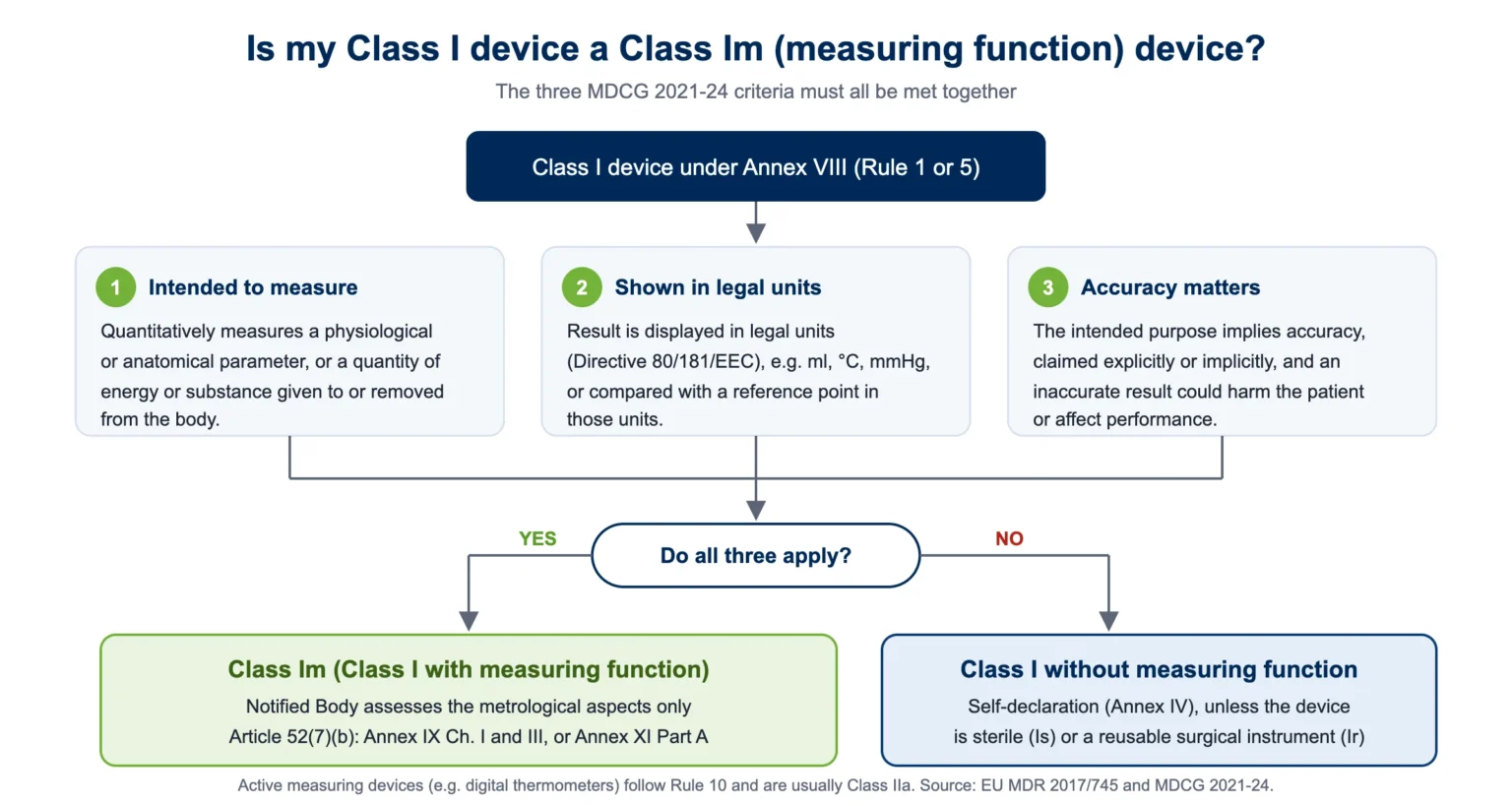
A device is Class Im when the Annex VIII rules of Regulation (EU) 2017/745 place it in Class I and it also has a measuring function. In practice, most Class Im devices are classified under Rule 1 (non-invasive) or Rule 5 (transient use through a body orifice).
MDCG 2021-24, the European Commission guidance on classification, explains what a measuring function is. A device has a measuring function when all three of these criteria apply together:
- It is intended to measure, quantitatively, a physiological or anatomical parameter, or a quantity of energy or substance delivered to or removed from the body.
- It shows the result in units of measurement, on a scale or display, or compares it with a reference point in those units.
- The accuracy of the result matters, so an inaccurate result could harm the patient or affect the device’s performance.
Annex I, section 15.2 requires these measurements to be expressed in legal units under Council Directive 80/181/EEC, such as millilitres, degrees Celsius or millimetres of mercury.
Examples
What Are Examples of Class Im Medical Devices?
These examples are typical. The intended purpose and accuracy claims always decide.
| Device (typical) | Rule | What is measured |
|---|---|---|
| Non-active clinical thermometers | Rule 1 / Rule 5 | Body temperature in °C |
| Non-active (manual) blood pressure devices | Rule 1 | Blood pressure in mmHg |
| Graduated medicine cups and measuring spoons for liquid medicines | Rule 1 | Dose volume in ml |
| Oral dosing syringes without a needle | Rule 5 | Dose volume in ml |
| Urine meters and urine bags with a calibrated volume scale | Rule 1 | Urine output volume in ml |
Active devices are different: digital thermometers and electronic blood pressure monitors are active diagnostic devices. They usually fall under Rule 10 and are Class IIa, not Class Im.
CE marking route
How Do You CE Mark a Class Im Device?
Article 52(7)(b) lets the manufacturer choose Annex IX Chapters I and III, or Annex XI Part A. The Notified Body assesses only the manufacturing aspects that relate to metrological requirements. The CE marking process for a Class Im device therefore follows these steps.
- Confirm Class I and the measuring functionApply the Annex VIII rules and record why the device measures, using MDCG 2021-24.
- Define the metrological specificationState the measuring range, units, accuracy and precision limits that the intended purpose needs.
- Verify accuracy and design the controlsTest against relevant standards and set up calibration, in-process checks and final inspection.
- Build the QMS around metrologyControl measuring equipment, calibration traceability, scale printing or moulding, and release testing within your ISO 13485 quality management system.
- Complete the technical documentationPrepare the Annex II and III technical documentation, the clinical evaluation and the GSPR checklist.
- Apply to a Notified BodyChoose a Notified Body designated for your device codes and the conformity assessment annex.
- Pass the metrology assessmentThe Notified Body reviews the metrology evidence and audits the related QMS processes.
- Sign the declaration and affix the CE markAdd the Notified Body’s identification number next to the CE mark (Article 20) and register the device in EUDAMED.
Metrology evidence
What Metrology Evidence Does a Class Im Device Need?
Accuracy
How close the measured value is to the true value, tested across the full measuring range.
Precision
How consistently the device gives the same result under the same conditions.
Calibration and traceability
Calibration of production gauges and test equipment against traceable standards.
Range and units
A measuring range that covers the intended use, with legal units clearly shown.
Scale durability
Evidence that printed or moulded scales stay legible for the device lifetime.
Labelling and IFU
Accuracy limits, reading instructions and any user calibration steps.
Accuracy testing normally follows the recognised standard for the device type. Commonly used references include ISO 80601-2-56 for clinical thermometers, ISO 81060-1 for non-automated blood pressure devices, and the EMA guideline on the graduation of delivery devices for oral dosing cups, spoons and syringes. The Notified Body expects test reports against the accuracy limits you have stated, not only a printed scale.
These records sit inside the normal Class I technical documentation, together with risk management to EN ISO 14971 and a clinical evaluation under Article 61.
After CE marking. Your obligations continue once the device is on the market:
- Keep the post-market surveillance plan running and update the PMS report under Article 85 when necessary.
- Report serious incidents and field safety corrective actions through the vigilance system.
- Expect Notified Body surveillance audits of the metrology and calibration processes during the certificate’s validity, and tell the Notified Body about significant changes to those processes before you implement them.
- Manufacturers outside the EU also need an EU authorised representative (Article 11), and every manufacturer needs a person responsible for regulatory compliance (Article 15).
- Keep the technical documentation available for at least 10 years after the last device is placed on the market, or 15 years for implantable devices.
Borderline cases
What Are Common Class Im Mistakes?
- Treating every scale as measuring. Rough guide marks, such as approximate fill lines not used for dosing, usually do not create a measuring function.
- Missing a dosing claim. A plain cup becomes Class Im when it is supplied or labelled for measuring medicine doses.
- Confusing active and non-active devices. Electronic measuring devices fall under the active device rules and are often Class IIa.
- No accuracy specification. The Notified Body needs a stated accuracy and test evidence, not only a printed scale.
- Combination with sterility. A sterile measuring device is both Is and Im, and the Notified Body scope covers both.
Compare
How Does Class Im Compare with Other Classes?
| Class | Notified Body scope |
|---|---|
| Class I | None, self-declared |
| Class Is | Sterile conditions only |
| Class Im | Metrological requirements only |
| Class Ir | Reuse aspects only |
| Class IIa and above | Full QMS audit and technical documentation assessment |
See every class side by side on Class I vs IIa vs IIb vs III.
Work with I3CGLOBAL
Certify Your Class Im Measuring Device
I3CGLOBAL has completed 300+ CE certifications, with offices in India, Europe and the USA. We confirm whether your device has a measuring function and prepare the evidence a Notified Body expects.
- Measuring function assessment
- Metrology and calibration documentation
- Technical file and clinical evaluation
- Notified Body coordination
See how we run Notified Body projects in our MDR CE marking case studies, which cover Class IIb and Class III devices such as infant warmers, phototherapy units, insulin pumps and defibrillators. Class Im projects follow the same documentation approach, with the Notified Body scope limited to the metrological aspects.
Request your proposal
Share your device details and we will prepare a Class Im proposal.
FAQs
Class Im Medical Device: Frequently Asked Questions
Is Class 1m the same as Class Im?
Yes. Class Im and Class 1m are the same category: Class I medical devices with a measuring function. The small m stands for measuring, and both spellings are used in industry.
Does a Class Im device need a Notified Body?
Yes. Under Article 52(7)(b) of the MDR, a Notified Body must assess the aspects of manufacture that relate to the device’s conformity with the metrological requirements. The rest of the device stays under the manufacturer’s Class I declaration.
What makes a device a measuring device under the MDR?
A device has a measuring function when it is intended to measure a physiological or anatomical parameter, an energy, or a quantity of a substance given to or removed from the body, shows the result in units, and its accuracy matters for safety or performance.
Is every device with a scale Class Im?
No. Markings that only give a rough guide, and are not intended for accurate measurement, do not usually create a measuring function. The intended purpose, claims and instructions decide whether accuracy matters.
Is a graduated oral syringe a measuring device under the MDR?
Yes, when it is supplied or co-packed to measure a dose of medicine and shows the volume in millilitres. MDCG 2021-24 lists plastic syringes used to measure a quantity of medicinal product before oral administration as Class I under Rule 5. A syringe without graduation, or a cup without a scale, is not a measuring device.
Is a digital thermometer Class Im?
Usually not. A digital thermometer is an active device. Active diagnostic devices that monitor physiological processes fall under Rule 10 and are typically Class IIa. Non-active clinical thermometers are the usual Class Im example.
What units must a Class Im device use?
Annex I, section 15.2 requires measurements to be expressed in legal units under Council Directive 80/181/EEC, such as millilitres, degrees Celsius or millimetres of mercury for blood pressure.
Which standards are used to prove accuracy for a Class Im device?
There is no single Class Im standard. Manufacturers use the recognised standard for the device type, such as ISO 80601-2-56 for clinical thermometers or ISO 81060-1 for manual blood pressure devices. For dosing cups and oral syringes, the EMA guideline on the graduation of delivery devices is the usual reference. The Notified Body expects test reports against the stated accuracy limits.
Can a device be both Class Is and Class Im?
Yes. A sterile device with a measuring function, such as a sterile graduated urine meter, is both Is and Im. The Notified Body’s assessment then covers both the sterile aspects and the metrological aspects, while the rest of the device remains under the manufacturer’s Class I declaration.
Does a Class Im device carry a Notified Body number next to the CE mark?
Yes. Because a Notified Body is involved in the conformity assessment, its four-digit identification number must appear next to the CE mark under Article 20 of the MDR, even though its scope is limited to the metrological aspects.