
Class IIb Medical Device (Class 2b) under EU MDR
A Class IIb medical device is a medium-to-high-risk device under EU MDR 2017/745. Examples include infusion pumps, ventilators, bone plates and long-term urinary catheters. A Notified Body must assess the device before CE marking, and most implantable Class IIb devices have their technical documentation reviewed one by one. Class IIb is also written as Class 2b.
Classification rules
Which Rules Make a Device Class IIb?
Sixteen of the 22 Annex VIII rules can lead to Class IIb. The ones that apply most often are Rule 8 (implants and long-term surgically invasive devices), Rules 9 and 10 (active therapeutic and diagnostic devices), Rule 11 (software) and Rule 12 (active devices that administer or remove medicines).
EU MDR Article 51 and Annex VIII set out 22 classification rules, and MDCG 2021-24 explains how to apply them. The table below lists the rules where Class IIb is a possible outcome. If more than one rule applies, the strictest one decides the class (Annex VIII, Section 3.5). See all 22 rules on our medical device classification page.
| Rule | Device type | When the result is Class IIb |
|---|---|---|
| Rule 2 | Non-invasive, channelling or storing | Blood bags. |
| Rule 3 | Non-invasive, modifying composition | Modifies the biological or chemical composition of blood, body liquids or other liquids for infusion, beyond filtration, centrifugation or exchange of gas or heat. |
| Rule 4 | Injured skin or mucous membrane | Used principally for wounds that breach the dermis or mucous membrane and can only heal by secondary intent. |
| Rule 5 | Invasive via a body orifice | Long-term use (over 30 days), except in the oral cavity, ear canal or nasal cavity when not absorbed by the mucous membrane. |
| Rule 6 | Transient surgically invasive | Supplies ionising radiation, has a biological effect, is wholly or mainly absorbed, or administers medicines in a potentially hazardous way. |
| Rule 7 | Short-term surgically invasive | Supplies ionising radiation, undergoes chemical change in the body (except in the teeth), or administers medicines. |
| Rule 8 | Implantable or long-term surgically invasive | Default result, unless the device is placed in the teeth (IIa) or meets a Class III exception. |
| Rule 9 | Active therapeutic | Exchanges energy in a potentially hazardous way, emits ionising radiation for therapy, or controls or monitors active therapeutic Class IIb devices. |
| Rule 10 | Active diagnostic and monitoring | Monitors vital parameters where variations could cause immediate danger, or uses ionising radiation for diagnosis or interventional radiology. |
| Rule 11 | Software | Decisions could cause serious deterioration of health or a surgical intervention, or it monitors vital parameters where variations could cause immediate danger. |
| Rule 12 | Active, administering or removing substances | Administers or removes medicines, body liquids or other substances in a potentially hazardous way. |
| Rule 15 | Contraception or STD prevention | All such devices, unless implantable or long-term invasive (Class III). |
| Rule 16 | Disinfecting, cleaning, sterilising | Disinfects, cleans, rinses or hydrates contact lenses, or disinfects invasive devices as the end point of processing. |
| Rule 19 | Nanomaterials | Presents low potential for internal exposure. |
| Rule 20 | Inhalation via a body orifice | Mode of action has an essential impact on the medicine’s efficacy and safety, or treats life-threatening conditions. |
| Rule 21 | Substances absorbed or dispersed | All cases not covered by Class III or Class IIa under this rule. |
Examples
What Are Examples of Class IIb Medical Devices?
Typical Class IIb devices include infusion pumps, ventilators, anaesthesia workstations, intensive care monitors, X-ray and CT systems, surgical lasers, haemodialysers, bone plates and screws, intraocular lenses, dental implants, long-term urinary catheters, condoms and contact lens solutions. The table below lists 17 examples with the Annex VIII rule that applies to each.
The final class always depends on the intended purpose and claims for your own device.
| Device | Annex VIII rule | Why it is Class IIb |
|---|---|---|
| Blood bags | Rule 2 | Named as Class IIb in Rule 2. |
| Haemodialysers | Rule 3 | Modify the chemical composition of blood returned to the body. |
| Dressings for chronic ulcers and severe burns | Rule 4 | Used for wounds that breach the dermis and heal only by secondary intent. |
| Long-term indwelling urinary catheters | Rule 5 | Invasive via a body orifice for more than 30 days. |
| Extended-wear contact lenses (over 30 days) | Rule 5 | Long-term invasive use on the eye surface. |
| Bone plates, screws and intramedullary nails | Rule 8 | Implantable devices that are not joint or spinal disc replacements. |
| Intraocular lenses | Rule 8 | Implantable devices placed in the eye. |
| Dental implants | Rule 8 | Implanted in the jaw bone, not placed in the teeth. |
| Infant incubators | Rule 9 | Exchange heat energy with a vulnerable patient in a potentially hazardous way. |
| Electrosurgical units and surgical lasers | Rule 9 | Deliver energy to tissue in a potentially hazardous way. |
| Radiotherapy equipment | Rule 9 | Active therapeutic devices that emit ionising radiation. |
| Diagnostic X-ray and CT systems | Rule 10 | Emit ionising radiation for diagnosis. |
| Intensive care patient monitors with alarms | Rule 10 | Monitor vital parameters where a change could cause immediate danger. |
| Infusion pumps for medicines | Rule 12 | Administer medicines in a potentially hazardous way. |
| Ventilators and anaesthesia workstations | Rule 12 | Administer gases to the patient in a potentially hazardous way. |
| Condoms | Rule 15 | Used for contraception and prevention of sexually transmitted diseases. |
| Contact lens care solutions and endoscope washer-disinfectors | Rule 16 | Disinfect contact lenses, or disinfect invasive devices as the end point of processing. |
Implants: many implants are Class III, not IIb. Rule 8 moves joint replacements, spinal disc replacements, breast implants, surgical meshes and implants in contact with the heart, central circulatory system or central nervous system into Class III.
CE marking
How Do You CE Mark a Class IIb Device?
Under Article 52(4) of the MDR, a Class IIb device needs a Notified Body and follows one of two routes: a quality management system route under Annex IX, or EU type-examination under Annex X combined with Annex XI. Both routes end with an EU certificate from the Notified Body, which the manufacturer needs before issuing the declaration of conformity and affixing the CE mark.
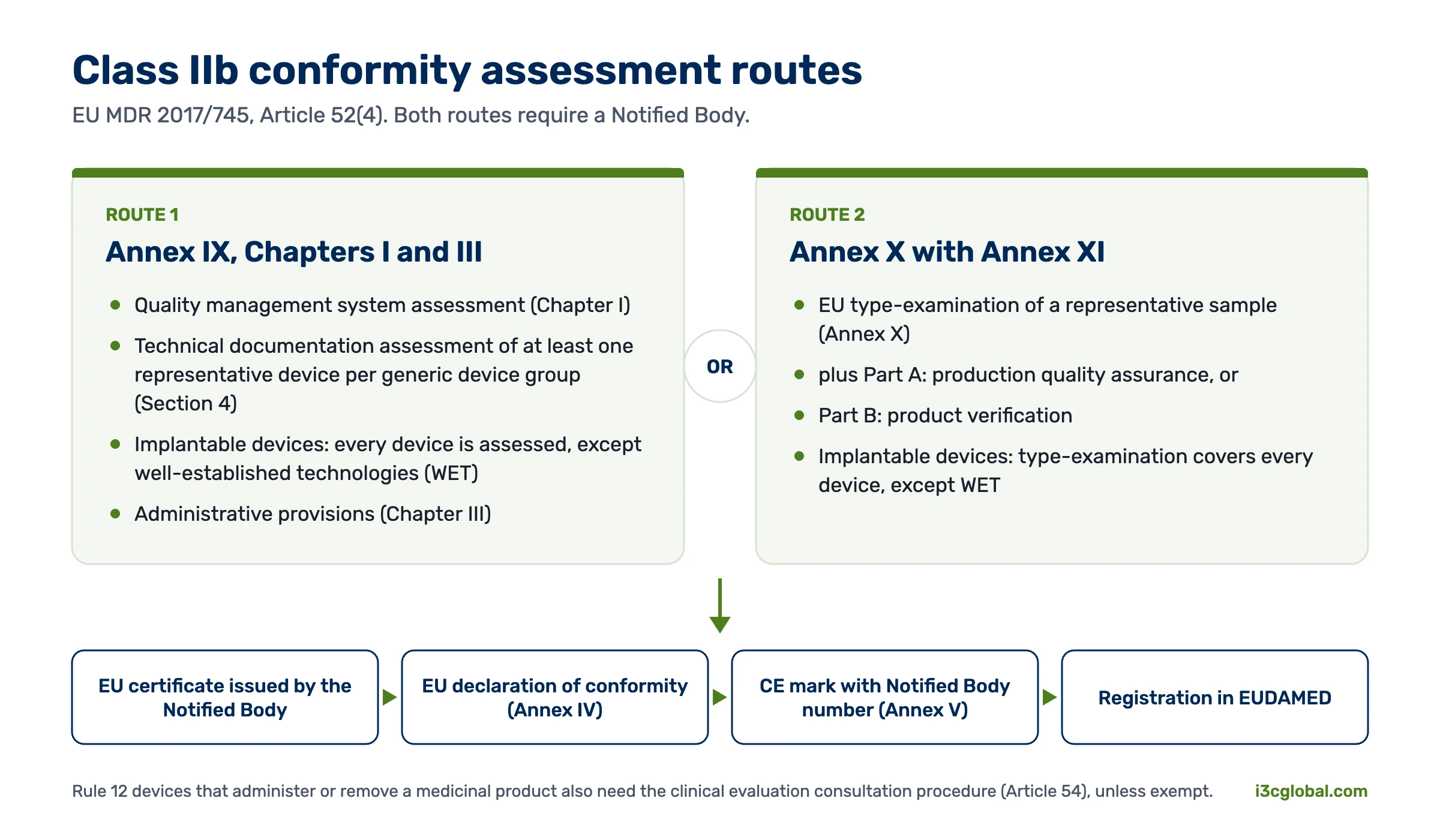
Route 1: Annex IX, Chapters I and III
Quality management system assessment plus technical documentation assessment of at least one representative device per generic device group. A generic device group means devices with the same or similar intended purpose or a common technology (MDR Article 2(7)); for Class IIa the wider device category is used instead (MDCG 2019-13).
Route 2: Annex X with Annex XI
EU type-examination of a representative sample (Annex X), combined with production quality assurance (Annex XI, Part A) or product verification (Annex XI, Part B).
| Class IIb device type | Technical documentation review by the Notified Body |
|---|---|
| Non-implantable | At least one representative device per generic device group |
| Implantable, well-established technologies (WET) | Representative basis. WET devices are sutures, staples, dental fillings, dental braces, tooth crowns, screws, wedges, plates, wires, pins, clips and connectors. |
| Implantable, other | Every device |
| Active device under Rule 12 that administers or removes a medicinal product | As for its implant status above, plus the clinical evaluation consultation procedure (Article 54), unless an Article 54(2) exemption applies |
- Confirm the class and ruleWrite the intended purpose and record which Annex VIII rule makes the device Class IIb, and whether it is implantable or a WET device.
- Set up the quality management systemImplement a QMS that meets Article 10(9), usually to EN ISO 13485:2016.
- Prepare the technical documentationBuild the technical file under Annexes II and III, with GSPR checklist, risk management to EN ISO 14971, biological evaluation and clinical evaluation.
- Plan clinical evidenceDecide whether a clinical investigation is needed (mandatory for implantable devices unless exempt) and set up post-market clinical follow-up.
- Apply to a Notified BodyThe Notified Body audits the QMS and reviews the technical documentation. Where the CECP applies, it sends its clinical evaluation assessment report to the expert panel, which issues a scientific opinion before the certificate is granted.
- Declare conformity and affix the CE markIssue the EU declaration of conformity (Annex IV), add the CE mark with the Notified Body number (Annex V) and register in EUDAMED.
Documentation
What Technical Documentation and Clinical Evidence Does Class IIb Need?
Clinical evaluation
Required under Article 61 and Annex XIV (clinical evaluation report). Implantable Class IIb devices need a clinical investigation unless an Article 61(4)-(6) exemption applies.
PSUR
Updated at least once a year (Article 86). For implantable Class IIb devices, the PSUR must be submitted to the Notified Body. Article 86(2) foresees submission through EUDAMED, but the EUDAMED vigilance module is not yet mandatory, so manufacturers currently send the PSUR directly to their Notified Body (MDCG 2022-21).
SSCP and implant card
Implantable Class IIb devices need a summary of safety and clinical performance (Article 32) and, unless exempt, an implant card (Article 18).
UDI and EUDAMED
UDI carriers have been required on Class IIb labels since 26 May 2023. Implantable devices have had them since 26 May 2021.
PRRC and Authorised Representative: every manufacturer needs a person responsible for regulatory compliance (Article 15); micro and small enterprises may contract this role rather than employ it. Manufacturers outside the EU must also appoint an EU Authorised Representative (Article 11), whose name and address appear on the label and in EUDAMED.
Learn more about the summary of safety and clinical performance and the full EU MDR requirements.
Borderline cases
What Are Common Class IIb Classification Mistakes?
- Calling every implant Class IIb. Rule 8 makes joint replacements, spinal disc replacements, breast implants, surgical meshes and active implantables Class III.
- Assuming WET applies to all orthopaedic implants. The WET list covers screws, wedges, plates, wires, pins, clips and connectors. Other implants, such as intraocular lenses, have every device reviewed.
- Missing the CECP. Active devices under Rule 12 that administer or remove a medicinal product may need an expert panel consultation, which adds time to certification.
- Under-classifying duration. A catheter intended for use beyond 30 days is long-term and moves from Class IIa to Class IIb under Rule 5.
- Treating monitoring software as Class IIa. Software that monitors vital parameters where variations could cause immediate danger is Class IIb under Rule 11.
Legacy devices: under Regulation (EU) 2023/607, legacy MDD certificates for implantable Class IIb devices (except WET) may be used until 31 December 2027, and for other Class IIb devices until 31 December 2028, if the conditions are met. See our MDR transition timeline.
MDR revision
What Is Changing for Class IIb under the Proposed MDR Revision?
On 16 December 2025 the European Commission published a proposal to amend the MDR and IVDR (COM(2025) 1023). For Class IIb manufacturers the main proposed changes are: PSUR updates every two years after the first year instead of annually; the clinical evaluation consultation procedure limited to Class III implantable devices; and wider use of representative-device sampling for technical documentation assessment.
The proposal is still being negotiated by the European Parliament and the Council and is not yet law. Until it is adopted and applies, the current MDR requirements described on this page remain in force. Status last checked: 9 November 2026.
Compare classes
Class IIa vs Class IIb: What Is the Difference?
| Topic | Class IIa | Class IIb |
|---|---|---|
| Risk level | Medium | Medium to high |
| Typical devices | Short-term catheters, hearing aids, dental fillings | Long-term catheters, infusion pumps, bone plates, ventilators |
| Routes (Article 52) | Annex IX, or Annex XI with Annex II and III documentation | Annex IX, or Annex X with Annex XI |
| Technical documentation review | At least one representative device per category of devices | At least one representative device per generic device group; every device for implants other than WET |
| PSUR | At least every two years | At least every year |
| Clinical investigation | Not automatically required | Required for implantable devices unless exempt |
See the full side-by-side table on our Class I vs IIa vs IIb vs III comparison, or read about Class IIa and Class III devices.
Work with I3CGLOBAL
Get Your Class IIb Device CE Marked
I3CGLOBAL has completed 300+ CE certifications and supports manufacturers from offices in India, Europe and the USA.
- Classification rule and WET check
- Technical file, risk management and biological evaluation
- Clinical evaluation, PMCF and annual PSUR
- SSCP and implant card for implantable devices
- Notified Body selection and support until certification
Request your proposal
Share your device details and we will prepare a Class IIb CE marking proposal.
FAQs
Class IIb Medical Device: Frequently Asked Questions
Is Class 2b the same as Class IIb?
Yes. The MDR writes the class with Roman numerals as Class IIb. People also write Class 2b, class 2 b or class ii b. All of these names describe the same medium-to-high-risk class under Annex VIII of EU MDR 2017/745.
Does a Class IIb device need a clinical investigation?
It depends. Implantable Class IIb devices need a clinical investigation under Article 61(4), unless an exemption applies, such as the well-established technologies listed in Article 61(6)(b). Non-implantable Class IIb devices need a clinical evaluation, which may rely on existing clinical data if it is sufficient.
What are well-established technologies (WET) under the MDR?
WET devices are sutures, staples, dental fillings, dental braces, tooth crowns, screws, wedges, plates, wires, pins, clips and connectors. For these implantable Class IIb devices, the Notified Body can review technical documentation on a representative basis instead of for every device.
How often is a PSUR needed for a Class IIb device?
At least once a year. Article 86 of the MDR requires manufacturers of Class IIb devices to update the periodic safety update report (PSUR) at least annually. For implantable Class IIb devices, the PSUR is submitted to the Notified Body, currently directly and later through EUDAMED once its vigilance module becomes mandatory.
When is the clinical evaluation consultation procedure needed for Class IIb?
The clinical evaluation consultation procedure (CECP) under Article 54 applies to Class IIb active devices intended to administer or remove a medicinal product under Rule 12, unless an Article 54(2) exemption applies. An expert panel then reviews the Notified Body’s clinical evaluation assessment.
Can a Class IIb device use the Annex XI route?
Only together with Annex X. Under Article 52(4), a Class IIb device follows Annex IX Chapters I and III, or an EU type-examination under Annex X combined with production quality assurance or product verification under Annex XI.
Is EU Class IIb the same as FDA Class II?
No. The EU and the US use separate classification systems. Many EU Class IIb devices are FDA Class II and follow the 510(k) route, but some, such as certain implants, are FDA Class III and need a PMA. Each market’s class must be determined on its own.
Who decides whether a device is Class IIb?
The manufacturer classifies the device using Annex VIII and documents the rationale. The Notified Body checks the classification during conformity assessment. If the manufacturer and Notified Body disagree, the competent authority of the manufacturer’s Member State decides (Article 51(2)).
Does a Class IIb device need a Person Responsible for Regulatory Compliance?
Yes. Article 15 requires every manufacturer to have at least one PRRC with the required qualification or experience. Micro and small enterprises do not need to employ the PRRC but must have one permanently and continuously at their disposal.
Does a non-EU manufacturer of a Class IIb device need an EU Authorised Representative?
Yes. Under Article 11, a manufacturer established outside the EU must designate an Authorised Representative in the EU before placing the device on the market. The Authorised Representative verifies the declaration of conformity and technical documentation and is registered in EUDAMED.
How is Class IIb software classified?
Software is classified under Rule 11. Software whose decisions could cause serious deterioration of health or a surgical intervention, or that monitors vital parameters where variations could cause immediate danger, is Class IIb. MDCG 2019-11 gives guidance, and IEC 62304 is the recognised standard for the software lifecycle.
What is changing for Class IIb under the proposed MDR revision?
The European Commission’s December 2025 proposal would move Class IIb PSUR updates to every two years after the first year and limit the clinical evaluation consultation procedure to Class III implantable devices. It is a proposal under negotiation, not yet adopted law, so current MDR requirements still apply.