
PSUR Writing Services – Periodic Safety Update Report Experts
Struggling with your PSUR? I3CGlobal’s expert medical writers deliver Notified Body-ready Periodic Safety Update Reports for MDR & IVDR. Get a free compliance review today.

Quick Contact
What Is a Periodic Safety Update Report (PSUR)?
A Periodic Safety Update Report is a structured, documented summary of everything your post-market surveillance system has learned about your device since the last reporting period. It is your opportunity — and your obligation — to demonstrate that the benefit-risk profile of your device remains acceptable in real-world use.
The PSUR is defined under Article 86 of EU MDR 2017/745 and Article 81 of EU IVDR 2017/746. It is distinct from the Post-Market Surveillance Report (PMSR), which applies to lower-risk Class I and Class A/B devices. The PSUR applies to higher-risk device classes and carries far greater regulatory weight.
At its core, a well-prepared Periodic Safety Update Report must address four key areas:
- The first is the conclusions of the benefit-risk determination — an honest, evidence-based assessment of whether the device’s clinical benefits continue to outweigh its risks in the current state of knowledge and use.
- The second is the main findings from Post-Market Clinical Follow-up (PMCF) for medical devices, or Post-Market Performance Follow-up (PMPF) for IVDs. This requires synthesizing real-world clinical data to answer whether the device performs as intended and whether any new safety signals have emerged.
- The third is sales volume and user population data — an estimate of how many patients or users the device has reached, how frequently it is used, and what the relevant population characteristics look like.
- The fourth is a summary of vigilance and PMS data, including complaints, adverse events, field safety corrective actions (FSCAs), and CAPA outcomes during the reporting period.
Periodic Safety Update Report (PSUR) Writing Services for MDR & IVDR
If you manufacture a Class IIa, IIb, or Class III medical device — or a Class C or D IVD — your Periodic Safety Update Report is not just a regulatory checkbox. Under EU MDR 2017/745 and IVDR 2017/746, it is one of the most scrutinized documents in your entire Technical File. Get it wrong, and you risk a major non-conformity finding during your Notified Body audit. Get it right, and it becomes a powerful demonstration of your device’s continued safety and market worthiness.
At I3CGlobal, we have spent over a decade helping medical device manufacturers — from startups to large multinationals — prepare PSUR documentation that genuinely satisfies Notified Body expectations. We don’t produce cookie-cutter reports. We build a safety narrative grounded in your real-world data, aligned with MDCG 2022-21 guidance, and written by experienced regulatory medical writers who understand exactly what auditors are looking for.
PSUR vs PMSR - the Difference
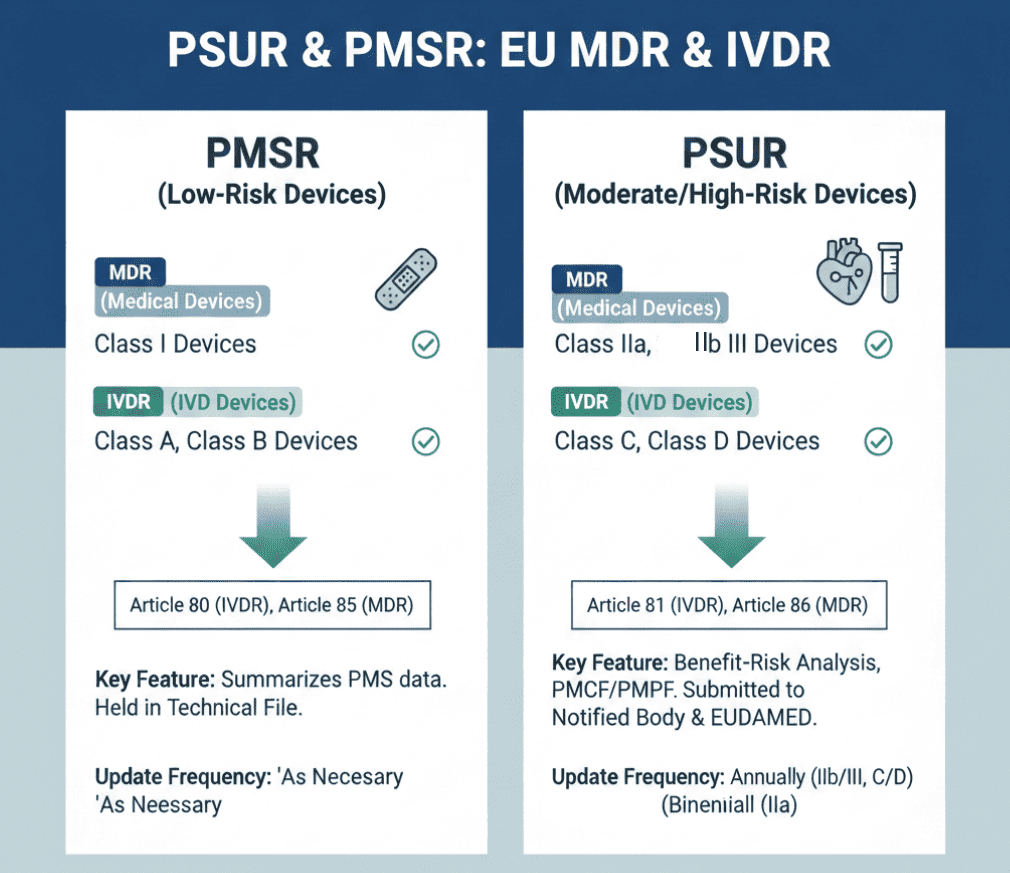
For manufacturers, one of the most common areas of confusion is what document they need. Here is how the two reports compare:
The Post-Market Surveillance Report (PMSR) is required for Class I (MDR) and Class A/B (IVDR) devices. It is a descriptive summary of your PMS activities and does not require a formal benefit-risk conclusion.
The Periodic Safety Update Report (PSUR) is required for Class IIa, IIb, III (MDR) and Class C, D (IVDR) devices. It goes significantly further — it must include a reasoned benefit-risk conclusion, integrate PMCF/PMPF data, and for certain device classes, be submitted to EUDAMED and reviewed by your Notified Body.
Think of it this way: the PMSR tells the story of what happened. The PSUR interprets what it means and argues that your device remains safe for its intended purpose.
Who Needs a PSUR and How Often?
The answer depends on the risk classification of your device under EU MDR or IVDR.
For MDR devices:
Manufacturers of Class IIb and Class III devices must update and finalize the PSUR at least annually. This annual cycle begins from the date of CE certification under MDR or the date the device is first placed on the EU market. Manufacturers of Class IIa devices must update the PSUR at least every two years.
For IVDR devices:
Manufacturers of Class D devices follow an annual PSUR cycle. Class C devices require a PSUR updated at least every two years, similar to Class IIa under MDR.
The clock is not reset to zero. If you miss a deadline or submit an incomplete report, you may receive a non-conformity finding which puts your CE mark renewal at risk and in more serious cases, this may lead to regulatory action from the competent authorities.
Managing multiple PSUR cycles concurrently, with different deadlines and Notified Body specific expectations is a big operational challenge for manufacturers with large device portfolios. This is one of the key areas where I3CGlobal delivers real, practical value.
What Does the PSUR Need to Be Submitted To EUDAMED?
EUDAMED submission requirements differ by device class and should not be overlooked
For Class III devices and implantable devices under MDR the PSUR must be submitted electronically to the Notified Body via EUDAMED (the European Database on Medical Devices). The Notified Body should then review the report and upload its assessment including details of any actions taken. These reports and assessments are available to competent authorities through the system.
For Class IIa and Class IIb devices, manufacturers shall make the PSUR available to the Notified Body involved in the conformity assessment; competent authorities may also require access at any time.
PSURs for Class D IVDs must be submitted to EUDAMED. Notified Body review process is similar to Class III MDR devices.
This distinction is important because a PSUR submitted to EUDAMED will be subject to more formal scrutiny than one that is kept on file. At I3CGlobal, we prepare you for both pathways, whether you need a self-contained Technical File document or a complete EUDAMED submission package.
What Does MDCG 2022-21 Say About the PSUR?
The Medical Device Coordination Group (MDCG) 2022-21, published December 2022, is the ultimate guidance document for PSUR preparation under the EU MDR, and offers detailed direction on how manufacturers should structure and populate their PSURs to meet regulatory expectations.
The guidance is clear that a PSUR is not just a data dump. Notified Bodies and competent authorities want a reasoned, analytical document – not just a list of complaints and sales figures.
The main points of MDCG 2022-21 are that the benefit-risk determination must have an explicit conclusion (not open-ended) that PMCF data must be actively incorporated into the benefit-risk evaluation (not simply added to the benefit-risk evaluation), and that the PSUR must be consistent with the current Instructions for Use, labelling and intended purpose of the device.
MDCG 2022-21 also stresses that if a manufacturer identifies a change in the benefit-risk profile during the reporting period, they must take action – be it a field safety corrective action, a design change, or updated labeling. In this respect, the PSUR is a living risk management tool, not just a compliance document.
At I3CGlobal, we embed MDCG 2022-21 requirements in all of our reports. We keep up to date with regulatory guidance updates so that your PSUR demonstrates current expectations, not guidance from three years ago.
Common Reasons PSURs Fail Notified Body Review
After working with hundreds of manufacturers and reviewing the feedback patterns from major Notified Bodies, we have identified the most frequent reasons why PSURs result in non-conformity findings:
The most common issue is a disconnect between PMCF findings and the benefit-risk conclusion. Manufacturers often treat the PMCF section and the benefit-risk section as separate documents stitched together. Notified Bodies expect these to be integrated the conclusions of PMCF must directly inform the benefit-risk determination.
The second most common issue is missing or superficial vigilance analysis. Listing adverse events is not enough. The PSUR has to analyze trends, evaluate root causes (CAPA) and explain why the current safety profile is acceptable given the events happened.
Third is the inconsistency with other Technical File documents in particular the Clinical Evaluation Report (CER), Risk Management File and Instructions for Use. A PSUR that references a different intended purpose than the CER, or cites safety data that conflicts with the risk file, immediately raises red flags.
Fourth is failure to address the state of the art. Regulators expect you to monitor the current literature and market for competing or equivalent devices. If new safety signals have emerged for similar devices and your PSUR doesn’t address them, it looks like willful ignorance.
At I3CGlobal, our peer-review process is specifically designed to catch all four of these failure points before your report ever reaches a Notified Body.
Our PSUR Writing Services — What We Cover
Whether you are preparing your first-ever PSUR or managing an annual update for a large device portfolio, our services are designed to meet you where you are.
MDR PSUR for Class IIa, IIb, and III Devices
For Class IIa devices, we help manufacturers establish a structured two-year surveillance cycle with clearly defined data collection endpoints, benefit-risk methodology, and a defensible conclusion that holds up to scrutiny.
For Class IIb and Class III devices, where the annual cycle and Notified Body review apply, our reports are built to anticipate and answer the specific questions that major Notified Bodies raise. We have experience writing PSURs reviewed by TÜV SÜD, BSI, SGS, Dekra, DNV, ITC, 3EC, SZUTEST and other leading bodies.
IVDR PSUR for Class C and D IVDs
IVDR PSUR requirements are relatively new territory for many IVD manufacturers, and the stakes for Class D devices (which include blood screening and infectious disease diagnostics) are particularly high. Our IVDR-specific team ensures that PMPF data is properly integrated, that diagnostic validity and clinical performance safety are addressed, and that Class D submissions meet EUDAMED requirements.
PSUR Gap Analysis and Review
Already have a draft PSUR? Our regulatory specialists will review it against your Notified Bodies published expectations, MDCG 2022-21, and your Technical File to ensure consistency across the documents. You receive a structured gap report with actionable recommendations.
Full Technical File Synchronization
A PSUR does not live in isolation. We integrate your PSUR with your Clinical Evaluation Report, Risk Management File, PMS Plan, PMCF Plan and IFU so the entire Technical File is consistent and audit ready.
Attention!!
A frequently overlooked aspect of Periodic Safety Update Reports is the integration of the results of the Post Market Clinical Follow-up (PMCF) with the ultimate conclusion on the Benefit-Risk ratio. Your PSUR should not only report safety data in line with the requirements of the EU MDR but also perform a detailed analysis to determine whether the benefit-risk profile of the device has been altered. Medical writers at I3CGLOBAL make sure that your technical documentation includes a consistent story that directly addresses the expectations of the Notified Body concerning the “Acceptability of the Benefit-Risk Ratio”. This is an important step to maintain your CE Certification.
The I3CGlobal PSUR Delivery Process
We’ve optimized our delivery process through hundreds of PSURs to remove the most frequent bottlenecks and provide reports that are submission-ready and not just revision-ready.
Step 1 – Data Discovery and PMS Audit We start with an audit of your existing PMS Plan and all available post-market data sources: complaint records, vigilance reports, literature searches, PMCF study results, sales data, CAPA records. We identify any gaps in data collection before writing starts so there are no surprises.
Step 2 – Medical Writing and Benefit-Risk Analysis Our medical writers develop the PSUR with emphasis on analysis rather than data presentation. We conduct the trend analysis, assess the significance of adverse events, incorporate PMCF findings, and craft a rationale benefit-risk conclusion that speaks directly to Article 86 requirements.
Step 3 – Internal peer review Before a report is published from our team, it’s peer-reviewed by a second regulatory expert. The review looks at your existing Technical File for consistency, the robustness of your benefit-risk conclusion, and compliance with MDCG 2022-21.
Step 4 — Finalization and Submission Support We deliver a finalized, formatted report ready for your QMS records and, where necessary, EUDAMED submission or Notified Body presentation. We are available throughout the review period to respond to Notified Body comments or queries.
Why US Based Medical Device Manufacturers Choose I3CGlobal
For US manufacturers working to achieve CE marking under the EU MDR, the PSUR is often an unfamiliar requirement. The EU MDR system, unlike the FDA’s post-market surveillance framework, requires a structured, documented report at set intervals and non-compliance can put your entire CE mark at risk.
I3CGlobal is located in Charlotte and Chicago, and has extensive experience working with manufacturers in the United States that are just getting started with complying to regulations in the EU. We bridge the gap between what your team knows from FDA compliance and what EU Notified Bodies expect from your Technical Documentation.
Our US clients particularly value the fact that we don’t just write the report we explain it. Every PSUR we deliver has a plain-language summary of our key findings and recommendations, so your regulatory team knows exactly what the document says and why.
We work with manufacturers of all sizes from small, single product start-ups looking for their first CE mark to mature medical device companies with annual PSUR cycles across dozens of SKUs.
- Notified Body Alignment: We write reports that anticipate the specific questions from leading Notified Bodies.
- Cross Functional Precision: We ensure your PSUR perfectly sync with your Clinical Evaluation Report (CER), Risk File, and PMCF.
- Data-to-Insight Conversion: We don’t just list your sales and complaint data; we perform the trend analysis and benefit-risk evaluation required by MDR Article 86 and IVDR Article 81.
- Regulatory Peace of Mind: Never miss a submission deadline. We manage the annual and biennial update cycles for your entire product portfolio.
At I3CGlobal we bridge the gap between raw post-market data and a Notified Body-ready PSUR. We help manufacturers secure their CE certification by delivering data-driven, audit-proof reports.
Start Your PSUR with Confidence
The PSUR is too important to leave to chance i3CGlobal is ready to help whether you are approaching your first PSUR deadline, managing an overdue update or preparing for an imminent Notified Body audit.
Our regulatory team is fast, writes clearly, and produces reports that stand up to scrutiny. We handle the complexity so your team can focus on what matters most — building and improving your device.
Contact us today for a free PSUR medical device compliance review. We will review your current PMS data, identify gaps and provide you with a clear picture of what your PSUR needs to look like – no obligation.
Struggling with complex PSUR timelines and Notified Body expectations?
The Periodic Safety Update Report (PSUR medical device) is no longer a “check-the-box” exercise. Under MDR 2017/745 and IVDR 2017/746, it is a high-stakes technical document that can determine the market life of your device. PSUR is the most critical for your Technical Documentation. A poorly drafted Periodic Safety Update Report is one of the leading causes of non-conformity during Notified Body audits. It isn’t just a summary; it’s an argument for your device’s continued safety.
Ensure Your CER is Audit-Ready
Don’t risk your CE Certification with incomplete technical documentation. I3CGLOBAL’s expert medical writers specialize in EU MDR 2017/745 Article 86 compliance, transforming complex clinical data into high-quality Periodic Safety Update Reports.
Our experts have created editable Medical Device PSUR templates in MS Word that cover Procedures, Plans, and Records.
Frequently Asked Questions
When should the first PSUR be prepared?
The first medical device PSUR cycle begins from the date of CE certificate issuance under MDR/IVDR or the date the device is first placed on the EU market, whichever comes first. For Class IIb and III devices, this means your first PSUR is due within 12 months of that date.
Is a PSUR required for Class I or Class A/B devices?
No. Class I devices (under MDR) and Class A/B devices (under IVDR) require a Post-Market Surveillance Report (PMSR), not a PSUR. The PMSR is a less formal document and does not require a formal benefit-risk conclusion.
Does the PSUR need to be uploaded to EUDAMED?
For Class III and implantable devices under MDR, and for Class D devices under IVDR, yes the PSUR must be submitted to EUDAMED and reviewed by the Notified Body. For other classes, the PSUR is held in the Technical File and made available on request.
Is a PSUR required for Class I/A/B devices?
No. Class I devices (MDR) and Class A/B devices (IVDR) require a Post-Market Surveillance Report (PMSR) instead of a PSUR. The PMSR is updated when necessary and made available to the Competent Authority upon request.
When and where to conduct Periodic Safety Update Report?
As per EU MDR article 86, the Periodic Safety Update Report must be prepared by the manufacturers of moderate and high-risk devices (class IIa, IIb, and III) and must be prepared for throughout the lifetime of the device, after it has been released to the market (as it requires PMS information). It must be submitted to the Notified body or competent authority at the time of conformity assessment and is part of the technical documentation.
How should I conclude PMSR?
PMS Report (PMSR) and PSUR are two different documents as of the MDR. PMSR is for class I devices and PSUR is for moderate and high-risk devices. The conclusion of PMSR will be based on the data collected from the PMS of the class I device and the CAPAs taken for it.
The PSUR, on the other hand, must have a conclusion about the data collected from risk-benefit, PMCF, the volume of sales, usage frequency and user population information, ultimately checking the safety and performance of the devices which can be input to documentation such as CER, RMF, IFU and so on.
Can the PSUR and CER be combined into one document?
No. The PSUR medical device and CER are separate, distinct documents with different purposes, scopes, and regulatory owners. However, they must be consistent with each other conflicting conclusions between the two documents are one of the most common non-conformity findings.
What happens if my PSUR is late or missing?
A missing or significantly delayed PSUR is treated as a non-conformity by your Notified Body. Depending on severity and the device class, this can result in suspension of your CE certificate. Competent authorities also have the right to request your PSUR for medical device at any time.
How is the PSUR different from a PMS Report (PMSR)?
The PMSR describes what PMS activities were conducted. The PSUR evaluates what the data means it must reach a conclusion about the acceptability of the device’s benefit-risk profile. The PSUR is a higher-risk document with greater regulatory consequence.
What is MDCG 2022-21 and do I need to follow it?
MDCG 2022-21 is the official EU guidance document for PSUR preparation under MDR. While technically guidance rather than legislation, Notified Bodies align their expectations directly with it. In practice, non-alignment with MDCG 2022-21 is treated as non-compliance during audits.
How long does it take to prepare a PSUR?
A standard first-time medical device PSUR typically takes four to six weeks from data handover to final delivery, depending on the volume and quality of available PMS data. Annual updates for established devices are typically completed in two to three weeks.