
Systems and Procedure Packs Under MDR Article 22
Systems and procedure packs combine CE-marked devices, and sometimes other products, for a specific medical purpose. Under MDR Article 22, the producer usually draws up a statement instead of obtaining a new CE mark for the combination. This changes if a device has no CE mark, the combination is incompatible, or sterilisation departs from instructions. I3CGLOBAL’s regulatory consultants help you choose and document the right route.
What Are Systems and Procedure Packs?

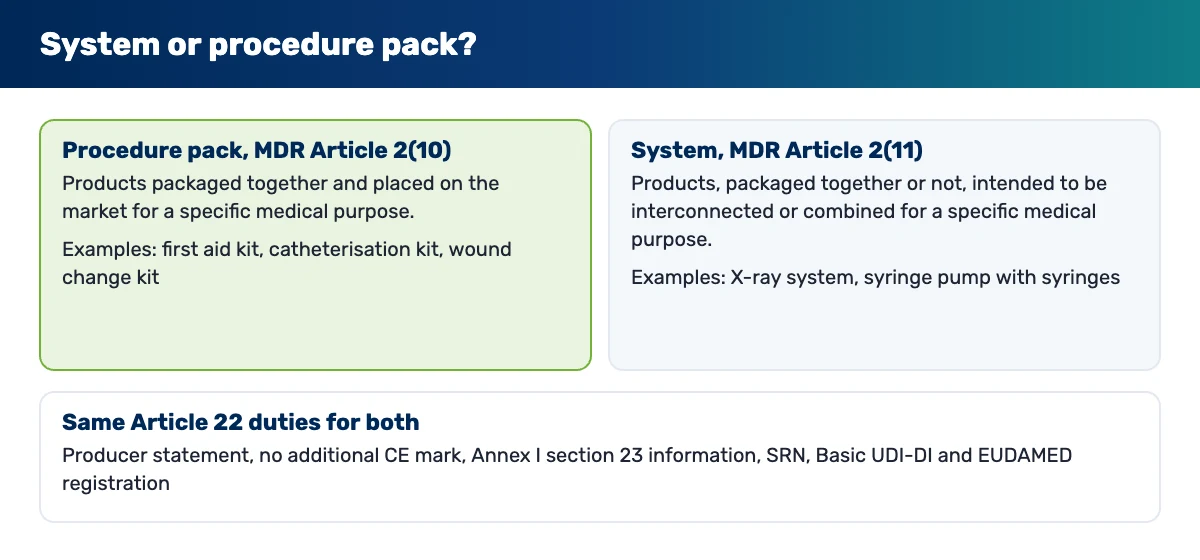
Systems and procedure packs are combinations of products placed on the EU market for a specific medical purpose. Regulation (EU) 2017/745 defines them in Article 2 and sets the rules in Article 22. The person who combines the products is called the system or procedure pack producer in MDCG 2018-3 Rev.1.
The main difference is packaging. Products in a procedure pack are packaged together. Products in a system may or may not be packaged together, but they are intended to be interconnected or combined. A combination can sometimes meet both definitions, and the duties under Article 22 are the same.
Key facts
Systems and procedure packs at a glance
- Legal basis
- MDR Articles 2(10), 2(11), 22 and 29(2)
- Responsible person
- System or procedure pack producer
- Core document
- Article 22(2) statement
- CE marking
- No additional CE mark on the pack under Article 22
- Identification
- SRN, Basic UDI-DI, UDI-DI and UDI-PI
- Records
- Article 22(2) and 10(8): at least 10 years, or 15 for implantable devices
- Notified body
- Sterility aspects only, unless Article 22(4) applies
What are common examples?
The right answer always depends on the intended medical purpose and on how the products are placed on the market. These examples show how the terms are commonly used:
| Type | Examples | Why it fits |
|---|---|---|
| Procedure pack | First aid kits, orthodontic kits, catheterisation kits, chest drainage kits and wound change kits | Products are packaged together and placed on the market for a specific medical purpose |
| System | X-ray systems, syringe pumps with syringes, electrosurgical units with electrodes and powered orthopaedic drills with compatible drill bits | Products are intended to be interconnected or combined, and need not share one package |
Which products can be included?
Under Article 22(1), a producer can combine CE-marked devices with:
- Other devices that bear the CE marking.
- In vitro diagnostic devices that bear the CE marking under Regulation (EU) 2017/746. See our IVDR guide.
- Other products that conform to the legislation that applies to them, only where they are used within a medical procedure or their presence is otherwise justified.
Which Products Are Not Systems and Procedure Packs?
Similar terms are easy to confuse, and the wrong classification leads to the wrong route. Check the combination against these common cases.
| Product or term | How it differs | Regulatory position |
|---|---|---|
| Distributor shipment | Items are supplied together on a client’s request, with no intended specific medical purpose for the combination | Not a system or pack; MDCG 2018-3 treats the supplier as a distributor or importer |
| Integral drug-device product | Drug and device form a single product, such as a pre-filled syringe | Medicinal product route; see MDR Article 117 |
| Co-packaged drug and device | A separate medicinal product and device are placed in one pack | Medicines law applies to the medicinal product; assess the pack case by case |
| IVD kit | Components packaged for a specific in vitro examination | An IVD in its own right under the IVDR |
| Configurable device | One device assembled by its manufacturer in several configurations | Device route; the term mainly matters for UDI |
| ME system (IEC 60601-1) | A term from an electrical safety standard | Not automatically an Article 22 system |
| Accessory | Supports use of a specific device according to its intended purpose | A device in its own right; check its classification |
Selling in the USA as well? EU terms do not map directly to FDA terms. The FDA uses terms such as convenience kits and device packages, and addresses co-packaged combination products under 21 CFR 3.2(e). Assess each market separately.
What Must Systems and Procedure Packs Producers Do?
Among the EU MDR procedure pack requirements, the central duty is the Article 22(2) statement. It is not a declaration that the combination is a new CE-marked device. It confirms how the combination was verified, packaged and controlled. In the statement, the producer declares that:
a
Compatibility was verified
The mutual compatibility of the products was verified according to the manufacturers’ instructions, and the activities followed those instructions.
b
Packaging and information are in place
The combination was packaged, and users receive the relevant information, including information from the original manufacturers.
c
The activity is controlled
Combining the products was subject to appropriate methods of internal monitoring, verification and validation.
What evidence should support the procedure pack statement?
Article 22 does not list a full technical file for a pack that stays within Article 22. However, the producer still needs evidence behind each declaration. A practical file usually includes:
- The intended medical purpose and a complete component list.
- A specification for the combined system or pack.
- CE certificates, declarations of conformity and instructions for each component.
- A compatibility assessment and a risk analysis for the combination.
- A justification for any non-device product.
- Verification, validation and in-process monitoring records.
How long must the statement be kept?
The statement must stay available to competent authorities for the Article 10(8) period that applies to the combined devices. That is at least 10 years, or at least 15 years for implantable devices. If the periods differ, the longest applies.
When should the statement be reviewed?
The statement describes a specific combination, so it should not be treated as a one-time document. Review it when a component, supplier, manufacturer instruction, intended purpose, sterilisation method or packaging changes. Also review it when a component’s CE certificate or legal status changes. A change could affect compatibility, shelf life or labelling, and it could move the combination into Article 22(4).
What must be registered in EUDAMED?
The producer registers as an actor to obtain a Single Registration Number (SRN). Before placing the combination on the market, the producer assigns a Basic UDI-DI and submits the core data, as required by Article 29(2). The HPRA reports that mandatory use of the EUDAMED actor and UDI/device modules began on 28 May 2026. New devices must be registered before first placement, and earlier-placed devices by 28 November 2026.
When Do Systems and Procedure Packs Become Devices?
Under Article 22(4), the combination is treated as a device in its own right if any one of these conditions applies. It then needs conformity assessment under Article 52, and the person who combines the products takes on the obligations of a manufacturer.
1
A device has no CE marking
The combination includes one or more devices that do not bear the CE marking.
2
The combination is incompatible
The chosen combination is not compatible with the original intended purpose of the devices.
3
Sterilisation departs from instructions
Sterilisation was not carried out according to the manufacturer’s instructions.
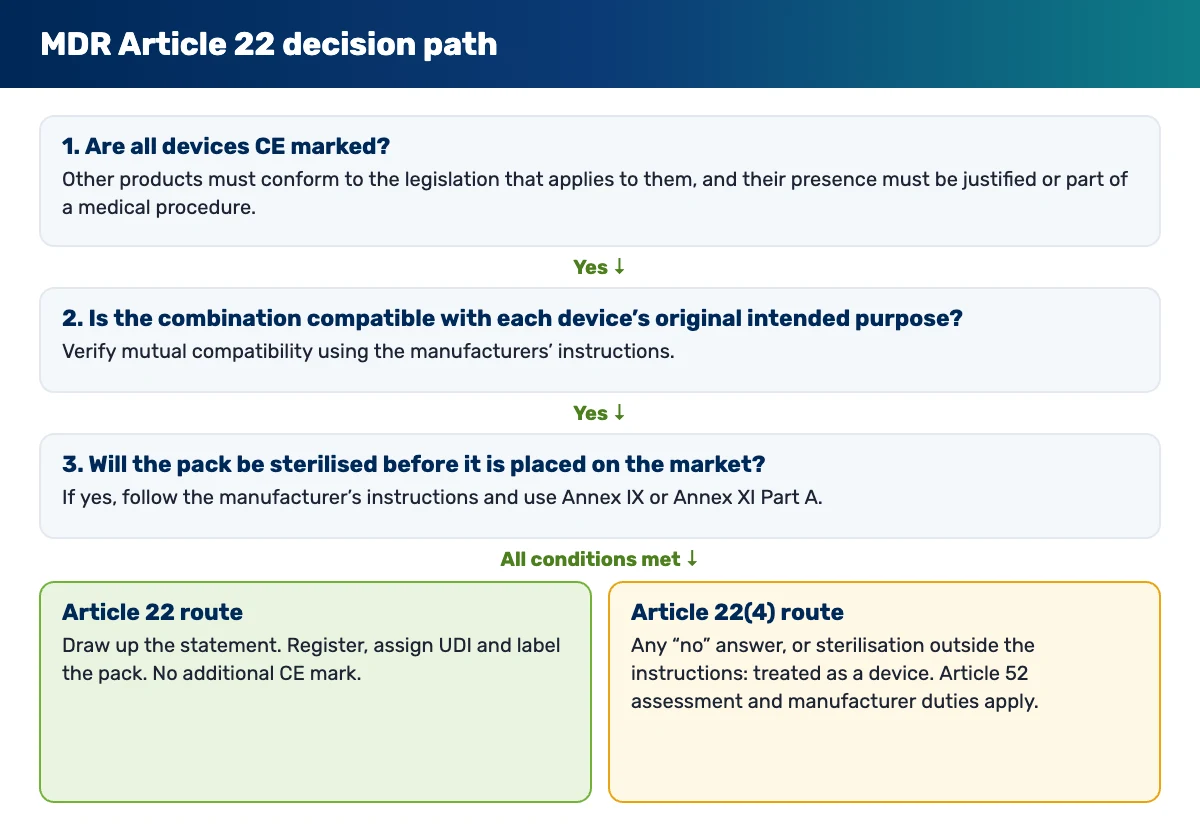
If Article 22(4) applies, plan for full CE marking. This generally means classification, a technical file, GSPR evidence, clinical evaluation and a quality management system such as ISO 13485, in proportion to the device.
How Are Sterile Systems and Procedure Packs Assessed?
Sterile combinations need extra planning. Sterilising a system or pack before placing it on the market requires a notified body. Under Article 22(3), the producer selects Annex IX or Annex XI Part A. Notified body involvement is limited to the aspects that ensure sterility until the sterile packaging is opened or damaged.
The producer must also state that sterilisation followed the manufacturer’s instructions. Check that each component’s instructions allow the chosen method, and plan the sterilisation validation early.
Mixed packs: if a pack holds both sterile and non-sterile items, the packaging and instructions must keep the sterile device sterile until use. The Norwegian Medical Products Agency also highlights the need for suitable packaging.
What Labelling and UDI Do Systems and Procedure Packs Need?
Under Article 22(5), the combination must not bear an additional CE marking. It must show the producer’s name, registered trade name or registered trade mark, and an address for contact. It must also carry the information in Annex I, section 23.
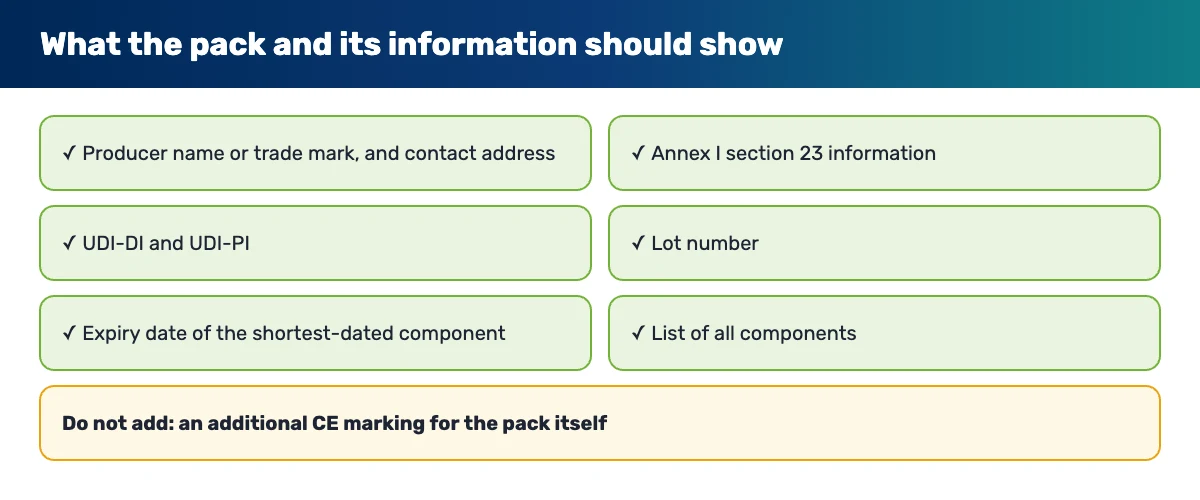
Under MDCG 2018-3, the combination has its own UDI, with a UDI-DI and UDI-PI. The Basic UDI-DI identifies combinations with the same group of components and the same intended purpose. Annex VI Part C generally places the UDI carrier on the outside of the packaging. Check whether each component also needs its own carrier inside the pack.
How Do You Place Systems and Procedure Packs on the EU Market?
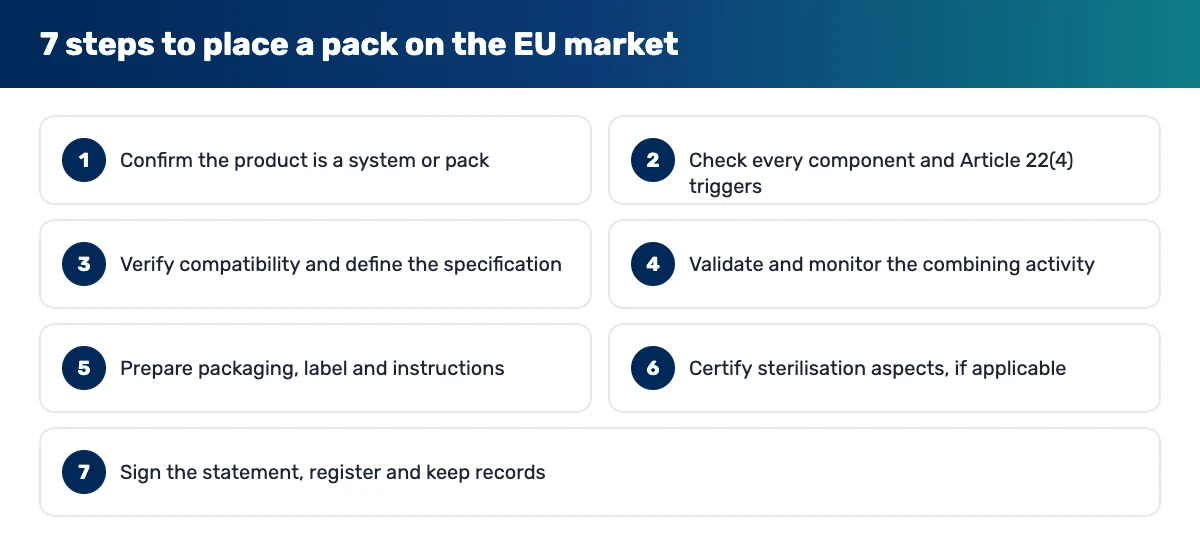
These seven steps provide a practical sequence for a typical project. Requirements for your product depend on its components and on whether it will be sterilised.
- Confirm the product typeDefine the specific medical purpose, and rule out distributor shipments, integral products, IVD kits and configurable devices.
- Check each componentConfirm the CE status and intended purpose of each device, and the legal conformity and justification of any other product.
- Verify compatibilityAssess compatibility against the manufacturers’ instructions, and document the specification of the combination.
- Control the activitySet up internal monitoring, verification and validation for the combining activity, in a way that suits the work.
- Prepare labels and instructionsInclude producer details, a component list, the lot number and UDI data. The Norwegian Medical Products Agency expects the expiry date to be based on the component with the shortest shelf life.
- Address sterilisationIf the pack will be sterilised, complete Annex IX or Annex XI Part A with a notified body. If not, record that this step does not apply.
- Sign, register and maintainSign the statement, obtain an SRN, register in EUDAMED, keep records, and review the file when a component or instruction changes.
Systems and Procedure Packs Support from I3CGLOBAL
I3CGLOBAL is a global regulatory consulting company for medical devices, IVDs, pharmaceuticals and life sciences. Our EU MDR consultants provide procedure pack compliance support, from the first route decision through to maintenance. Non-EU companies can also ask about EU representative services.
Every project starts with your component list, intended purpose and target markets. We use these to show which duties apply to your combination, what evidence already exists and where the gaps are. You then receive a clear plan that separates the producer route from full device conformity assessment.
| Service | What our consultants do |
|---|---|
| Regulatory assessment | Determine whether the combination falls under Article 22 or Article 22(4). |
| Component review | Review CE status, certificates, instructions and the justification for any non-device product. |
| Statement and evidence | Prepare the Article 22 statement and organise its supporting evidence. |
| Risk and compatibility | Support compatibility assessment and risk analysis for the combination. |
| Labels and instructions | Review labels and instructions against Annex I, section 23. |
| UDI and EUDAMED | Support SRN, Basic UDI-DI and EUDAMED registration tasks. |
| Notified body coordination | Coordinate sterility-related or full conformity assessment activities. |
| Technical documentation | Prepare MDR technical documentation where the pack is treated as a device. |
| Annual maintenance | Keep the Article 22 statement and its evidence file current, and review them when a component, instruction or certificate changes. |
Need help with systems and procedure packs?
Share your component list and intended purpose, and get a tailored proposal for your project.
Systems and Procedure Packs: Frequently Asked Questions
System vs procedure pack: what is the difference?
A procedure pack is a set of products packaged together and placed on the market for a specific medical purpose. A system is a set of products, packaged together or not, intended to be interconnected or combined for a specific medical purpose. Article 22 applies to both.
Do systems and procedure packs need a CE mark?
Under Article 22, the combination must not bear an additional CE marking. Its devices keep their own CE marking. If Article 22(4) applies, the combination is treated as a device and must complete conformity assessment under Article 52.
Is a technical file required for systems and procedure packs?
A full technical file is required if Article 22(4) applies. Otherwise, Article 22 centres on the producer statement. The producer should still keep evidence for compatibility, packaging, information and control of the combining activity.
Can a non-medical product be included?
Yes, if it conforms to the legislation that applies to it and it is used within a medical procedure, or its presence is otherwise justified. Record the justification and include the product in the compatibility and risk review.
Who is the system or procedure pack producer?
The producer is the natural or legal person who combines the products to place the system or pack on the market. MDCG 2018-3 uses this term. Importers and distributors who only supply items together on request are not producers.
Can a manufacturer combine its own devices into a system or procedure pack?
Yes. A manufacturer that combines its own CE-marked devices into a system or procedure pack and places it on the market takes on the producer role for that combination, unless the combination is already covered by the devices’ own conformity assessment and labelling. As a producer, it must meet Article 22: draw up the producer statement, register in EUDAMED with its SRN and provide the required UDI and labelling.
Do systems and procedure packs need UDI and EUDAMED registration?
Yes. The producer obtains an SRN, assigns a Basic UDI-DI and submits the core data to the UDI database before placing the combination on the market. The combination also bears its own UDI-DI and UDI-PI.
What is the EUDAMED deadline for systems and procedure packs?
Mandatory use of EUDAMED began on 28 May 2026. Producers must register as actors, and combinations placed on the market from that date must be registered before first placement. Those placed on the market earlier must be registered by 28 November 2026.
Does a notified body review every procedure pack?
No. A notified body is involved for sterilisation under Article 22(3), limited to sterility aspects, or for conformity assessment where Article 22(4) applies. Check any device components that need their own certificates separately.
Does a non-EU producer need an authorised representative?
Article 22 does not set this out directly, and published views differ for a producer that stays within Article 22. If Article 22(4) applies, the producer has manufacturer obligations, so Article 11 applies to a non-EU company. Seek advice for your own case.
Do existing MDD declarations remain valid?
Transitional rules may apply where a pack contains legacy devices. Published commentary refers to MDCG 2021-25 on this point, but the outcome depends on the status of each component. Check every component’s certificate and the transition period that applies to it before relying on an older declaration.
What expiry date should be used on a pack?
Use the expiry date of the component with the shortest shelf life. The Norwegian Medical Products Agency also expects a specific lot number and a list of all components in the supplied information.
Official References and Related Guides
- Regulation (EU) 2017/745 (MDR), Articles 2(10), 2(11), 22, 29(2) and 52
- MDCG 2018-3 Rev.1: UDI for systems and procedure packs
- EUDAMED help: registering a system or procedure pack
- HPRA: mandatory use of EUDAMED modules
- Norwegian Medical Products Agency: systems and procedure packs
- Medical Device CE Marking
- Medical Device Technical File
- EUDAMED Registration
- MDR Article 117
- Sterilization Validation
- CE Marking Consultants
Updated 7 November 2026 | Author: Sobha Augustine, Founder, I3CGLOBAL | Reviewed by: Asha Johnson, Manager, I3CGLOBAL