
Quick Contact
IEC 62304 Consultants
IEC 62304 consultants at I3CGlobal help medical device manufacturers and SaMD developers navigate the complexities of IEC 62304 standard compliance across all three software safety classes — Class A, Class B, and Class C. Our consultants work directly with your software development team and process owners to explain each clause of IEC 62304:2006, interpret Certification Body (CB) and Notified Body (NB) expectations, and build a compliant software lifecycle from development planning through release and post-market maintenance.
Whether you are preparing for an FDA 510(k) submission, EU MDR CE marking, or IVDR technical documentation, our team of consultants bridges the gap between your software engineering team and regulatory requirements by providing ready-to-use procedure templates, SOP drafts, risk management guidance aligned with ISO 14971, and hands-on review of every deliverable from your end
We do not just hand over documents; we sit with your process owners, walk them through all 16 IEC 62304 procedures, and ensure they understand what auditors and reviewers expect to see. Our engagement model clearly defines what I3CGlobal delivers as your compliance partner and what your software developers own as the technical execution team, so there are no gaps, no overlaps, and no surprises during a CB or NB audit.

(Listen for 6 Minutes)
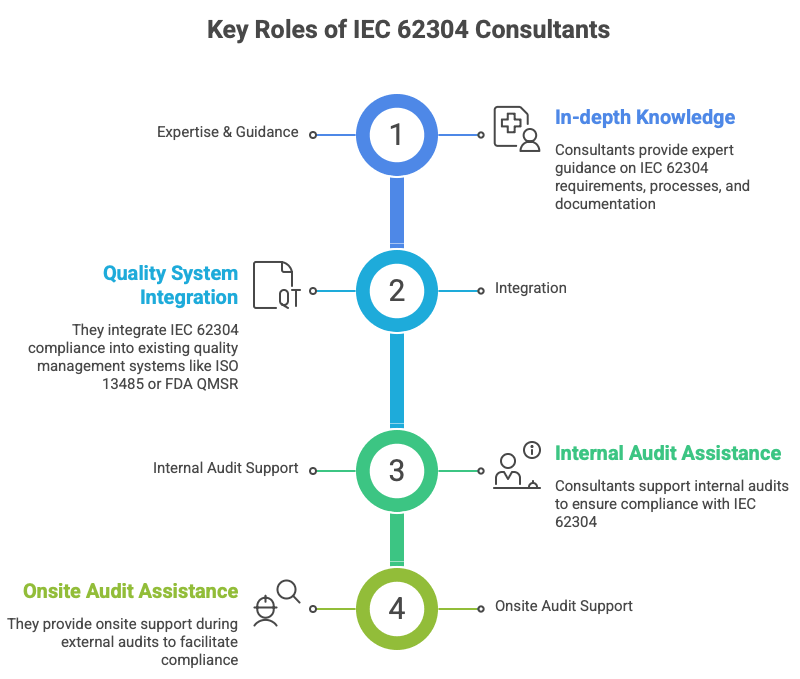
Key Roles of IEC 62304 Consultants
IEC 62304 Consultants play a vital role in guiding organisations through the process of complying with the standard’s requirements and implementing best practices for medical device standard compliance. Here’s a breakdown of their key roles:
Effectively coordinating with consultant team with software developers requires careful planning, clear communication, and a focus on building relationships and trust. By implementing the strategies outlined in this document, organizations can leverage the expertise of consultants to achieve their project goals while ensuring knowledge transfer and long-term sustainability.
Remember that flexibility and adaptability are key to success when working with consultant teams. Continuously evaluate and refine your coordination strategies to optimize performance and achieve desired outcomes.
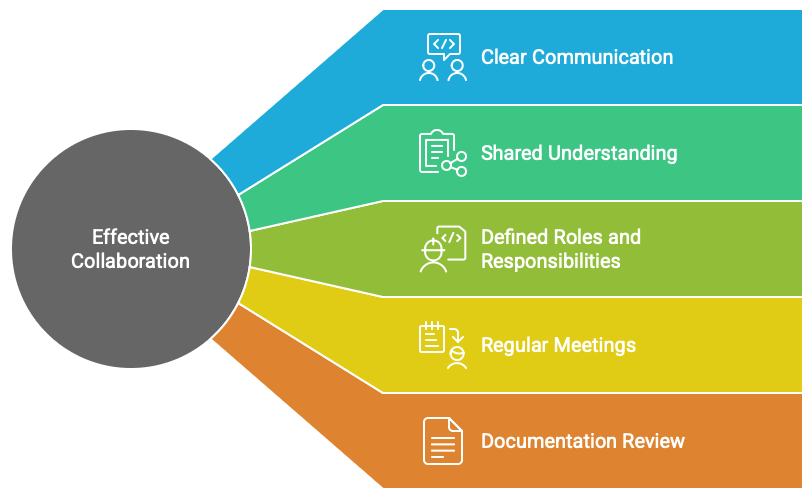
Effective collaboration is built on the above five essential pillars that drive team success shown on the above image. Clear communication ensures all members stay aligned and informed; Shared understanding creates a common vision and goals; Defined roles and responsibilities eliminate confusion by clarifying each person’s contribution; Regular meetings keep the team on track through consistent check-ins and progress updates; and documentation review maintains transparency and accountability by keeping records accurate and up to date. Together, these elements form the foundation of a productive and cohesive collaborative environment.
IEC 62304 Software Classification
Software failures in medical devices can have direct consequences for patients. A miscalculated dose, a missed alarm, an incorrect reading. This is addressed in IEC 62304 which requires manufacturers to classify their software on what could realistically go wrong. The greater the potential danger , the more stringent the development and testing standards . This risk-based approach means that a basic administrative interface on a device is held to a different standard than the algorithm managing drug distribution. Knowing what class your software belongs to are the beginning of all that follows, your development lifecycle, your testing requirements, your regulatory submission.
IEC 62304 standard establishes a cohesive framework for designing and testing software for medical devices through defined processes, activities, and tasks, ensuring safe usage in patients. The standard categorizes software into three safety classes according to the risk to the patient from a possible software failure
- Class A: No injury or damage to health is possible
- Class B: Non-serious injury is possible
- Class C: Death or serious injury is possible
IEC 62304 Specific Requirements
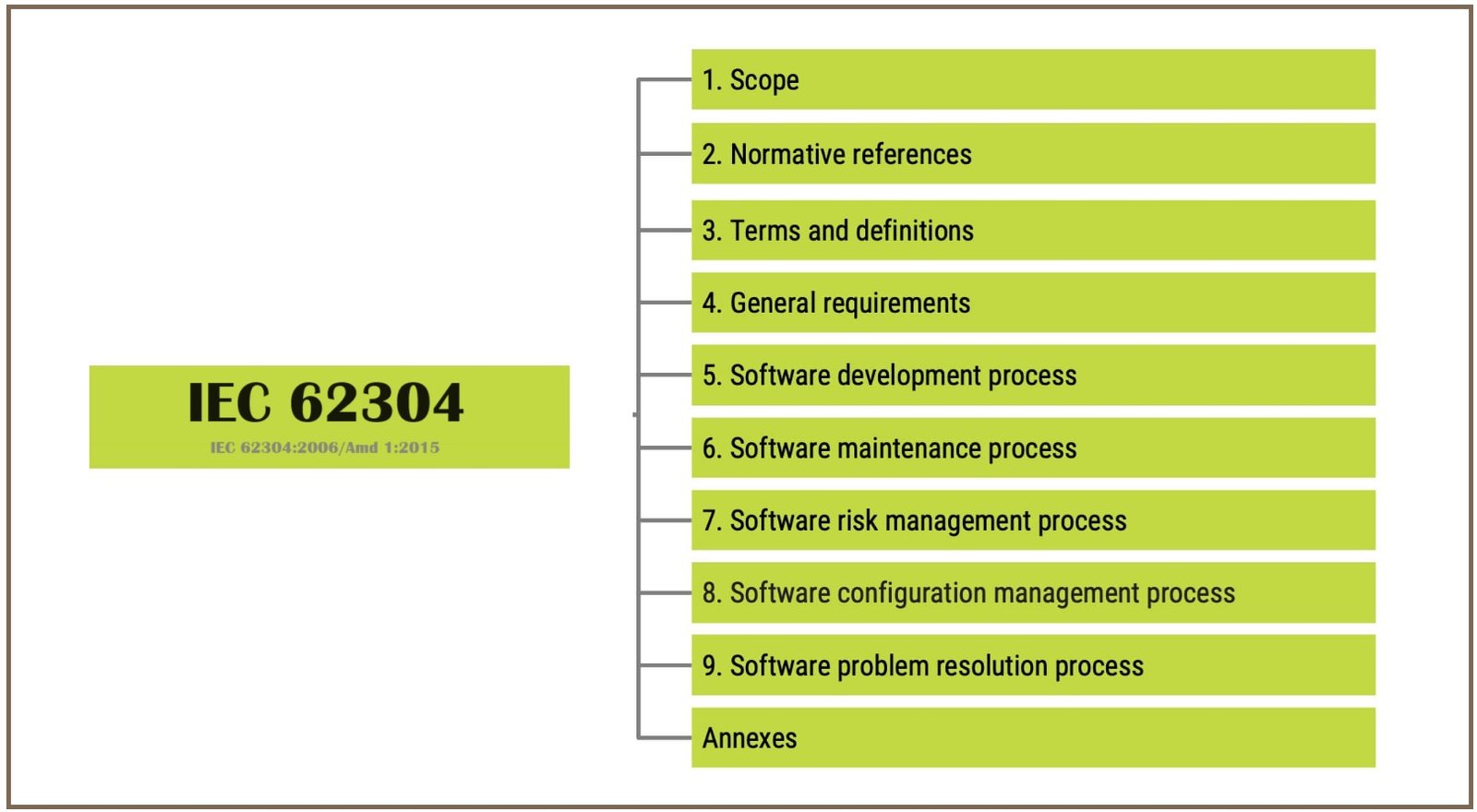
The subsequent 5 chapters of IEC 62304 detail specific requirements and guidelines for the development and proper implementation of medical device software.
| Chapter | Description |
|---|---|
| Chapter 5 | Software development and planning process including requirements analysis, design, testing, and release processes. |
| Chapter 6 | Software maintenance plan, including the implementation of a maintenance plan and issue analysis procedures. |
| Chapter 7 | Software risk management and identification of hazardous situations, risk control, verification, and risk management procedures following the ISO 14971 standard. |
| Chapter 8 | Software configuration management including change control and configuration status tracking. |
| Chapter 9 | Software problem resolution investigating and reporting on problems, change control processes, trend analysis, and resolution testing and verification. |
The FDA encourages the use of recognized consensus standards to show compliance. IEC 62304 standard acknowledged by the FDA for this purpose. Employing 62304 can facilitate the 510k submission process as it offers a comprehensive framework for software development, risk management, and documentation.
Benefits of Implementing IEC 62304 Standard
Implementing the IEC 62304 standard offers several benefits for software medical device manufacturers (SAMD & SIMD). A few are listed below:
- Compliance with 62304 helps ensure that medical device software is developed with patient safety as a primary consideration. By identifying and mitigating risks throughout the software lifecycle, organizations can minimize the likelihood of software-related errors or malfunctions that could harm patients
- Adhering to 62304 facilitates compliance with regulatory requirements in the European Union, the United States, and other regions where the standard is recognized. This can streamline the regulatory approval process and expedite certifications and approvals faster
- The standard emphasizes the importance of risk management in medical software. By systematically identifying, assessing, and mitigating risks, organizations can proactively address potential hazards and ensure the safety and effectiveness of their final released software
IEC 62304 is a standard that outlines requirements and guidelines for the development of medical device software; however, it does not ask for a certification or no certification body issues certificates.
Organizations can demonstrate compliance with IEC 62304 by implementing the standard’s requirements and following its guidelines throughout their software development processes
While there is no formal IEC 62304 Standard, organizations can still provide evidence of their adherence to the standard through documentation and audit reports. This can help build confidence in customers, regulatory authorities, and other stakeholders
With the help of IEC 62304 consultants such as I3CGlobal, the developers can identify, prepare, modify, implement, and conduct regular reviews and updates to these procedures to ensure ongoing compliance and effectiveness in managing software development activities.
IEC 62304 Consultants Vs. Software Developer
| No | Cl# | Procedure | I3CGlobal (Consultant) | Software Developer | Lead |
|---|---|---|---|---|---|
| 📋 Chapter 5 — Software Lifecycle (Development) | |||||
| 1 | 5.1 | Software Development Planning Class A+B+C |
|
|
Shared |
| 2 | 5.2 | Software Requirements Analysis Class A+B+C |
|
|
Shared |
| 3 | 5.3 | Software Architectural Design Class B+C |
|
|
Developer |
| 4 | 5.4 | Software Detailed Design Class B+C |
|
|
Developer |
| 5 | 5.5 | Verification of Software Unit Class A+B+C |
|
|
Developer |
| 6 | 5.6 | Verification & Testing of Integrated Software Class B+C |
|
|
Developer |
| 7 | 5.7.1 | Software System Testing Class B+C |
|
|
Shared |
| 8 | 5.7.3 | Retest After Changes Class B+C |
|
|
Developer |
| 9 | 5.8 | Software Release Class A+B+C |
|
|
Shared |
| 🔧 Chapter 6 — Software Maintenance | |||||
| 10 | 6.1 | Establishing Software Maintenance Plan Class A+B+C |
|
|
Shared |
| 11 | 6.2.1 | Feedback Class A+B+C |
|
|
Shared |
| 12 | 6.2.3 / 6.2.4 / 6.2.5 | Analysis, Approval & Communication of Changes Class A+B+C |
|
|
Shared |
| 13 | 6.5 | Implementation of Approved Modifications Class A+B+C |
|
|
Developer |
| ⚠️ Chapter 7 — Risk Management | |||||
| 14 | 7 | Risk Management Process Class A+B+C |
|
|
Shared |
| 🗂️ Chapter 8 — Configuration Management | |||||
| 15 | 8 | Configuration Management Class A+B+C |
|
|
Shared |
| 🐛 Chapter 9 — Problem Resolution | |||||
| 16 | 9 | Software Problem Resolution Class A+B+C |
|
|
Shared |
Frequently Asked Questions
What is medical device software?
Any software associated with a medical device or Invitro diagnostic device regardless of software in a medical device, software as a medical device, firmware, or embedded software is called medical software.
What Types of Software are Included?
Software used for medical device design, development, production, installation, and support is covered under the IEC 62304 standard. This includes the supporting software used in production and quality control in addition to the software that works directly with the patient or performs a medical function.
What is the timeline for ISO 62304 Implementation?
ISO 62304 Implementation generally, it takes 3-4 months.
How much does IEC 62304 consultancy cost?
Cost varies based on the safety class of your software and the complexity of your development processes. The prices for IEC 62304 consultants are based on the amount of work needed. The documentation requirements for Class A software are less complex and less expensive. Projects in Class C require full traceability, architectural evaluations and extensive verification, and thus take much more time.
IEC 62304 Consulting Online prices normally start at $12,000 USD and include gap analysis, process implementation, documentation assistance and compliance assessment. Implementation normally takes 3-5 months depending on the maturity of your current development procedures and turnaround time of deliverables.
Engaging IEC 62304 consultants early in your development lifecycle is usually faster and less costly than finding deficiencies during MDR /IVDR or FDA 510k document review.