
EU IVDR Regulation 2017/746
The EU In Vitro Diagnostic Medical Devices Regulation (IVDR), Regulation (EU) 2017/746, replaced the IVD Directive 98/79/EC. It entered into force on 26 May 2017 and has applied since 26 May 2022. New IVDs and non-sterile Class A devices must comply in full. Legacy devices that meet the Article 110 conditions can remain on the market during their transition periods, with some IVDR duties, such as post-market surveillance, already applying. This guide covers the EU IVDR Regulation (IVDR 2017/746): transition deadlines to 2029, Class A–D rules, notified body routes and key changes from the IVDD. I3CGLOBAL’s IVDR consultants support IVD manufacturers across all risk classes.
The basics
What is the EU IVDR Regulation?
The IVDR sets the rules for placing in vitro diagnostic medical devices on the EU market. As a regulation, it applies directly in every EU member state, with no national transposition, which removes the differences that existed under the directive.
Compared with the IVDD, the IVDR adds a risk-based classification system, much stronger performance evidence, notified body review for most devices, and lifetime obligations for post-market surveillance and traceability. Under Article 10(4), every manufacturer must draw up and keep up to date technical documentation that shows the device meets the regulation.
The legal text is available on EUR-Lex, and the European Commission publishes guidance on its medical devices pages.
What Counts as an IVD Under the IVDR?
Under Article 2(2), an in vitro diagnostic medical device is any medical device that is a reagent, reagent product, calibrator, control material, kit, instrument, apparatus, piece of equipment, software or system, used alone or in combination, intended by the manufacturer for the in vitro examination of specimens derived from the human body, including blood and tissue donations. It must be intended solely or principally to provide information on one or more of the following:
Physiological or pathological state
A physiological or pathological process or state.
Congenital impairment
Congenital physical or mental impairments.
Predisposition
A predisposition to a medical condition or a disease.
Safety and compatibility
The safety and compatibility with potential recipients.
Treatment response
Predicted treatment response or reactions.
Therapeutic measures
Defining or monitoring therapeutic measures.
Specimen receptacles are also IVDs. Software that meets this definition is an IVD in its own right; see IVDR software.
What Changed from the IVDD to the IVDR?
| Area | IVD Directive 98/79/EC | IVDR 2017/746 |
|---|---|---|
| Classification | Lists (Annex II List A, List B, self-tests, general) | Risk-based classification: 7 rules, Classes A to D |
| Notified body involvement | A minority of IVDs | Most IVDs (Classes B, C, D and sterile A) |
| Performance evidence | Limited requirements | Performance evaluation: scientific validity, analytical and clinical performance (Article 56, Annex XIII) |
| Post-market | Vigilance | PMS system, PMS report or periodic safety update report (PSUR), post-market performance follow-up (PMPF) |
| Traceability | No UDI requirement | UDI and registration in EUDAMED |
| Responsibilities | Mainly the manufacturer | Defined duties for manufacturers, authorised representatives, importers and distributors, plus a PRRC (Article 15) |
| Safety requirements | Essential Requirements | General Safety and Performance Requirements (GSPR, Annex I) |
Not sure whether your team is ready? See IVDD to IVDR for the main gaps manufacturers face.
What Are the IVDR Risk Classes and Conformity Assessment Routes?
The class decides the conformity assessment route, the notified body’s role and the depth of evidence. Use our IVDR classification guide, along with MDCG 2020-16 rev.5, to work through the rules.
| Class | Risk | Notified body |
|---|---|---|
| Class A | Low individual, low public | No: self-declaration |
| Class A sterile | Low individual, low public | Yes, sterility aspects only |
| Class B | Moderate individual, low public | Yes: QMS audit plus sampled technical documentation |
| Class C | High individual, moderate public | Yes: QMS audit plus technical documentation per generic device group |
| Class D | High individual, high public | Yes: every device, plus EU reference laboratory and expert panel where applicable |
A list of designated notified bodies is on our notified bodies page, and the fees they publish under Article 46 on notified body fees. See also IVDR CE certification cost.
Implementation
How Do You Implement the EU IVDR? 7 Steps
- Gap analysisList each IVD with its stock keeping units (SKUs), confirm the class and plan CE certification starting from a gap analysis. Non-EU manufacturers should also appoint an EU authorised representative before placing a device on the EU market.
- Project teamForm a project team that coordinates all activities with consultants and the notified body.
- Performance evaluationStart with the performance evaluation plan and the performance evaluation report (PER). Consult experts on study design so the study produces reliable sensitivity and specificity data.
- Technical documentationTransfer the relevant data from the PER into the technical documentation and complete the GSPR checklist.
- QMS implementationHave the facility assessed so the QMS meets Article 10(8) of the IVDR, with EN ISO 13485 as the usual basis.
- Notified body assessmentSubmit the technical documentation, respond to file review comments and complete the QMS audit.
- LifecycleKeep performance evaluation running through post-market performance follow-up.
Want this IVDR summary by email? Enter your address below. Privacy Policy
What Are the IVDR Transition Deadlines?
A legacy device is an IVD that relies on the Article 110 transition. It has either a valid IVDD notified body certificate, or an IVDD declaration of conformity drawn up before 26 May 2022 and now needs a notified body under the IVDR. It must meet the conditions and dates in Article 110.
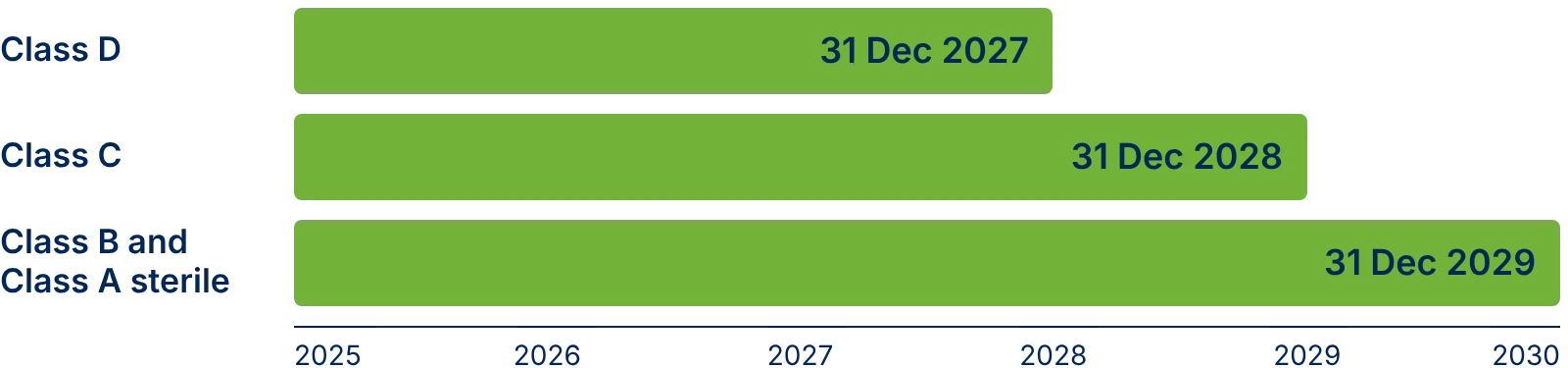
The IVDR’s date of application did not move: it is still 26 May 2022. To avoid shortages caused by limited notified body capacity, Regulation (EU) 2024/1860, published on 9 July 2024, extended the transition periods for legacy devices. Regulation (EU) 2023/607 had already removed the “sell-off” date, so devices already placed on the market can stay available until their shelf life ends.
Status on 3 November 2026. The deadlines to apply to a notified body and sign a written agreement have passed for Class D and Class C legacy devices. For Class B and Class A sterile legacy devices, the application deadline is 26 May 2027 and the written agreement deadline is 26 September 2027. The QMS deadline of 26 May 2025 applied to all these classes. A device that missed a required date cannot rely on these transition periods. See the Commission’s transitional provisions.
| Device status | IVDR-compliant QMS | Application lodged with NB | Written agreement with NB | End of transition |
|---|---|---|---|---|
| IVDD certified by a notified body | 26 May 2025 | 26 May 2025 | 26 Sept 2025 | 31 Dec 2027 |
| Self-declared, now Class D | 26 May 2025 | 26 May 2025 | 26 Sept 2025 | 31 Dec 2027 |
| Self-declared, now Class C | 26 May 2025 | 26 May 2026 | 26 Sept 2026 | 31 Dec 2028 |
| Self-declared, now Class B or Class A sterile | 26 May 2025 | 26 May 2027 | 26 Sept 2027 | 31 Dec 2029 |
Scenario 1: valid IVDD certificate
The certificate stays valid if the QMS met the IVDR by 26 May 2025, an application was lodged by 26 May 2025 and an agreement signed by 26 September 2025. The device can then be placed on the market until 31 December 2027.
Scenario 2: certificate expired before 9 July 2024
The same transition applies to a certificate that expired before 9 July 2024 if the manufacturer and a notified body signed a written agreement before the expiry date, or a competent authority granted a derogation under Article 54(1) or required a conformity assessment under Article 92(1).
Scenario 3: self-declared under the IVDD
Devices with an IVDD declaration of conformity signed before 26 May 2022 that now need a notified body follow the class-based dates in the table above.
What Must IVD Manufacturers Do Under the IVDR?
01
Quality management system
An EN ISO 13485 QMS covering the IVDR obligations in Article 10(8). See upgrading QMS to IVDR.
02
Person responsible (PRRC)
At least one qualified person responsible for regulatory compliance (Article 15).
03
Technical documentation
Annex II and III documentation kept up to date for the device lifetime.
04
Performance evaluation
Scientific validity, analytical and clinical performance, updated through PMPF.
05
PMS and vigilance
PMS plan, PMS report (Class A, B) or PSUR (Class C, D), vigilance and trend reporting. See PMS report.
06
UDI and EUDAMED
Unique device identification and registration in EUDAMED. The UDI carrier must be on the label from 26 May 2023 for Class D, 26 May 2025 for Classes B and C, and 26 May 2027 for Class A. These dates apply to IVDR-compliant devices, not legacy devices. Use of the first four modules became mandatory on 28 May 2026, following Commission Decision (EU) 2025/2371. Devices already on the market, including legacy devices, must be registered by 28 November 2026. New devices must be registered before they are placed on the market. Notified bodies must register certificates issued before 28 May 2026 by 28 May 2027.
What is changing next?
Commission Implementing Regulation (EU) 2026/977 sets minimum requirements for notified bodies, including quotes and maximum timeframes. It applies from 25 February 2027. The quotation and timeline rules cover procedures where the written agreement is signed on or after that date. The re-certification provisions do not apply to reviews of certificates expiring before 25 November 2027. See our Regulation 2026/977 update. Separately, in December 2025 the Commission proposed a revision of the MDR and IVDR. It is still a proposal and does not change current deadlines.
How we help
EU IVDR Compliance Support from I3CGLOBAL
Our IVDR consultants guide small, medium and large IVD manufacturers through Regulation (EU) 2017/746, across all risk classes from Class A to Class D. We support IVD manufacturers worldwide from offices in the United States, the United Kingdom, Germany, Portugal, India, Malaysia and Vietnam. See our IVDR CE marking case studies: four IVD projects from 2023 to 2025, including Class C and Class D devices.
Case study: Class D syphilis ELISA kit. A manufacturer’s blood-donor screening kit moved from IVDD List B to Class D under Annex VIII, Rule 1, which brought in notified body and EU reference laboratory (EURL) review. The main challenges were clinical data gaps, traceability to WHO international standards and unpredictable EURL timelines. I3CGLOBAL delivered the Annex II and III technical documentation in 7 months. The kit achieved IVDR CE marking, with no major non-conformities after two rounds of notified body review, and the EURL confirmed the results without re-testing.
- IVDD to IVDR gap analysis and implementation plan
- Performance evaluation and technical documentation
- QMS upgrade, PRRC and EUDAMED support
- Notified body submission and review support
Start your IVDR project
Share your device details and get a tailored proposal.
FAQs
EU IVDR Regulation: Frequently Asked Questions
When did the EU IVDR Regulation start to apply?
The IVDR entered into force on 26 May 2017 and has applied since 26 May 2022, replacing Directive 98/79/EC (IVDD). Legacy devices can use the extended transition periods of Regulation (EU) 2024/1860 if they meet its conditions. See the IVDR transition timeline.
What is a legacy device under the IVDR?
A legacy device is an IVD that relies on the Article 110 transition. It has either a valid IVDD notified body certificate, or an IVDD declaration of conformity drawn up before 26 May 2022 and now needs a notified body under the IVDR. It must meet the conditions and dates in Article 110. Non-sterile Class A devices do not qualify.
What are the conditions for using the extended timelines?
The device must continue to comply with the IVDD and have no significant change in design or intended purpose. It must pose no unacceptable risk. The manufacturer must have had an IVDR QMS by 26 May 2025, and must meet the class-based dates for the notified body application and written agreement.
What IVDR requirements apply during the extension period?
IVDR requirements for post-market surveillance, market surveillance, vigilance and registration of economic operators and devices apply, along with a QMS meeting Article 10(8). EN ISO 13485 is the usual basis for that QMS.
Which IVDR deadlines are still open?
Devices already on the market, including legacy devices, must be registered in EUDAMED by 28 November 2026. Notified bodies must register certificates issued before 28 May 2026 by 28 May 2027. Class A devices must carry the UDI on the label from 26 May 2027. Class B and Class A sterile legacy devices must apply to a notified body by 26 May 2027 and sign a written agreement by 26 September 2027. The transition periods end on 31 December 2027 for Class D, 31 December 2028 for Class C, and 31 December 2029 for Class B and Class A sterile.
Do UDI label deadlines apply to legacy devices?
No. The UDI label dates for Classes A to D apply to IVDR-compliant devices. Legacy devices must still be registered in EUDAMED.
Does the IVDR apply to non-EU manufacturers?
Yes, if they place devices on the EU market. They must also appoint an EU authorised representative.
How do the extended timelines affect IVD manufacturers?
For Class D and Class C legacy devices, the application and written agreement deadlines have passed, so only devices that met them can use the transition, which runs until 31 December 2027 and 31 December 2028. Class B and Class A sterile manufacturers should complete their gap analysis and apply to a notified body ahead of the 26 May 2027 deadline.
How important is performance evaluation under the IVDR?
It is central to IVDR conformity. Performance evaluation under Article 56 and Annex XIII requires evidence of scientific validity, analytical performance and clinical performance. The Performance Evaluation Report brings this evidence together and is kept up to date through post-market performance follow-up.
Does the IVDR apply to Class A devices?
Yes. Non-sterile Class A devices are self-declared, but must meet the IVDR in full, with no transition period. See IVDR Class A.
What is the difference between the IVDD and the IVDR?
The IVDR replaces the IVDD’s list-based system with risk Classes A to D. It brings most IVDs under notified body review, and adds stricter performance evidence, post-market surveillance, UDI and EUDAMED requirements.
Which IVDs need a notified body under the IVDR?
Class A sterile, Class B, Class C and Class D devices need a notified body. For Class A sterile devices, its role covers sterility aspects only. Non-sterile Class A devices are self-declared.
Which IVDR rules are changing next?
Implementing Regulation (EU) 2026/977 sets uniform requirements for notified bodies from 25 February 2027. Its quotation and timeline rules cover procedures where the written agreement is signed on or after that date, and its re-certification provisions do not apply to reviews of certificates expiring before 25 November 2027. Annual reporting applies from 1 January 2028. The Commission’s December 2025 proposal to revise the MDR and IVDR does not change current deadlines unless it is adopted.
Do IVD manufacturers have to report supply interruptions?
Yes, in certain cases. Under Article 10a, a manufacturer that anticipates an interruption or discontinuation that could cause serious harm or a risk of serious harm must give at least six months’ notice. Notice goes to the competent authority and to the operators, health institutions and professionals it directly supplies. This has applied since 10 January 2025.
Does the IVDR apply to tests made in-house by hospitals?
Yes, under the conditions in Article 5(5). Annex I has applied since 26 May 2022, and Article 5(5)(b), (c) and (e) to (i) since 26 May 2024. Article 5(5)(d) applies from 31 December 2030. It requires the health institution to justify that patient needs cannot be met, or met at the appropriate performance level, by an equivalent device on the market.
Does an IVDD-certified device follow the class-based end dates?
No. A device with a valid IVDD certificate that meets the conditions can be placed on the market until 31 December 2027. The later class-based dates apply to self-declared legacy devices that now need a notified body.
How Can You Prepare an IVDR Technical File for Notified Body Review?
An incomplete technical file under Regulation (EU) 2017/746 can lead to additional review rounds and delay certification.
Our pre-submission audit of your IVDR technical documentation mirrors the rigorous review of designated EU notified bodies, identifying critical gaps across GSPR traceability, Annex XIII clinical evidence, and Annex II stability data before you lodge your formal application.
What Your Pre-Submission Audit Delivers
- Line-by-Line GSPR Traceability ReviewVerification that every Annex I requirement points to concrete test protocol IDs, validation reports, and applicable harmonized standards or Common Specifications (CS).
- PER Three-Pillar Rigor AssessmentDetailed review of your Scientific Validity (SVR), Analytical Performance (APR), and Clinical Performance (CPR) documentation against Annex XIII and MDCG 2022-2.
- Annex II Stability & Design Verification AuditGap closure for in-use stability, transport simulations, specimen integrity, and open-vial data.
- Actionable Deficiency Remediation MatrixA prioritized, step-by-step roadmap outlining exactly what to remediate, rewrite, or validate prior to Notified Body submission.
Request Your Pre-Submission Audit
Submit your device details below to consult with a senior EU IVDR regulatory specialist. All inquiries are covered under a mutual Non-Disclosure Agreement (NDA).
Privacy Assurance: Your technical data and intellectual property are protected under a binding NDA. We respond within 1 business day.
How the Pre-Submission Audit Works
- Agreed TurnaroundThe delivery date for your gap audit report is confirmed in your proposal.
- Direct AccessWork directly with I3CGLOBAL IVDR consultants.
- ConfidentialitySecure data rooms and mutual NDAs executed prior to file transfer.