
CE Marking Approval Process
Quick Contact
Medical Device CE Certification
Medical Device CE Certification is mandatory for manufacturers planning to market medical devices in the European Union under MDR 2017/745. I3CGLOBAL supports manufacturers with CE Certification medical device compliance, including Technical Documentation, Clinical Evaluation Reports (CER), ISO 13485 implementation, Risk Management, and Notified Body coordination.
Looking for Medical Device CE Certification Consultants?
Getting a medical device CE certified is not a straight road. Between MDR technical documentation, clinical evaluation reports, ISO 13485 quality systems, and risk management files, the compliance workload is substantial and the margin for error is narrow.
I3CGlobal works with manufacturers at every stage of the CE marking process. Whether you are preparing for a first submission, transitioning legacy devices under EU MDR, or responding to notified body queries, our consultants bring hands-on regulatory experience to every engagement.
We support clients across Europe, the US, Asia, and beyond—handling technical documentation, CER writing, EUDAMED registration, ISO 13485 gap analysis, and post-market surveillance requirements.
No generic templates. No hand-holding that leads nowhere. Just structured, expert-led support that moves your device toward market.
GERMANY – INDIA – MALAYSIA – PORTUGAL – SOUTH KOREA – UK – USA – VIETNAM
What is Medical Device CE Certification?
CE certification is how a manufacturer proves that their medical device is safe, performs as intended, and meets the requirements of European regulations — specifically the EU Medical Device Regulation (EU MDR 2017/745) for medical devices and EU IVDR 2017/746 for in-vitro diagnostic devices.
Once a device meets these requirements, the manufacturer can affix the CE Mark. That mark is the passport to selling in the European Union and several other countries that recognise it, including Switzerland, Norway, Iceland, and the UK (under its own UKCA framework).
How does the medical device ce certification process work?
The certification route depends on the risk class of your device. Class I devices — lower risk — allow manufacturers to self-declare conformity in most cases. Class IIa, IIb, and Class III devices require a notified body to independently review and approve your documentation before the CE Mark can be applied. Regardless of class, every manufacturer must work through the same core steps:
- Device classification — determining which risk class your device falls into under EU MDR rules
- Technical documentation — compiling design, labelling, manufacturing, and performance evidence
- Risk management — identifying and controlling risks throughout the device lifecycle per ISO 14971
- Clinical evaluation — demonstrating clinical safety and performance through data, literature, or clinical investigations
- Quality Management System — implementing ISO 13485-compliant processes across your organisation
- Notified body review — mandatory for Class IIa and above; the notified body audits your documentation and QMS before issuing certification
What has changed under EU MDR?
The old Medical Device Directive (MDD) has been replaced with EU MDR and the standards are a lot higher now. Claims of equivalency are no longer acceptable without proper substantiation. Requirements for clinical data are more rigorous, post market surveillance must be active and continuous and technical documentation is now subject to regular review not just a single submission.
For manufacturers transitioning legacy devices or entering the EU market for the first time, understanding these requirements early saves significant time and cost down the line.
How Much Does Medical Device CE Certification Cost?
The price of CE Certification depends on factors such as your device classification, complexity of your technical documentation, Notified Body involvement, and the level of regulatory support your team needs.
Generally, costs are lower for Class I self-certification projects (no Notified Body fee applies). For Class IIa, IIb and Class III devices you have to take into account the consultancy fee plus the Notified Body assessment fee, which varies by body and device type.
I3CGlobal’s CE Certification consultancy services start at €9,000 EUR for online engagements, providing gap analysis, technical documentation support, clinical evaluation assistance, and Notified Body coordination. Implementation typically spans 10 to 16 months, contingent on device complexity and your team’s preparedness.
Getting a consultant involved early avoids costly rework during Notified Body review, which is almost always more expensive than doing the documentation right the first time.
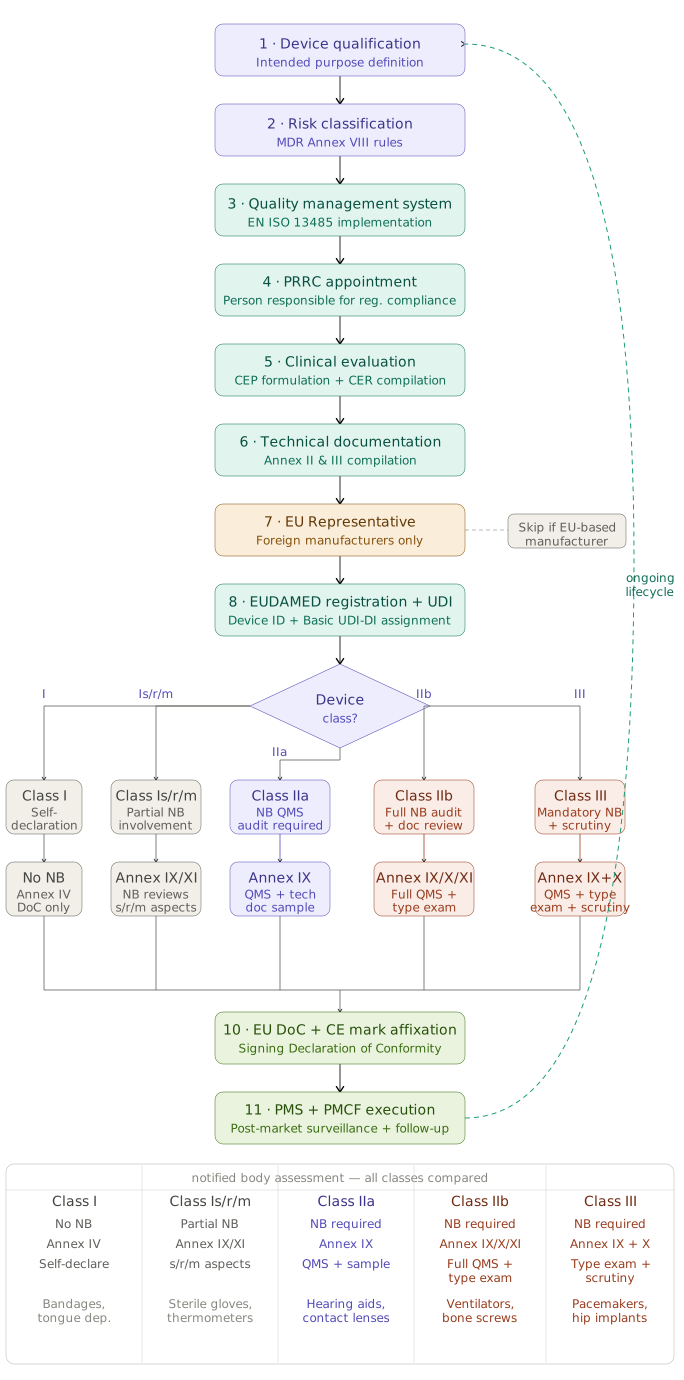
CE Certification of Medical Device - The Process Flow Diagram for all Classes
The CE certification process differs based on your equipment classification. Class I devices are primarily self-certified whereas Class IIa, IIb and Class III devices have growing involvement of a notified body. Below is the process flow depicting each classification path from initial device classification, technical documentation, conformity assessment, EUDAMED registration and CE marking. Use this as a guide in planning your regulatory approach.
Critical Steps in the CE Certification of Medical Device
The CE certification process involves several regulatory and technical steps.
⊕ Device Classification
The first step in Medical Device CE Certification is to find out the correct class of the device according to MDR or IVDR rules. Medical devices are divided into different classes such as Class I, Is, Im, IIa, IIb, and III depending on the risk of the device. In the case of IVD devices, they are classified as Class A, B, C, or D. This classification is important because it decides how much regulatory review is needed and whether a Notified Body must check the device before it can be sold.
⊕ Quality Management System (ISO 13485)
Manufacturers must establish a proper Quality Management System (QMS) before applying for CE certification. ISO 13485 is the internationally accepted standard for medical device quality management. The QMS normally includes procedures for design control, risk management, supplier management, complaint handling, and post-market surveillance activities.
⊕ Technical Documentation Preparation
Technical documentation is one of the most important parts of Medical Device CE Certification. The technical file usually contains details such as device description, intended use, design and manufacturing information, risk management documentation, biological evaluation, sterilization validation (if the device is sterile), clinical evaluation, performance data, and labeling with Instructions for Use. For higher-risk devices, this documentation must be reviewed by a Notified Body.
⊕ Clinical Evaluation
Clinical evaluation is an important requirement under MDR. The manufacturer must show that the medical device is safe and works properly for its intended use. This can be done by carrying out clinical investigations, reviewing scientific articles, or comparing the device with a similar device already available in the market. All this information is written and presented in a document called the Clinical Evaluation Report (CER).
⊕ Notified Body Assessment
For most medical devices, except some Class I devices, the documents prepared by the manufacturer must be checked by an independent organisation called a Notified Body. The Notified Body will review the technical documents, the Quality Management System, and the clinical evidence to make sure the device follows the required regulations.
⊕ CE Mark Declaration
After completing the Technical Documentation File and meeting all regulatory requirements, the manufacturer prepares a document called the Declaration of Conformity (DoC). This document states that the device follows the European regulations. After that, the CE Mark is placed on the device, and the product can then be sold in countries within the European Economic Area (EEA).
CE Certification - Medical Device Vs. In-Vito Diagnostic Devices
EU MDR 2017/745
(Medical Device Regulation)
Medical Device Regulation MDR 2017/745 replaced the older Medical Device Directive MDD 93/42/EEC. The new MDR rules are stricter than before and require more detailed technical and clinical documents from manufacturers. Under MDR, manufacturers must prepare several important documents and follow certain requirements, such as:
-
Clinical Evaluation Plan and Report
-
Risk Management plan and Report according to ISO 14971
-
Post Market Surveillance (PMS) Plan and Report (PMSR)
-
Periodic Safety Update Report (PSUR) along with Plan
-
EUDAMED and Unique Device Identification (UDI)
-
Complete Technical Documentation File (TDF) for the device
All medical device CE certification applicants need to establish a Quality Management System like EN ISO 13485 to make sure their medical devices are designed, manufactured, and controlled according to regulatory requirements.
EU IVDR 2017/746
(In Vitro Diagnostic Regulation)
The IVDR regulation governs In Vitro Diagnostic devices such as diagnostic test kits, reagents, and laboratory instruments. IVDR introduced a new risk-based classification system, Class A, B, C and D. Compared to the previous directive, IVDR significantly increased the number of devices requiring Notified Body review. Manufacturers must demonstrate:
-
Scientific validity
-
Analytical performance
-
Clinical performance
-
Complete Technical Documentation File (TDF) for the IVD
-
EUDAMED and Unique Device Identification (UDI)
- GSPR Fulfillment
- Post-Market Performance Follow-up (PMPF)
- Gather Data Via PMPF Surveys
- Use expert strategy to develop an Post-Market Performance Follow-up plan and report
The standard guidelines are difficult to interpret and technical documentation requirements under IVDR are extensive, particularly for Class C and Class D IVD devices.
CE Certification of Medical Device and its Challenges
Medical Device CE Certification is no straightforward process. It takes time, detailed documentation, and a clear understanding of European regulations. Many manufacturers — whether based in the UK, USA, India, or elsewhere — run into similar problems along the way.
⊕ Not Enough Clinical Data
One of the most common challenges is not having enough clinical evidence to support the device. The EU MDR requires manufacturers to demonstrate that their device is clinically safe and functions as intended, which requires data from clinical studies, published literature or post-market surveillance. For newer devices or those with no long history of use, creating this evidence takes a lot of work.
⊕ Complex Documentation Requirements
The technical documentation required by EU MDR and IVDR is extensive. Manufacturers must prepare detailed files covering device design, manufacturing, risk management, labelling and clinical evaluation – all in a format expected by notified bodies. For many companies, particularly smaller ones, this volume of paperwork is difficult to handle without dedicated regulatory resources.
⊕ Choosing the Right Notified Body
Not every notified body covers every type of device. Manufacturers often struggle to identify which notified body is authorised to assess their specific product category. The limited number of Notified Bodies currently designated under the EU MDR has also resulted in a significant increase in the waiting times for review slots.
⊕ Long Review Timelines
Manufacturers should anticipate that the review process can take several months even after submitting a complete application. Notified bodies are often quite busy, and any gaps or questions in your documentation can create additional delays. It’s important to plan ahead — the full process from start to finish may take longer than many manufacturers expect.
⊕ Transitioning from MDD to EU MDR
Moving from MDD to EU MDR Manufacturers that had MDD certification before have had to rebuild their technical documentation to comply with the more stringent MDR requirements. The transition has not been smooth. Clinical data standards are higher, post-market surveillance obligations are more demanding, and legacy devices that were once approved under equivalence now need stronger justification.
How Regulatory Consultants Help Medical Device CE Certification?
Because of these challenges, many manufacturers choose to work with experienced CE certification consultants. A good consultant helps you understand exactly what is required for your device class, prepares and reviews your technical documentation, supports your clinical evaluation process, and manages communication with the notified body on your behalf. This reduces the risk of delays, rejections, and costly rework — and gives your team confidence that the submission is done right the first time.
Our global operations are carried out from Bangalore – India, Chicago – USA, Charlotte – USA, Düsseldorf – Germany, Delhi – India, Penang – Malaysia, Seoul – South Korea, and London – United Kingdom. Find Contact Locations
Why Manufacturers Choose I3CGlobal for CE Certification
I3CGlobal has been supporting medical device manufacturers with CE Certification since 2010. Over 15 years, we have helped more than 500 manufacturers across 40 countries achieve compliance under EU MDR and IVDR — covering everything from Class I consumables to Class III implantable devices and Class D IVDs.
Our consultants hold direct experience with Notified Body submissions, clinical evaluation writing, ISO 13485 implementation, and EUDAMED registration. We operate from offices in the USA, UK, Germany, India, Malaysia, Portugal, and South Korea — giving manufacturers a local point of contact regardless of where they are based.
No subcontracting. No templates handed over without support. Every engagement is handled by qualified regulatory professionals from start to finish.
For UK Manufacturers
After Brexit, UK manufacturers selling to the European Union will need to comply with EU MDR regulations independently of UKCA. This entails appointing an EU Authorised Representative and registering in EUDAMED as well as any UK regulatory duties. I3CGlobal provides UK based manufacturers with both CE and UKCA compliance and manages the dual market needs from our London office.
For European Manufacturers
Being established within the EU, European manufacturers would feel that CE Certification is uncomplicated — yet completing EU MDR and IVDR regulations is similarly hard regardless of where you are located. Every manufacturer must meet the same documentation standards, the same clinical evidence requirements and the same Notified Body timescales.
I3CGlobal has offices in GermanY and Portugal provides hands-on regulatory support in technical documentation, clinical evaluation, ISO 13485 implementation and Notified Body cooperation to support European firms. Whether you are a first-time application or transferring an existing MDD-certified product to EU MDR, our European staff works in your time zone, understands local market regulations, and coordinates directly with Notified Bodies across the EU on your behalf.
For the USA and Canada Manufactures
When US businesses enter the European market, they typically misunderstand how different EU MDR is to FDA regulations. But the criteria for clinical evidence, post-market surveillance requirements and formats for technical documentation all vary. I3CGlobal works directly with US based manufacturers from our Charlotte and Chicago offices, helping to bridge the gap between FDA and EU MDR compliance without duplication of effort where standards overlap.
For Manufacturers of India and Asia-Pacific Countries
India is one of the fastest growing medical device manufacturing sectors in the world with more and more businesses pursuing CE Certification to enter European clients and international supply chains. The Bangalore team at i3CGlobal partners with Indian manufacturers to deliver technical documentation, clinical evaluation, ISO 13485 implementation and EU Representative services – providing complete support from a team that understands the local manufacturing environment and European regulatory expectations.
Frequently Asked Questions
What is the difference between CE Marking and CE Certification?
These terms are interchangeable but there is a slight difference. CE Marking is the physical mark on the device. CE Certification refers to the entire process of meeting the regulatory requirements that allows you to apply that mark. You cannot legally place the CE Mark on a medical device without completing the full certification process under EU MDR or IVDR.
Do I need a Notified Body for all medical devices CE Certification?
Not for all devices. Class I medical devices that are non-sterile and have no measuring function can be self-certified by the manufacturer. However, Class Is (sterile), Class Im (measuring), Class IIa, IIb, and Class III devices all require a Notified Body to review and approve your technical documentation before you can affix the CE Mark
Can a manufacturer outside Europe apply for Medical Device CE Certification?
Yes. Manufacturers based in the USA, India, UK or any other country outside of the European Economic Area can apply for CE Certification but must appoint an EU Authorised Representative based within the EU. The EU Representative is the official point of contact for regulatory authorities and assumes certain legal responsibilities on behalf of the manufacturer.
What happens if my CE Certificate expires or my device is modified?
CE Certificates issued by Notified Bodies generally have a validity of three to five years and must be renewed prior to expiry. If you make a substantial modification to your device – such as a design modification, change in intended use or a new manufacturing process – you are required to inform your Notified Body and determine whether the modification necessitates a new conformity assessment. Failure to manage certificate renewals or device changes can lead to your product being withdrawn from the European market
How long the MDR and IVDR CE Certification Process
Based on the device complexity, risk class, models and variants the total time line for the certification will change. Usually high risk class device take around 12 to 16 months for the receipt of CE Certificate.
What is a Declaration of Conformity and who signs it?
The Declaration of Conformity (DoC) is a legal document issued by the manufacturer stating that the medical device complies with all the applicable requirements of the EU MDR or IVDR. The DoC must be signed by an authorised person within the manufacturer’s organisation – generally the CEO, Managing Director or the Person Responsible for Regulatory Compliance (PRRC). The DoC must be kept on file and available for regulatory authorities if they want to see it.
How long does Medical Device CE Certification take?
Is Medical Device CE Certification mandatory in Europe?
What documents are required for Medical Device CE Certification?
- Biocompatibility Records
- Electrical Safety Test Records
- Performance test reports
- Shel-life and Stability reports
- Risk Management File
- Clinical Evaluation Report (CER)
- Labeling and IFU (Instructions for Use)
- UDI and EUDAMED Registration Information
Medical Device CE Certification Cost
Medical Device CE Certification Page content modified by Sara Moly on 18th June 2026 and approved by Asha Johnson