
IVDR Certification Statement of Work
A phase-by-phase Statement of Work (SOW) for IVDR certification under Regulation (EU) 2017/746. See exactly what I3CGlobal delivers, what the manufacturer provides, and how each step leads to notified body submission and your IVDR CE certificate.
How an IVDR Statement of Work Helps Regulatory Professionals
An IVDR statement of work (SOW) gives regulatory affairs and quality professionals one agreed plan for IVDR certification. It defines who does what, and when, so every technical file deliverable has a clear owner, deadline and approval step.
- Assign clear ownership of each activity between the consultant and the manufacturer
- Plan resources and timelines across all 10 phases of the project
- Track progress on Annex II and III technical documentation, performance evaluation and PMS
- Prepare evidence in the order a notified body expects, reducing review rounds
IVDR certification itself is how an in vitro diagnostic manufacturer proves conformity with Regulation (EU) 2017/746: classify the device, implement a QMS, compile Annex II and III technical documentation, complete the performance evaluation and, for most classes, pass a notified body assessment before affixing the CE mark.
The SOW outlined below for IVDR certification explains the activities and responsibilities of consultants and CE applicants (manufacturers), along with deliverables, for the on-time completion of technical documentation and submission to a notified body for obtaining CE certification under the European Union In Vitro Diagnostic Medical Devices Regulation (EU IVDR 2017/746) for an in vitro diagnostic device.
This SOW is designed to build awareness for newcomers applying for IVD CE marking. Minor deviations in the steps may be necessary during actual documentation, depending on the device class and intended use.

Official references: Regulation (EU) 2017/746 (EUR-Lex) · Regulation (EU) 2024/1860 · MDCG guidance · NANDO notified bodies
Last reviewed: 1 November 2026
The 10 Phases of IVDR Certification
Each phase builds a part of the technical file required by Annex II and Annex III of the IVDR. Here is the journey at a glance before the detailed Statement of Work.
- Legal address and scopeCompany registration, outsourcing locations and QMS status.
- Device informationModels, GMDN/EMDN codes, intended use and risk classification.
- IVDR requirements and design controlsStandards, GSPR checklist, DoC, ISO 13485 and IEC 62304 design files.
- Risk analysis and usabilityRisk management file, benefit-risk analysis and usability report.
- Biocompatibility and V&VBiological evaluation, analytical performance and metrological traceability.
- Production controlsProcess, sterilization and clean room validation.
- Labelling, storage and packagingLabels, IFU, shelf life and packaging/transport validation.
- Quality controlSpecifications, COA, batch release and performance testing.
- Performance evaluation and PMSPEP and PER, PMS, vigilance and PMPF.
- Notified body certificationSubmission, review rounds, onsite audit and IVDR CE certificate.
IVDR CE Certification Statement of Work: I3CGlobal vs Manufacturer
The table below lists every activity, the scope handled by I3CGlobal and the inputs or approvals expected from the manufacturer, grouped by phase.
Swipe sideways to view all three columns.
| ACTIVITY | SCOPE OF I3CGLOBAL | SCOPE OF MANUFACTURER |
|---|---|---|
| PHASE 1 | ||
| Legal Address and Scope | Review and approve | Legal address Company Registration Certificate Incorporation Certificate |
| Review and approve | Critical outsourcing locations if any Address Confirmation QMS Implementation Status | |
| PHASE 2 | ||
| Device Information | Request, review, guide and approve | Information on Previous Govt. Approvals if any |
| Device Models Confirmation | ||
| Generic name | ||
| GMDN Code & EMDN Codes | ||
| Trade Name/Brand Name | ||
| Device Variants Confirmation SKU (Stock keeping unit) | ||
| Previous and similar generations of the device | ||
| Overview of Identified Similar Devices | ||
| Medical Device Rationale | ||
| IVDR Codes | ||
| Device Description & Specifications | ||
| Review and Approval | Identifying key functional component Device Components Device Accessories Hardware/firmware/software | |
| Request, review, guide and approve | Intended use | |
| Specification | ||
| Risk Classification, Rule, and Justification | ||
| Request, review, guide and approve | Software Safety Classification (IEC 62304) | |
| Indications | ||
| Principle of Assay Method (or) Principle of operation of the Instrument | ||
| Connections to the device | ||
| PHASE 3 | ||
| Confirmation of IVDR requirements and compliance issues | Identification of regulations | |
| Harmonized Standards | ||
| Non-Harmonized Standards | ||
| Device-Specific Standards and CLSI Guidelines | ||
| Other Applicable regulations if any | ||
| GSPR Checklist | ||
| Declaration of Conformity | ||
| Documentation of additional declarations | ||
| Review and Feedback | Documentation as per ISO 13485
| |
| Design Controls (Software) in line with IEC 62304 | Review and Feedback | Documentation as per ISO 13485 / IEC 62304
|
| PHASE 4 | ||
| Risk Analysis & Usability | Development of Procedures and Templates and Implementation Guidance and coordination with manufacturer team | Support and coordination with consultants in the risk management process.
|
| Risk Mitigation | ||
| Benefit-Risk Analysis | ||
| Risk Management File documentation | Review | |
| Usability engineering procedure and template | Support and suggestions | |
| Guidance, review and approval | Usability engineering report | |
| PHASE 5 | ||
| Biocompatibility (It will be applicable based on the type and duration of contact with the human body) | Biological Evaluation procedure and templates | |
| Identification of biocompatibility compliance requirements | ||
| Biocompatibility Plan | ||
| Guidance | Biocompatibility Test Reports | |
| Product Verification and Validation | Request, review, guide and approve | Information on the Performance of the device (Analytical Performance) |
| Request, review, guide and approve | Metrological Traceability | |
| Request, review, guide and approve | Chemical, Physical, and Biological Properties | |
| PHASE 6 | ||
| Production Controls | Request, review, guide and approve. | Process Flow chart |
| Critical Process Identification | ||
Critical Process Validation
| ||
Sterilization Validation
| ||
| Request, review, guide and approve. | Clean Room Validation
| |
| PHASE 7 | ||
| Device Labelling | Request, review, guide and approve. | Device information Panel
|
| Instructions for Use/User Manual /Leaflet | IFU/User Manual | |
| Device Storage | Storage / Storage Temperatures | |
| Lifetime/Shelf life |
| |
| Packaging Controls (Active, Non-Active Devices) | Device Packing
| |
| PHASE 8 | ||
| Quality Control | Request, review and approve. | Specifications of the finished device |
| Specification of Critical Raw Materials/Components | ||
| Quality Plan/Control Plan | ||
| Certificate of Analysis (COA) | ||
| Batch Release (Batch Manufacturing Record) | ||
| Request, review, guide and approve. | Performance Testing | |
| Review and approve. | Electrical Safety Testing | |
| PHASE 9 | ||
| Performance Evaluation | Development of Quality System Procedure, if not available with the manufacturer
|
|
| Guidance and drafting of templates |
| |
Develop a detailed Performance Evaluation Plan
|
| |
| Performance Evaluation |
|
|
| ||
|
| |
| ||
| ||
| Post-Market Surveillance and Vigilance Reporting |
|
|
| Post Market Performance Follow-up |
|
|
| PHASE 10 | ||
| Notified Body Submission, Review, Onsite Audit, and Issue of Certificate or NB Opinion Letter | Support in the Identification of Notified Body | |
| NB Application and Contract Signing | ||
| Technical Documentation Submission to NB | ||
| Answering initial NB review comments and resubmission of TDF | Support and suggestions | |
| Answering 2nd round NB review comments and resubmission of TDF | ||
| Onsite QMS Audit and closing of NCs | ||
| Review draft IVDR CE Certificate | Confirm contents in the IVDR CE Certificate draft | |
| Accept IVDR CE Certificate (Soft/Hard) or Notified Body Opinion Letter | ||
Want this SOW tailored to your IVD device class and timeline?
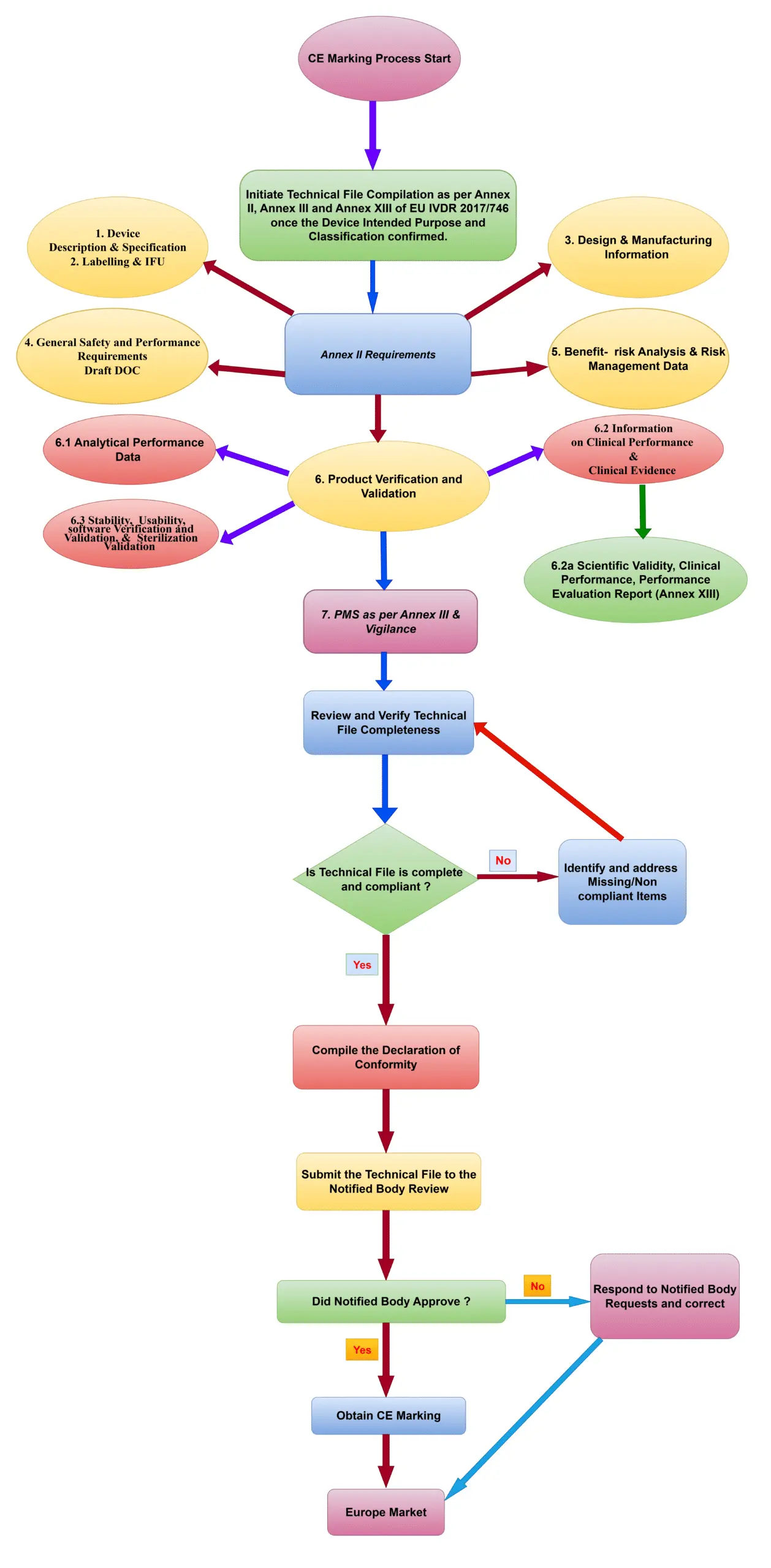
IVDR CE Certification Process Flow Diagram
The example below shows how technical file compilation moves from project start to notified body certification for a Class B IVD. The same sequence applies to other classes, with the conformity assessment route changing by class.
IVDR Certification Routes by Device Class
For more details about Class A, Class A Sterile, Class B, Class C and Class D, refer to the respective pages.
Submit your email for a reply message with more information, about how we can help you with IVDR certification in seconds.
Achieve IVDR Certification for Your IVD Device
Our IVDR consultants manage the full Statement of Work for Class A through Class D devices, from scope review to notified body certification.
- Technical documentation per Annex II and III
- Performance evaluation and PMPF
- GSPR checklist and risk management
- Notified body submission and audit support
Start your IVDR certification project
Share your device details and get a tailored proposal.
Request a Quote See PricingIVDR Certification Statement of Work: Frequently Asked Questions
What is IVDR certification?
IVDR certification is the route an in vitro diagnostic manufacturer follows to show conformity with Regulation (EU) 2017/746. It covers device classification, a compliant QMS, technical documentation per Annex II and III, performance evaluation, post-market surveillance and, for most devices, notified body certification before the CE mark is affixed.
What is included in an IVDR statement of work?
An IVDR statement of work lists every activity needed for IVDR certification across 10 phases and states which tasks the consultant delivers and which inputs, data and approvals the manufacturer provides, from scope review and device information through technical documentation, performance evaluation and post-market surveillance to notified body submission and the CE certificate.
Do all IVD devices need a notified body under the IVDR?
No. Non-sterile Class A devices are self-declared by the manufacturer. Class A sterile devices need notified body involvement for sterility aspects, and Class B, C and D devices require a full notified body conformity assessment. See our IVDR classification guide.
What does the manufacturer have to provide during the process?
The manufacturer supplies legal and company records, device information, design and production data, test reports, clinical evidence and post-market data, and reviews and approves the documents I3CGlobal prepares. The Statement of Work table above lists these inputs phase by phase.
What is the role of performance evaluation in IVDR CE certification?
Performance evaluation demonstrates scientific validity, analytical performance and clinical performance of the device. The results are documented in the performance evaluation report (PER) and kept up to date through post-market performance follow-up.
Which post-market reports are required for each class?
Class A and Class B manufacturers prepare a post-market surveillance report (PMSR). Class C and Class D manufacturers prepare a periodic safety update report (PSUR), which is updated at least annually.
Can I3CGlobal support the notified body submission and audit?
Yes. We help identify a suitable notified body, prepare the technical documentation submission, answer review questions across rounds, and support the onsite QMS audit and closure of nonconformities until the IVDR CE certificate is issued.
What are the IVDR transition deadlines for legacy devices?
Under Regulation (EU) 2024/1860, legacy IVDs covered by a Directive certificate or declaration can stay on the market until 31 December 2027 (Class D), 31 December 2028 (Class C) and 31 December 2029 (Class B and Class A sterile), provided the manufacturer had an IVDR QMS by 26 May 2025, applies to a notified body and signs a written agreement by the class-specific dates, and makes no significant changes to the device. Check the European Commission transitional provisions page for any later amendments.
How much does IVDR CE certification cost?
Cost depends on device class, the number of devices and variants, the evidence already available and the notified body fees. See our IVDR CE certification cost page for a breakdown, or request a tailored quote.
How long does IVDR CE certification take?
It depends on the device class, how complete your existing documentation and performance evidence are, and the notified body's workload. Class A non-sterile devices can be self-declared once the technical documentation is ready. Devices that need notified body certification usually take longer, often more than a year, because of application, document review rounds and the QMS audit. I3CGlobal plans your timeline after a gap assessment.