
Post Market Clinical Follow Up (PMCF): MDR-Compliant Plans, Studies & Reports for Medical Device

Post Market Clinical Follow Up (PMCF)
Post Market Clinical Follow Up (PMCF) has evolved from a regulatory afterthought into one of the most scrutinized and consequential obligations under EU MDR 2017/745. Whether you are a manufacturer transitioning a legacy device or launching a new product for the first time, your PMCF strategy directly determines whether your CE mark survives its next Notified Body review. This page explains what PMCF is, what the law requires, how to choose the right methods, and how I3CGlobal supports manufacturers across every stage of the PMCF lifecycle.
What is Post Market Clinical Follow Up?
Post Market Clinical Follow Up (PMCF) is a proactive, continuous, and clinically focused subset of Post Market Surveillance (PMS). PMS is the overall process of monitoring the device after it is placed on the market, including complaint handling, vigilance reporting and field safety corrective actions. PMCF (Post-Market Clinical Follow-up) is the process of collecting and evaluating clinical data of a device to verify its safety, performance and benefit-risk profile during the entire commercial life of the device.
Under EU MDR 2017/745, PMCF is legally grounded in Article 61 and Annex XIV, Part B. Article 61 establishes the manufacturer’s ongoing obligation to maintain a current Clinical Evaluation for every device. Annex XIV Part B defines in detail what a PMCF Plan must contain, what activities are acceptable, and how findings must be documented and reported.
The key clinical objectives of PMCF are to:
- Confirm the clinical performance and safety of the device in routine, real-world use
- Detect rare or long-term adverse events not captured during pre-market clinical investigation
- Address residual clinical evidence gaps identified during the CE marking process
- Validate the benefit-risk assumptions made in the Clinical Evaluation Report (CER)
- Contribute updated clinical evidence to the Periodic Safety Update Report (PSUR)
PMCF vs PMS: Understanding the Difference
A common source of confusion for manufacturers is the relationship between Post Market Surveillance (PMS) and Post Market Clinical Follow Up (PMCF). The two are related but distinct.
PMS is the broader system for monitoring a device after it reaches the market. It includes reactive activities such as processing complaints, managing Field Safety Corrective Actions (FSCAs), and submitting vigilance reports to competent authorities. It also includes proactive activities — and this is where PMCF comes in.
PMCF is the clinical arm of PMS. It focuses exclusively on generating and evaluating clinical evidence from real-world device use. Under EU MDR, PMS is mandatory for all devices without exception. PMCF is also mandatory unless the manufacturer provides a clearly justified and documented rationale for why it is not applicable — a justification Notified Bodies are increasingly reluctant to accept, especially for Class IIb and Class III devices.
Together, PMS monitors your device in the field while PMCF proves it continues to perform clinically. Both are essential to maintaining your MDR CE mark.
MDR PMCF Requirements: What the Law Says
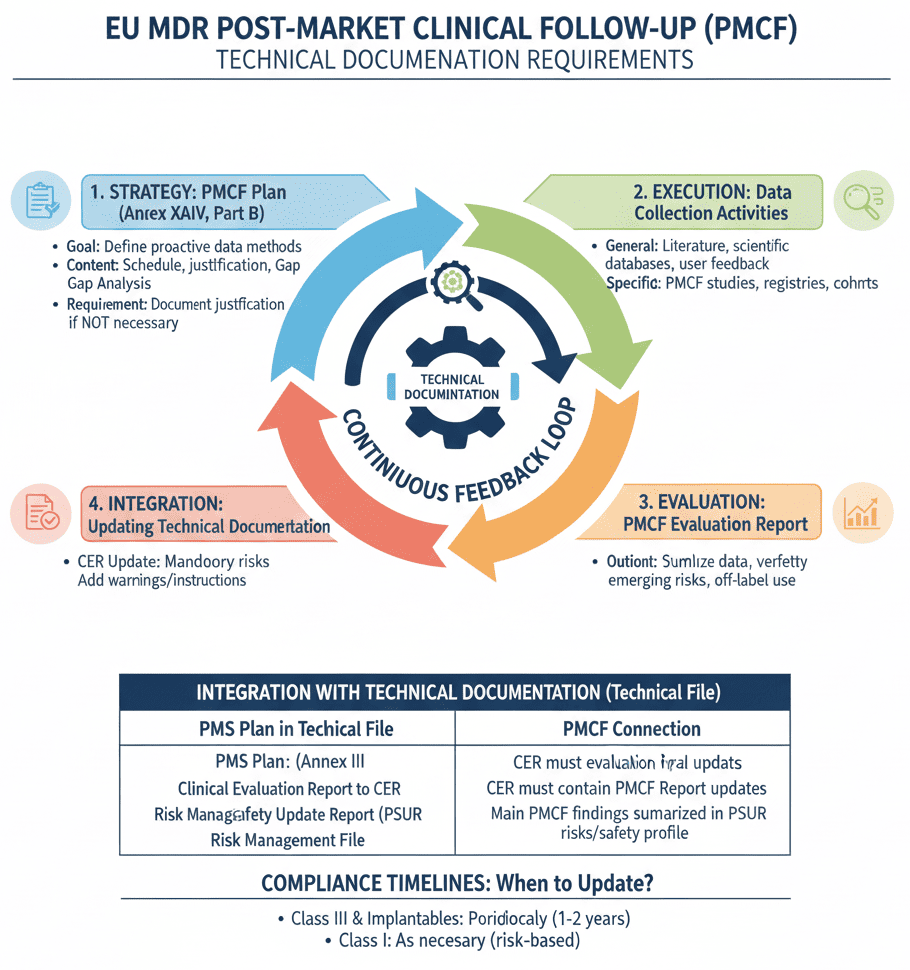
Annex XIV, Part B of EU MDR 2017/745 is the primary regulatory reference for PMCF. It requires that:
- Every manufacturer must have a documented PMCF Plan forming part of the technical documentation.
- The PMCF Plan must define the objectives, rationale, methods, and timelines of all PMCF activities.
- The results of PMCF activities must be summarized in a PMCF Evaluation Report on a regular basis — annually for Class III and implantable devices; at least every two years for other devices.
- The PMCF Evaluation Report must be fed back into and update the Clinical Evaluation Report (CER), the PMS Plan, the PSUR, and the risk management file.
Guidance on how to implement these requirements is provided in MDCG 2020-7 (PMCF Plan and Report templates) and MDCG 2020-6 (clinical evidence levels for legacy devices). Manufacturers should also reference the legacy document MedDev 2.12/2 rev 2, which, although it predates MDR, continues to provide useful methodological guidance.
PMCF vs PMS: Understanding the Difference
Not all PMCF looks the same. The appropriate methods depend on your device’s risk class, novelty, the volume and quality of pre-market clinical evidence, and the nature of any residual clinical uncertainties. EU MDR Annex XIV, Part B distinguishes between general PMCF methods and specific PMCF methods.
General PMCF Methods
Systematic literature reviews represent the baseline PMCF activity required for all devices regardless of class. These are ongoing, structured searches of databases such as PubMed, Embase and Cochrane to identify published evidence relating to your device or equivalent technologies. I3CGlobal conducts MDR-compliant literature reviews with documented search protocols, PRISMA-based methodology and evidence appraisal aligned to MDCG 2020-6 evidence levels.
Safety database searches, including review of EUDAMED, FDA MAUDE, MHRA Yellow Card and other post-market adverse event registries, provide a low cost, high value mechanism to identify device-related safety signals and benchmark comparisons across the market.
Use structured questionnaires and clinical interviews to collect feedback from users and healthcare professionals to gain valuable real world insight into performance, usability and patient outcomes.
Specific PMCF Methods
One of the most common specific techniques under MDR are PMCF Surveys Well-designed patient and physician surveys that align with the criteria of MDCG 2020-6 are considered level 4 evidence (the same level as cohort studies) and thus can be valuable in bridging the gaps of clinical evidence without the cost and timeline of a full clinical investigation. The most important aspect of reaching level 4 status is adherence to the design principles of ISO 14155, pre-determined endpoints, statistical power calculations, and ethical compliance. I3CGlobal designs, manages, and reports MDR-compliant PMCF surveys from protocol development through data analysis.
PMCF Cohort Studies and Registries provide high-quality, prospective, longitudinal data ideal for Class III and implantable devices or those with novel mechanisms of action. These involve systematic data collection from defined patient populations across multiple clinical sites over time. While resource-intensive, they deliver the strongest possible real-world clinical evidence and are increasingly expected by Notified Bodies for higher-risk products.
Investigator-Initiated Studies (IIS) allow independent clinicians or academic institutions to generate device-specific evidence, often at significantly lower cost to the manufacturer. When aligned with your PMCF objectives, IIS can be a highly efficient supplement to manufacturer-led evidence generation.
Prospective PMCF Clinical Investigations — full clinical studies performed post-market — are required when existing data is insufficient to confirm safety or performance, or when new indications, patient populations, or device variants introduce clinical uncertainties that cannot be addressed by lighter-touch methods.
PMCF for Legacy Devices vs. New Devices
PMCF for Legacy Devices
Legacy devices are devices that were CE marked under the MDD or AIMDD and that continue to be compliant or are transitioning to compliance under the EU MDR. In these instances, the main goal of PMCF is to confirm ongoing safety and clinical performance in actual use, detect any long-term or rare adverse events and show that the benefit-risk profile is still acceptable under the more stringent MDR framework. PMCF is also important for bridging gaps in clinical evidence found during the MDR transition.
Notified Bodies are looking at historical clinical data and assessing it against the expectations of the MDR. This includes reviewing the strength of the original evidence, whether it was mostly equivalence-based, whether the clinical endpoints are still relevant and whether the follow-up period is sufficient. Devices that were heavily reliant on equivalence under the MDD generally have stronger PMCF requirements as literature-only approaches are now rarely accepted. In these cases, Notified Bodies are increasingly asking for device-specific real-world clinical data.
For legacy devices, PMCF must include complaint trending, vigilance and FSCA data, and post-market risk signals. Even when complaint rates are low, manufacturers must provide statistical justification that the data adequately support safety conclusions. In many cases, PMCF can be achieved without prospective clinical trials by combining literature reviews, PMS data analysis, user or physician surveys, and registry data, provided that this approach is well justified. However, Class III and implantable legacy devices almost invariably require specific PMCF activities, often including formal studies.
In the review, Notified Bodies usually ask manufacturers to justify why the current PMCF remains appropriate, what has changed under MDR and how they demonstrate ongoing clinical benefit.
PMCF for New Devices (First-Time MDR CE Marking)
New devices placed on the EU market under MDR are subject to significantly higher PMCF scrutiny, as there is no historical market experience to rely on. PMCF for new devices is intended to validate pre-market clinical assumptions, detect early safety signals, confirm intended clinical performance in routine use, and establish a robust real-world benefit risk profile.
For these devices, PMCF is viewed as a continuation of clinical investigation, rather than a maintenance activity, and is expected to begin immediately after market launch. The level of PMCF required increases with device risk class, novelty, and clinical uncertainty, with higher-risk and innovative devices often requiring structured, prospective PMCF studies.
| Factor | Legacy Devices (MDD → MDR) | New Devices (First MDR) |
|---|---|---|
| Starting Evidence Base | Existing MDD clinical data | No market history |
| Primary PMCF Goal | Confirm continued safety and performance under MDR standards | Validate pre-market clinical assumptions in real-world use |
| Notified Body Focus | Adequacy and currency of historical clinical evidence | Early signal detection and prospective data generation |
| Literature-Only Accepted? | Rarely for Class IIb / Class III devices | Almost never for novel or high-risk devices |
| PMCF Start Point | At MDR transition / Notified Body renewal | Immediately at market launch |
| Typical PMCF Methods | Surveys, registries, PMS data analysis, literature reviews | Prospective cohort studies, registries, surveys |
The PMCF Plan and PMCF Evaluation Report
Annex XIV, Part B of EU MDR 2017/745 is the primary legal reference governing how Post Market Clinical Follow Up must be planned, executed, and documented. Every manufacturer must maintain two core PMCF documents as part of their technical documentation: the PMCF Plan and the PMCF Evaluation Report. These are distinct documents with different purposes — and Notified Bodies assess both during technical file review.
PMCF Plan
The PMCF Plan is a prospective document that defines what PMCF activities will be carried out, why those methods were selected, and how the results will be used. It must be in place before any PMCF activity begins and must form part of the medical device technical documentation. According to Annex XIV Part B and MDCG 2020-7 — the current MDR-specific guidance document for PMCF — the Plan must address the specific clinical objectives of each PMCF activity, the scientific rationale and justification for the methods chosen, reference to applicable standards including ISO 14155 where relevant, timelines and responsibilities for each activity, and how findings will feed back into the Clinical Evaluation Report, PMS Plan, PSUR, and risk management file.
The PMCF Evaluation Report
The PMCF Evaluation Report is a retrospective document that records and analyzes the actual findings from all PMCF activities carried out under the Plan. The manufacturer must justify that the activities performed were sufficient to address the objectives defined in the PMCF Plan. The Report must specifically address four key clinical objectives: device adverse events including their identification, frequency, and clinical significance; the severity and probability of occurrence of side effects and their impact on the benefit-risk assessment; possible misuse of the device and how real-world use patterns compare to the intended use; and safety and performance of the device in routine use, confirming that real-world outcomes remain consistent with pre-market clinical data.
The Report must also include a clear summary of the methods used to collect the data, a statistical interpretation of findings, and an explicit conclusion on whether the benefit-risk profile remains acceptable. Critically, the PMCF Evaluation Report becomes an integral part of the Clinical Evaluation Report and must be updated on the same review cycle — annually for Class III and implantable devices, and at a minimum every two years for Class IIa and Class IIb devices.
The findings of the PMCF shall be analyzed by the manufacturer and documented in the PMCF Evaluation Report. This report shall form part of both the Clinical Evaluation Report and the overall technical documentation submitted to the Notified Body.
A Note on MedDev 2.12/2 rev 2
MedDev 2.12/2 rev 2 continues to provide useful methodological context for understanding the objectives and structure of PMCF documentation. However, it predates EU MDR 2017/745 and does not override or modify MDR requirements. Manufacturers should treat MDCG 2020-7 as the primary current reference for PMCF Plan and Report structure, using MedDev 2.12/2 rev 2 only as supplementary background guidance.
When Is a CRO Required for PMCF?
A common question from manufacturers is whether a regulatory consultant can manage all PMCF activities or whether a Contract Research Organization (CRO) is also required. The answer depends entirely on the nature of the PMCF methods specified in the plan.
For literature-based PMCF, survey design and analysis, safety database reviews, and registry strategy, I3CGlobal provides complete end-to-end regulatory support. These activities require regulatory expertise, medical writing capability, and statistical analysis — all of which I3CGlobal delivers in-house.
For prospective clinical investigations or multi-site cohort studies, a dedicated CRO is required to handle ethics committee submissions, patient recruitment, source data verification, on-site monitoring, adverse event reporting, and investigator management. In these cases, I3CGlobal functions as the regulatory and compliance partner — designing the protocol, defining endpoints, preparing the investigational device dossier, and coordinating with the CRO from a submission-readiness perspective.
Although I3CGLOBAL is not a traditional field CRO /CMO sending monitors to hospitals, they actively support several MDR accepted PMCF data sources, especially where operational burden is lower but regulatory rigor remains high.
- Literature based PMCF active clinical data collection from PubMed, Embase, and scientific databases, ongoing safety and performance trend analysis and fully aligned with MDR Annex XIV (Part B)
- PMCF Surveys & questionnaires related to design of MDR compliant physician and user surveys, Digital distribution and response tracking and Data aggregation and statistical interpretation
- Registry-Based PMCF for the Identification of relevant national or international registries, support with licensing and applicability assessment and clinical relevance and statistical justification for Notified Bodies
These methods are often sufficient for: Class I and IIa devices, Mature technologies and Devices with strong pre-market clinical evidence.
Why Choose I3CGlobal for PMCF?
I3CGlobal is a specialist medical device regulatory consultancy with deep expertise in EU MDR 2017/745 Clinical Evaluation and Post Market Clinical Follow Up. Our team supports manufacturers at every stage — from PMCF strategy design and plan writing through study execution, survey management, and final evaluation report preparation.
We work across all device risk classes and have supported clients through Notified Body audits, MDR transition assessments, and initial CE certification. We combine regulatory precision with practical experience to produce PMCF documentation that is audit-ready from day one.
Our PMCF services include: PMCF Strategy Assessment · PMCF Plan Writing · Literature Review and PMCF Data Collection · PMCF Survey Design and Analysis · Registry Identification and Applicability Assessment · PMCF Evaluation Report · CRO Coordination and Protocol Development · PMCF Template Packages
Post Market Clinical Follow Up Under EU MDR
PMCF is no longer a easy activity under EU MDR 2017/745. For many manufacturers, PMCF has become one of the most scrutinized elements of the Clinical Evaluation lifecycle often determining whether a device retains its CE mark or faces serious Notified Body objections. A common point of confusion is who actually performs PMCF activities, especially data collection. Manufacturers frequently ask Can a regulatory consultant like I3CGLOBAL collect PMCF data for us? The answer lies in clearly understanding the division between regulatory consulting and operational execution.
| Activity | I3CGLOBAL – Regulatory Consultant | CMO / CRO – Operational Executor |
|---|---|---|
| PMCF Strategy | Defines scope, intensity, and compliance approach | Executes approved strategy |
| Site Selection | Advises on clinical requirments | Advises on type of hospitals and clinical settings
Physically visits sites and contracts investigators |
| Patient Recruitment | Defines inclusion/exclusion criteria | Recruits and tracks real patients |
| On-site Monitoring | Reviews monitoring outcomes | Conducts on-site Source Data Verification (SDV) |
| EDC Systems | Recommends compliant data approaches | Builds databases and manages raw data |
Special Note:
- I3CGLOBAL designs, governs, and documents PMCF.
- CROs collect, verify, and operationalize patient level data.
Are you planning to obtain CE Certification through a Notified Body? Contact us. We specialize in Technical Documentation and Clinical Evaluation covering medical device PMCF.
Frequently Asked Questions
Is PMCF mandatory for all medical devices under EU MDR?
PMCF is mandatory unless a manufacturer can provide a well-substantiated justification for why it is not applicable. Under Article 61 and Annex XIV Part B of EU MDR 2017/745, the default assumption is that PMCF must be performed for all CE-marked devices. Notified Bodies are increasingly critical of justifications for non-applicability, particularly for Class IIb and Class III device
What is the difference between a PMCF Plan and a PMCF Evaluation Report?
The PMCF Plan is a prospective document that defines what activities will be performed, why, and how. The PMCF Evaluation Report is a retrospective document that records the actual findings from those activities, analyzes the results, and concludes whether the clinical evidence remains sufficient or whether updates to the CER and risk management file are needed.
How often must the PMCF Evaluation Report be updated?
Under EU MDR, the PMCF Evaluation Report must be updated at least annually for Class III and implantable devices. For other device classes it must be updated at intervals specified in the PMCF Plan and linked to the PMS reporting cycle — typically at least every two years, and whenever significant new clinical data or safety signals are identified.
What evidence level do PMCF surveys provide?
According to MDCG 2020-6, high-quality PMCF surveys designed in accordance with ISO 14155 principles are classified as Level 4 evidence — the same level as cohort studies. General usability surveys are assigned Level 8 evidence. Achieving Level 4 requires pre-defined clinical endpoints, statistical power calculations, ethical compliance, and a structured data collection and analysis methodology.
Can literature reviews alone satisfy PMCF requirements?
For many lower-risk devices with well-established safety profiles, systematic literature reviews combined with safety database searches and user feedback may be sufficient. However, for Class III devices, implantable devices, novel technologies, and devices with residual clinical uncertainties, Notified Bodies typically require specific PMCF methods such as surveys, registries, or prospective studies. A justification-first approach is essential: whatever methods are chosen must be explicitly justified in the PMCF Plan.
What happens if PMCF findings reveal new safety concerns?
If PMCF activities identify new safety signals, increased adverse event rates, or unexpected clinical findings, the manufacturer is obligated to update the risk management file, the Clinical Evaluation Report, and the PMS plan. Depending on severity, the findings may also trigger a Field Safety Corrective Action (FSCA), a Serious Incident report to the competent authority, or a proactive communication to healthcare professionals.
Do legacy devices transitioning from MDD to MDR need new PMCF activities?
Yes — in most cases. Legacy devices are reassessed against MDR’s higher evidentiary standards during Notified Body review. If the existing clinical evidence relied heavily on equivalence or was generated under MDD standards that Notified Bodies no longer consider sufficient, new or enhanced PMCF activities will be required to generate device-specific real-world clinical data.
What is included in i3CGlobal's PMCF template package?
I3CGlobal’s PMCF template package includes a fully structured PMCF Plan template and PMCF Evaluation Report template in MS Word format, pre-formatted to the requirements of Annex XIV Part B and MDCG 2020-7. Templates include placeholder instructions, section-by-section guidance notes, and editable compliance matrices for both Class IIa/IIb and Class III devices.
What are the conditions when above such studies might not be required?
- When the medium or long-term safety and clinical performance are already known from previous use of the device;
- Where other appropriate post-market surveillance activities would provide sufficient data to address the risks.
What are some of the cases that justify PMCF studies?
- Innovation, e.g., where the design of the device, the raw materials, the principles of operation, the technology, or the medical indications are novel;
- High-risk target populations e.g. pediatrics, elderly;
- High product-related risk e.g. based on design, materials, components, invasiveness, and clinical procedures;
- Identification of previously unstudied subpopulations which may show different benefit/risk ratio e.g. hip implants in different ethnic populations and so on.
State a few examples of methodologies to carry out PMCF studies?
- The extended follow-up of patients enrolled in premarket investigations;
- A new clinical investigation;
- A review of data derived from a device registry; or
- A review of relevant retrospective data from patients previously exposed to the device.
What is the use of the PMCF study data?
- The data and conclusions derived from the Post Market Clinical study are used to provide clinical evidence for the clinical evaluation. This may result in the need to reassess whether the device continues to comply with the General Safety and Performance Requirements (GSPR). Such assessment may result in corrective or preventive actions, for example, changes to the instructions for use/labelling, changes to manufacturing processes, revision of the device design, or public health notifications.