
Summary of Safety and Clinical Performance (SSCP) Under the EU MDR
The Summary of Safety and Clinical Performance (SSCP) is a public summary required by MDR Article 32 for implantable and class III devices, excluding custom-made and investigational devices. It presents the clinical evidence, residual risks and benefit-risk conclusions in language suited to its readers. I3CGLOBAL’s SSCP consultants help manufacturers prepare and maintain it.
What Is the Summary of Safety and Clinical Performance?

The Summary of Safety and Clinical Performance is a device-specific document published in EUDAMED, the European database on medical devices. Regulation (EU) 2017/745 requires it in Article 32, and MDCG 2019-9 Rev.1 explains how to prepare it.
Its purpose is transparency. Healthcare professionals, and patients where relevant, can see an objective and balanced summary of the available clinical data, whether favourable, unfavourable or inconclusive. It does not replace the instructions for use (IFU) or implant card, and it is not meant to promote the device.
Content must come from the device’s technical documentation, and the IFU may also be a source. The summary should therefore stay aligned with the clinical evaluation, risk management and post-market records.
Key facts
Summary of Safety and Clinical Performance at a glance
- Legal basis
- EU MDR 2017/745, Article 32
- Guidance
- MDCG 2019-9 Rev.1 and MDCG 2026-4
- Devices
- Implantable and class III devices
- Excluded
- Custom-made and investigational devices
- Readers
- Healthcare professionals, and patients where required
- Validation
- By the notified body
- Publication
- EUDAMED, linked to the Basic UDI-DI
- Review
- When the PMCF evaluation report and PSUR are updated, at least annually where those reports are annual
Which Devices Need a Summary of Safety and Clinical Performance?
Manufacturers need a Summary of Safety and Clinical Performance for implantable devices and class III devices. Confirm the device classification first, because the class and route also affect when the notified body validates the document.
| Device group | Is an SSCP needed? | Notified body validation |
|---|---|---|
| Class III, including implantable | Yes | Validated before the certificate is issued |
| Class IIb implantable, except sutures, staples and similar devices | Yes | Validated before the certificate is issued |
| Class IIa implantable, and class IIb sutures, staples and similar devices | Yes | A draft is submitted for validation. Where one certificate covers several devices, at least one draft is validated first, and the others at least once during the certificate’s validity |
| Custom-made or investigational device | No | Not applicable |
When is a patient section required?
MDCG 2019-9 Rev.1 expects a separate patient section for implantable devices that come with implant cards and for class III devices used directly by patients. It also expects Annex XVI devices that are eligible for an SSCP to include one. The patient section must use plain language and be tested for readability with lay persons.
IVD manufacturers: IVDR Article 29 sets a similar duty, the summary of safety and performance (SSP), for class C and D devices. See our IVDR guide.
What Must a Summary of Safety and Clinical Performance Contain?
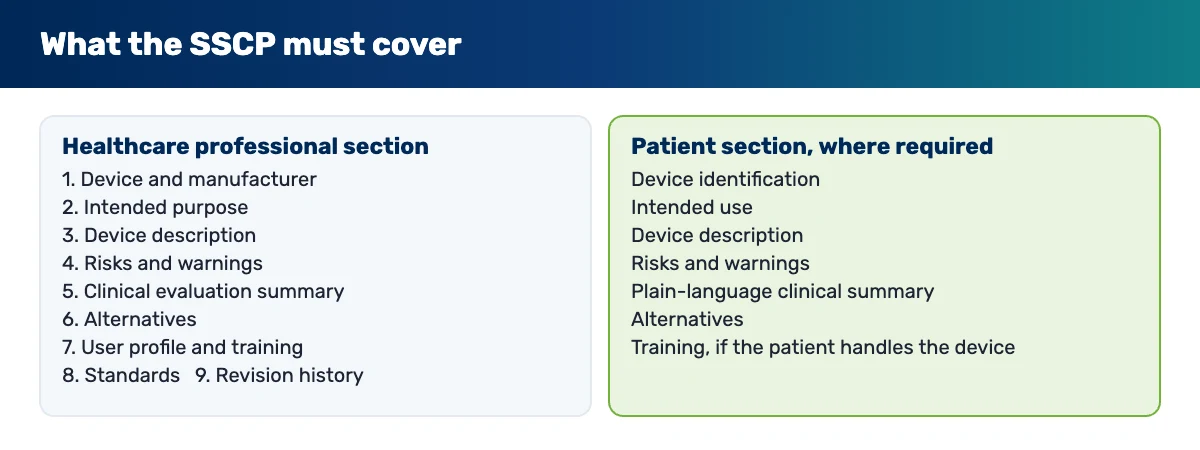
MDCG 2019-9 Rev.1 recommends a template with a section for healthcare professionals and, where required, a separate section for patients. The professional section has nine parts.
01
Device and manufacturer
Device names, Basic UDI-DI, SRN, device class, year of the first CE certificate and notified body details.
02
Intended purpose
Intended purpose, indications, target populations, contraindications and limitations.
03
Device description
Operating principles, previous generations, variants, accessories and devices used in combination.
04
Risks and warnings
Quantified residual risks and undesirable effects with a time reference, warnings, precautions and field safety corrective actions.
05
Clinical evaluation summary
Equivalent-device data, pre-CE investigations, other clinical data, overall benefit-risk summary and ongoing or planned PMCF.
06
Alternatives
Possible diagnostic or therapeutic alternatives.
07
User profile and training
Suggested experience, education and any training needed for safe use.
08
Standards
Harmonised standards and common specifications applied, with the version, and whether applied in full or in part.
09
Revision history
Revision number, issue date, changes, whether the notified body validated the revision and the validation language.
Why does the Summary of Safety and Clinical Performance matter to readers?
For a healthcare professional, the Summary of Safety and Clinical Performance offers a concise way to compare device information and clinical evidence. For a patient, the Summary of Safety and Clinical Performance can explain in plain language what the device is for and what risks remain. Because anyone can read it, weak or inconsistent content is visible outside the notified body review.
What should the clinical evaluation summary include?
This is often the most demanding part. It should summarise the clinical evaluation report findings without simply pasting its executive summary. If conformity was assessed based on equivalence, state this and identify the equivalent device by name and Basic UDI-DI if available, together with its manufacturer. Clinical investigations conducted before CE marking and other main findings should also be summarised, followed by a clear benefit-risk conclusion.
What changes in the patient section?
The patient section covers device identification, intended use, device description, risks and warnings, a plain-language clinical summary and alternatives. Training is included if the patient handles the device. Standards and common specifications are not required. Use the lay term first, followed by the medical term in brackets.
How Does the Summary of Safety and Clinical Performance Differ from a CER and IFU?
The Summary of Safety and Clinical Performance draws on other documents but has its own role. These documents overlap, but each has a separate role. Keep them consistent, without treating one as a replacement for another.
| Document | Main purpose | Main readers | Availability |
|---|---|---|---|
| SSCP | Objective public summary of safety and clinical performance | Healthcare professionals and, where required, patients | Public in EUDAMED |
| Clinical evaluation report (CER) | Full record of the clinical evaluation and its evidence | Manufacturer and notified body | Part of the technical documentation |
| Instructions for use (IFU) | Information needed to use the device safely | Users and patients where relevant | Supplied with the device |
| Implant card | Device identification and information for the implant patient | Implant patients | Provided to the patient |
The IFU must state that the SSCP is available in EUDAMED and is linked to the Basic UDI-DI. It should give the public EUDAMED website address and the Basic UDI-DI, or other data that uniquely identifies the document.
Who Validates and Uploads the Summary of Safety and Clinical Performance?
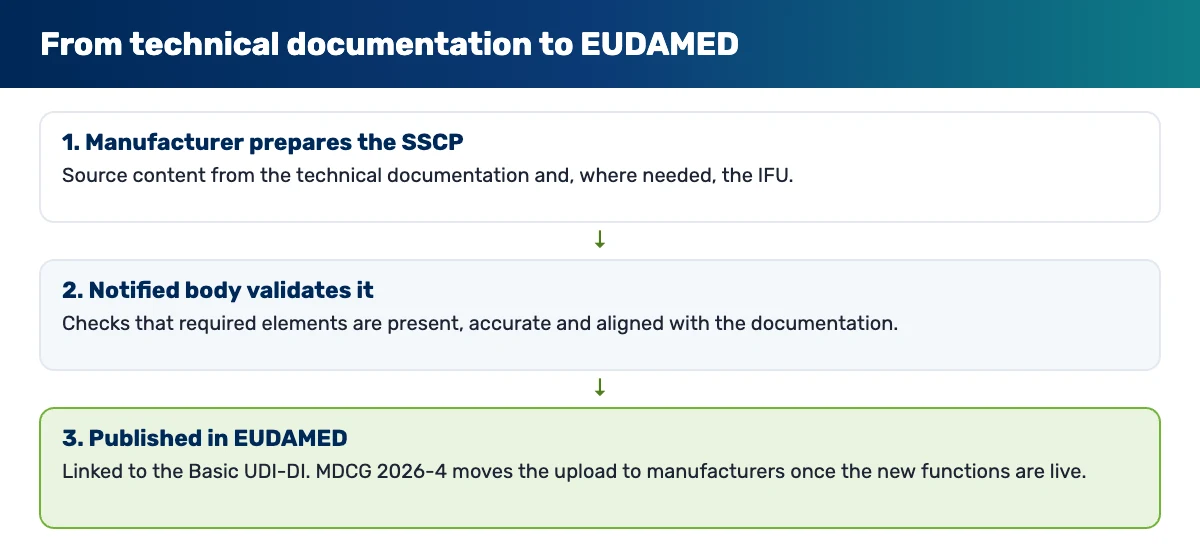
The Summary of Safety and Clinical Performance must pass notified body validation. The notified body validates the document once it confirms that all required elements are present, accurately presented and aligned with the current technical documentation. If two notified bodies are involved under Annexes X and XI, the one assessing the technical documentation under Annex X validates it.
What is changing in EUDAMED?
MDCG 2026-4 announces a new upload process that changes the procedure in MDCG 2019-9 Rev.1. Notified bodies currently upload master versions when they register certificates. Under the new process, manufacturers upload master versions and translations, and notified bodies indicate which version they validated.
| Date in MDCG 2026-4 | What it means |
|---|---|
| From 28 May 2026 | First four EUDAMED modules are mandatory. Until the new functions are live, notified bodies upload master versions without translations |
| October 2026 | New manufacturer upload functions were planned for the Production environment |
| 27 February 2027 | Latest date to upload the document for devices placed on the market before the UDI/Devices module became mandatory |
| 27 May 2027 | End of the 12-month transition for notified body certificate upload |
Which languages are required?
Language planning is an important part of the Summary of Safety and Clinical Performance project. Each language has its own document, and the manufacturer is responsible for translations. They should cover the languages of the Member States where the device is sold, and an English version is advised if English is not among them. The patient section must be available in the languages required for patient IFUs.
Before you act: agree the process with your notified body, and check EUDAMED and the MDCG website. MDCG 2026-4 says its process will be reflected in a revision of MDCG 2019-9 Rev.1, and detailed instructions may follow.
When Should the Summary of Safety and Clinical Performance Be Updated?
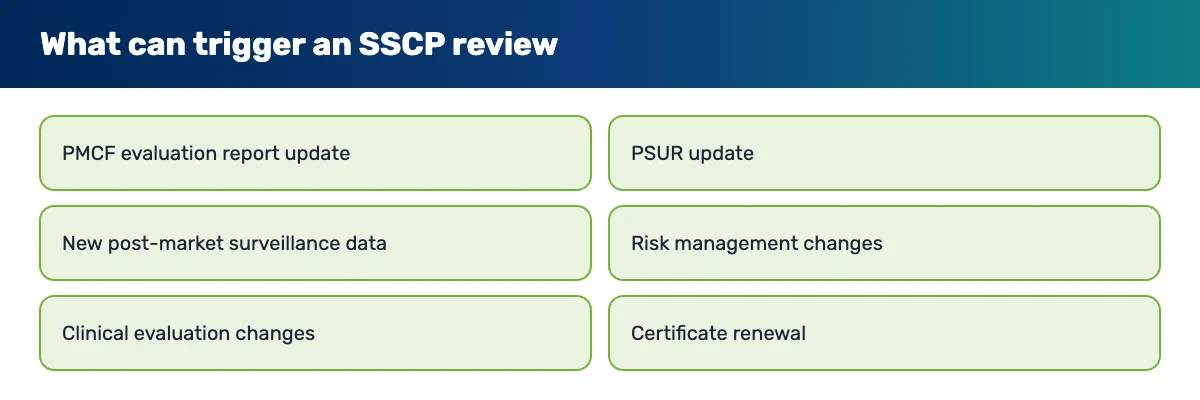
The Summary of Safety and Clinical Performance is a living document. Review it when the PMCF evaluation report and PSUR are updated. MDCG 2019-9 Rev.1 says this should be at least annually. New safety information, post-market surveillance data or risk management changes can also make an update necessary.
| Situation | Expected action |
|---|---|
| PSUR submission | Submit any updated SSCP with the PSUR, which goes to the notified body at least annually, or every two years for class IIa implantable devices |
| Renewal: class III and class IIb implantable devices, except sutures, staples and similar devices | The document must have been updated within the previous 12 months |
| Renewal: other devices | Confirm alignment with the technical documentation, or provide an update |
| Any revision | Keep the same manufacturer reference number, and update the revision history |
How Do You Write a Good Summary of Safety and Clinical Performance?
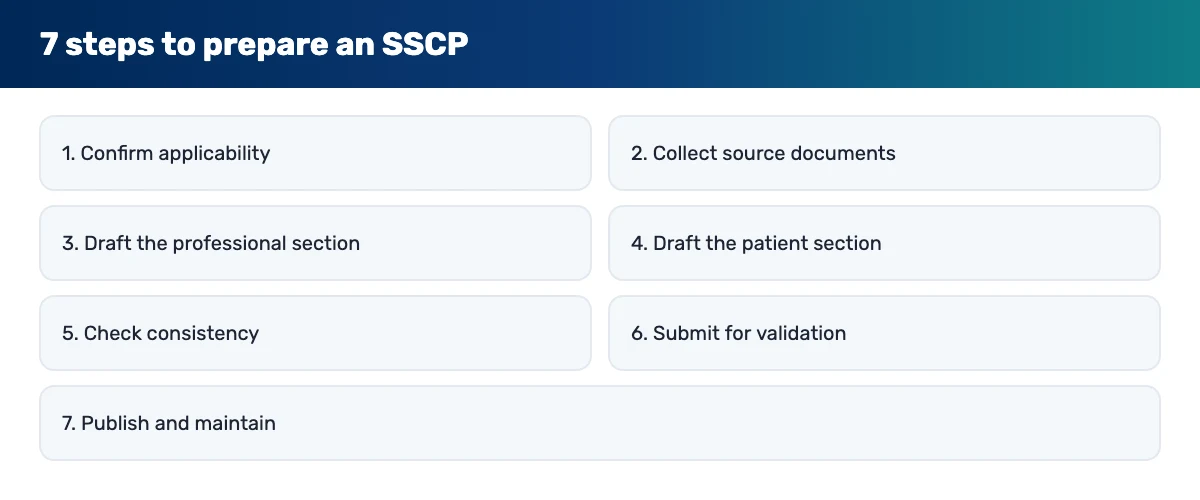
A Summary of Safety and Clinical Performance is easier to validate when it is planned alongside the clinical evaluation, not added at the end of the project. A typical preparation sequence looks like this:
- Confirm applicabilityCheck the device class, implantable status and whether a patient section is needed.
- Collect source documentsGather the current CER, risk file, IFU, PMS and PMCF records, and record their versions.
- Draft the professional sectionUse the MDCG template, and quantify residual risks and undesirable effects where data exist.
- Draft the patient sectionRewrite the content in plain language, explain medical terms and test readability with lay persons.
- Check consistencyCompare every statement with its source, and resolve any differences before submission.
- Submit for validationProvide the document to the notified body, and respond to its comments.
- Publish and maintainPlan translations, EUDAMED upload, IFU wording and periodic review.
What are the 9 writing tips?
These nine tips follow the expectations in MDCG 2019-9 Rev.1. Your notified body may have additional formatting or submission requirements, so check them early.
- Start from controlled recordsTrace every statement to the technical documentation or IFU.
- Keep the data balancedInclude favourable, unfavourable and inconclusive results, and avoid advertising language.
- Quantify risksGive rates and time references for residual risks and undesirable effects where available.
- Align with the CERCheck that the SSCP matches the current clinical evaluation, risk file, PMS and PMCF data.
- State equivalence clearlyIdentify any equivalent device and manufacturer used to support conformity.
- Write for each readerKeep professional and patient sections separate with a page break, and define abbreviations.
- Test the patient sectionCheck readability with lay persons, and correct what they find unclear.
- Plan translations earlyAllocate time for each required language, and check each version against the validated master.
- Prepare a usable PDFProvide a printable, searchable and non-editable PDF with a unique reference and revision history.
Summary of Safety and Clinical Performance Support from I3CGLOBAL
I3CGLOBAL is a global regulatory consulting company for medical devices, IVDs, pharmaceuticals and life sciences. As part of our MDR technical documentation service, our EU MDR consultants prepare the Summary of Safety and Clinical Performance as a concise summary of the intended purpose, clinical evaluation results, adverse events and post-market surveillance data.
| Service | What our consultants do |
|---|---|
| Applicability review | Confirm whether your device needs an SSCP and a patient section. |
| Evidence review | Review the CER, risk file, PMS and PMCF records used as sources. |
| Professional section | Write the healthcare professional section using the MDCG template. |
| Patient section | Write the plain-language section, and plan its readability testing. |
| Benefit-risk summary | Present conclusions consistently with the clinical evaluation. |
| Notified body support | Coordinate submission and respond to validation comments. |
| Translations and EUDAMED | Plan language versions and support upload tasks. |
| Annual maintenance | Update the document with new PSUR and PMCF findings. |
Need help with your SSCP?
Share your device class and current clinical documents, and get a tailored proposal for your project.
Summary of Safety and Clinical Performance: Frequently Asked Questions
What is the Summary of Safety and Clinical Performance?
The Summary of Safety and Clinical Performance is a public document required by MDR Article 32 for implantable and class III devices. It gives an objective summary of device information, clinical evidence, residual risks and benefit-risk conclusions.
Who must prepare an SSCP?
The manufacturer prepares the Summary of Safety and Clinical Performance for implantable and class III devices. Custom-made and investigational devices are excluded.
Who validates and uploads the SSCP?
The notified body validates it. MDCG 2026-4 announces a process in which manufacturers upload master versions and translations, and notified bodies indicate the validated version. Until the new functions are live, notified bodies upload master versions.
How often must an SSCP be updated?
Review it when the PMCF evaluation report and PSUR are updated, which MDCG 2019-9 Rev.1 says should be at least annually. Submit any updated version with the PSUR, and meet the renewal expectations for your device.
Does every SSCP need a patient section?
No. MDCG 2019-9 Rev.1 expects one for implantable devices with implant cards, class III devices used directly by patients, and eligible Annex XVI devices.
Is an SSCP the same as a clinical evaluation report?
No. The clinical evaluation report is the full evidence record in the technical documentation. The SSCP is a public summary for defined readers and must stay consistent with that report.
Is benefit-risk analysis important for the SSCP?
Yes. The conclusions of the benefit-risk analysis are an integral part of the clinical evaluation summary, and residual risks and undesirable effects must also be described.
Which languages are needed?
Translations should cover the languages of the Member States where the device is sold, and an English version is advised if English is not among them. The patient section must be available in the languages required for patient IFUs.
What must the IFU say about the SSCP?
The IFU must say that the SSCP is available in EUDAMED and is linked to the Basic UDI-DI. It should give the public EUDAMED address and the Basic UDI-DI, or other data that uniquely identifies the document.
When must existing devices have an SSCP in EUDAMED?
MDCG 2026-4 says manufacturers should upload it as soon as possible and no later than 27 February 2027 for devices placed on the market before the UDI/Devices module became mandatory. Check current instructions, and align the timing with your notified body.
Is SSCP documentation part of your MDR CE marking service?
Yes. We prepare the SSCP as part of our MDR technical documentation writing service. Contact us to confirm the scope for your device.
Official References and Related Guides
- Regulation (EU) 2017/745 (MDR), Article 32
- MDCG 2019-9 Rev.1: SSCP guide for manufacturers and notified bodies (March 2022)
- MDCG 2026-4: Management of SS(C)P in EUDAMED after mandatory use (June 2026)
Use these sources with your notified body’s instructions when you plan a Summary of Safety and Clinical Performance, and check the MDCG website for later revisions.
- Clinical Evaluation Report
- Medical Device Technical File
- PMCF Evaluation Report
- Post-Market Surveillance
- GSPR Checklist
- MDR Technical File Templates
Updated 4 November 2026 | Author: Sobha Augustine, Founder, I3CGLOBAL | Reviewed by: Asha Johnson, Manager, I3CGLOBAL