
Quick Contact

Please log into NANDO website to know the latest list of MDR qualified Notified Bodies
Please log into NANDO website to know the latest list of IVDR qualified Notified Bodies
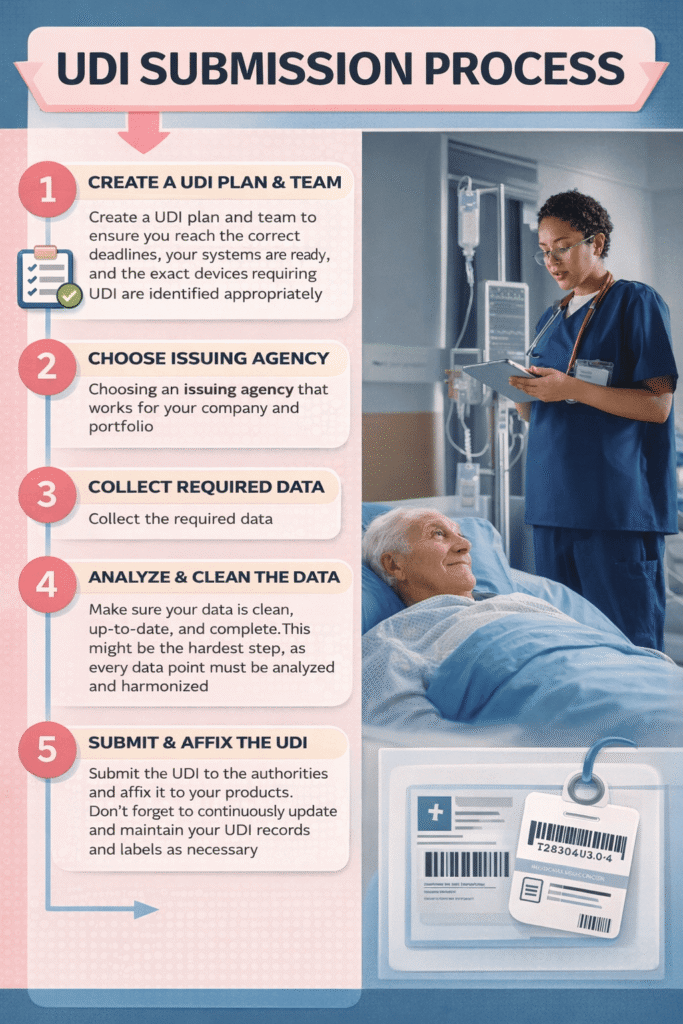

Unique Device Identification System
EU MDR and IVDR Regulations introduce an unique device identification system for medical devices based on a Unique Device Identifier. UDI for medical devices is a string of numeric or alphanumeric characters generated by an internationally recognized device identification and coding standard.
Unique Device Identification compliance is the responsibility of the manufacturer also, to place the UDI system on the device label and the package of a device or, in the case of reusable devices, on the device itself (direct marking).
The number will be conveyed through a UDI carrier using Automatic Identification and Data Capture or Human Readable Interpretation (HRI). This carrier should be placed on the label or on the device itself and all higher levels of device packaging.
The unique device identifier system is set to simplify the traceability of medical devices, greatly improve the efficiency of post-market safety activities, and enable more effective monitoring by regulatory bodies. Additionally, it will aid in reducing medical errors and combating counterfeit devices. Ultimately, the implementation of the Unique Device Identification system is expected to enhance procurement and waste management policies, as well as inventory control by healthcare institutions and other stakeholders.
The new unique device identification system will be implemented for all medical devices, with the exception of custom-made and investigational devices used in performance studies. It is largely grounded in globally recognized principles, particularly through the adoption of definitions that align with those utilized by key trading partners.
Importance of Unique Device Identification (UDI) System
| Area | Impact / Benefit |
|---|---|
| Post-market surveillance | Enhances post-market safety-related activities and continuous monitoring of medical devices throughout their lifecycle. |
| Incident reporting | Improves the accuracy, speed, and effectiveness of incident reporting. |
| Regulatory oversight | Enables regulatory bodies to efficiently monitor device safety and effectiveness, contributing to overall public health. |
| Field Safety Corrective Actions (FSCA) | Allows targeted and timely Field Safety Corrective Actions. |
| Competent Authority monitoring | Improves monitoring and traceability by Competent Authorities. |
| Medical error reduction | Reduces risks such as incorrect device implantation or the use of expired products through standardized identification. |
| Healthcare IT integration | Supports integration of UDI into Electronic Health Records (EHR) and other healthcare IT systems, improving data accuracy and care coordination. |
| Anti-counterfeiting | Helps fight against falsified and counterfeit medical devices. |
| Inventory & waste management | Improves purchasing, stock management, and disposal of medical device waste. |
| System interoperability | Ensures compatibility with other authentication and identification systems already in place. |
| Patient empowerment | Enables informed decision-making by patients and healthcare providers regarding device origin, usage, and risks. |
The Basic Unique device identification is an EU approach for linking devices to their regulatory documentation and it is intended to uniquely identify the product model throughout the entire life cycle of the product. The Basic UDI is the main key in the database and mentioned in the Technical Documentation and also in the declaration of conformity to connect devices with the same intended purpose, risk class and design characteristics. Basic UDI-DI is different from the packaging/labelling of the device.
The Basic UDI is generated through a globally accepted device identification and coding standard and delivered by accredited Unique Device Identification issuing entities designated by the European Commission. It is also used as an access key to the information stored in the EUDAMED. Manufacturers should keep in mind any change in EUDAMED data triggers for new Basic UDI-DI. With a change in the Basic UDI-DI, all associated UDI-DIs would also need to be changed
What is Basic Unique Device Identification?
The Basic Unique device identification is an EU approach for linking devices to their regulatory documentation and it is intended to uniquely identify the product model throughout the entire life cycle of the product. The Basic UDI is the main key in the database and mentioned in the Technical Documentation and also in the declaration of conformity to connect devices with the same intended purpose, risk class and design characteristics. Basic UDI-DI is different from the packaging/labelling of the device.
The Basic UDI is generated through a globally accepted device identification and coding standard and delivered by accredited Unique Device Identification issuing entities designated by the European Commission. It is also used as an access key to the information stored in the EUDAMED. Manufacturers should keep in mind any change in EUDAMED data triggers for new Basic UDI-DI. With a change in the Basic UDI-DI, all associated UDI-DIs would also need to be changed
Key UDI Compliance Dates
Visual overview of UDI implementation deadlines under MDR and IVDR.
General Medical Devices
Article 123(3)(f), Article 27(4)
- Implantable & Class III26 May 2021
- Class IIa & IIb26 May 2023
- Class I26 May 2025
Reusable Devices
Article 123(3)(g), Article 27(4)
- Implantable & Class III26 May 2023
- Class IIa & IIb26 May 2025
- Class I26 May 2027
In Vitro Diagnostic Devices
Article 113(3)(e), Article 24(4)
- Class D IVDs26 May 2023
- Class C & B IVDs26 May 2025
- Class A IVDs26 May 2027
UDI Database
The UDI Medical Devices database will be set up by the European Commission to validate, collate, process, and make available to the public. The technical design of the database will be in such a manner that it will ensure adequate accessibility of information stored, including multi-user access and automatic uploads and downloads of the information. The design will be in a special manner that no UDI-PIs and no commercially confidential product information can be included.
General Principles of the UDI Database
| Principle | Description |
|---|---|
| Core UDI data support | The UDI database must support the use of all core UDI database data elements. |
| Manufacturer responsibility | Manufacturers are responsible for the initial submission and updates of identifying information and other device data elements. |
| Data validation | Appropriate methods and procedures for validation of the data provided will be implemented. |
| Periodic data verification | Manufacturers must periodically verify the correctness of all relevant device data, except for devices no longer available on the market. |
| Regulatory conformity | The presence of a UDI-DI in the UDI database does not imply conformity with the MDR. |
| Packaging level linkage | The UDI database must allow linking of all packaging levels of a device. |
| Availability of new UDI-DIs | Data for new UDI-DIs must be available at the time the device is placed on the market. |
| Timely data updates | Manufacturers must update the UDI database within 30 days of changes that do not require a new UDI-DI. |
| Use of international standards | Internationally accepted standards for data submission and updates must be used wherever possible. |
| Multilingual user interface | The UDI database user interface will be available in all official EU languages, with minimized use of free-text fields. |
| Data retention | Data relating to devices no longer available on the market will be retained in the UDI database. |
Why Global Manufacturers Choose I3CGlobal for UDI Support
EU MDR /IVDR UDI implementation requirements are complex which involving evolving regulations, strict timelines, EUDAMED readiness, and flawless data accuracy. At I3CGlobal, we partner with medical device and IVD manufacturers and exporters worldwide to deliver end-to-end UDI solutions that reduce regulatory risk, accelerate market access, and ensure long-term compliance.
Appoint I3CGLOBAL as your European Authorized Representative and complete EUDAMED Registration and UDI updation
Frequently Asked Questions
When is a new Basic UDI-DI required, and how does it impact our existing UDI records?
A new Basic UDI-DI is required when there are changes affecting a device’s intended purpose, risk class, or key design characteristics. When a Basic UDI-DI changes, all associated UDI-DIs must also be updated, and corresponding records in EUDAMED must be revised. Our experts help manufacturers assess change triggers, manage impacts, and execute updates correctly, avoiding unnecessary regulatory disruptions.
Can I3CGlobal support both initial UDI implementation and ongoing maintenance?
Yes. I3CGlobal provides full lifecycle UDI support from initial UDI planning and database submissions to ongoing maintenance, periodic data verification, change management, and regulatory updates. We act as a long-term UDI compliance partner, ensuring your device data remains accurate, current, and audit-ready throughout the product lifecycle.
Are Unique Device Identification a public Information?
Yes, It’s a public information. should be submitted to the European Database on Medical Devices (EUDAMED)
Do we need a separate UDI strategy for FDA, EU MDR, and IVDR?
While the core principles of UDI are aligned globally, FDA, EU MDR, and IVDR each have distinct requirements, timelines, and database expectations (GUDID vs. EUDAMED). A single, well-planned global UDI strategy can be developed, but it must be carefully adapted for each regulatory system. At I3CGlobal, we design harmonised UDI strategies that ensure compliance across multiple regions while minimising duplication, errors, and rework.
What are the most common UDI mistakes manufacturers make?
Common challenges include incorrect Basic UDI-DI grouping, inconsistent data across regions, late updates to EUDAMED or GUDID, and misunderstanding change triggers. Our role is to identify and prevent these risks early, saving time, cost, and potential regulatory findings.
What if you have many devices in portfolio? Do I need to have a Unique device identification for each medical device?
What if am a developer of standalone medical software? Does Unique Device Identification applicable?
The UDI number must be assigned to any commercially available standalone software. The software identification shall be regarded as the manufacturing control mechanism and displayed in the UDI-PI. The requirements for software Unique device identification are detailed in Annex VI Part C and the MDCG 2018-5 guidance document.
Who is the major UDI issuing entities?
- GS1 AISBL
- Health Industry Business Communications Council (HIBCC)
- International Council for Commonality in Blood Banking Automation (ICCBBA)
- Informationsstelle für Arzneispezialitäten (IFA) GmbH